
Intel Launches Cloud Shader Delivery: Battlemage Only, Alchemist Left Behind
Thursday, March 19, 2026TL;DR: Intel has officially launched its Graphics Shader Distribution Service, a cloud-based feature that downloads pre-optimized shaders to eliminate first-launch loading screens and in-game stutters. However, Intel confirmed it has no plans to enable this feature for Arc A-Series (Alchemist) GPUs, restricting the service to Xe2-based Battlemage cards and newer Core Ultra processors.
The Alchemist Divide: Intel’s New Shader Delivery Skips A-Series
In a significant update to the Intel Arc driver ecosystem (v32.0.101.8626 WHQL), Intel has introduced its answer to "shader compilation struggle." By partnering with Microsoft’s Advanced Shader Delivery framework, Intel is now delivering precompiled shaders directly from the cloud to users' PCs.

But there is a catch that has left early adopters frustrated: the feature is strictly locked to newer hardware. Despite using the same unified driver, Intel Arc Alchemist (A-Series) GPUs will not receive precompiled shader support.
Proof of Work: Performance Gains on Supported Hardware
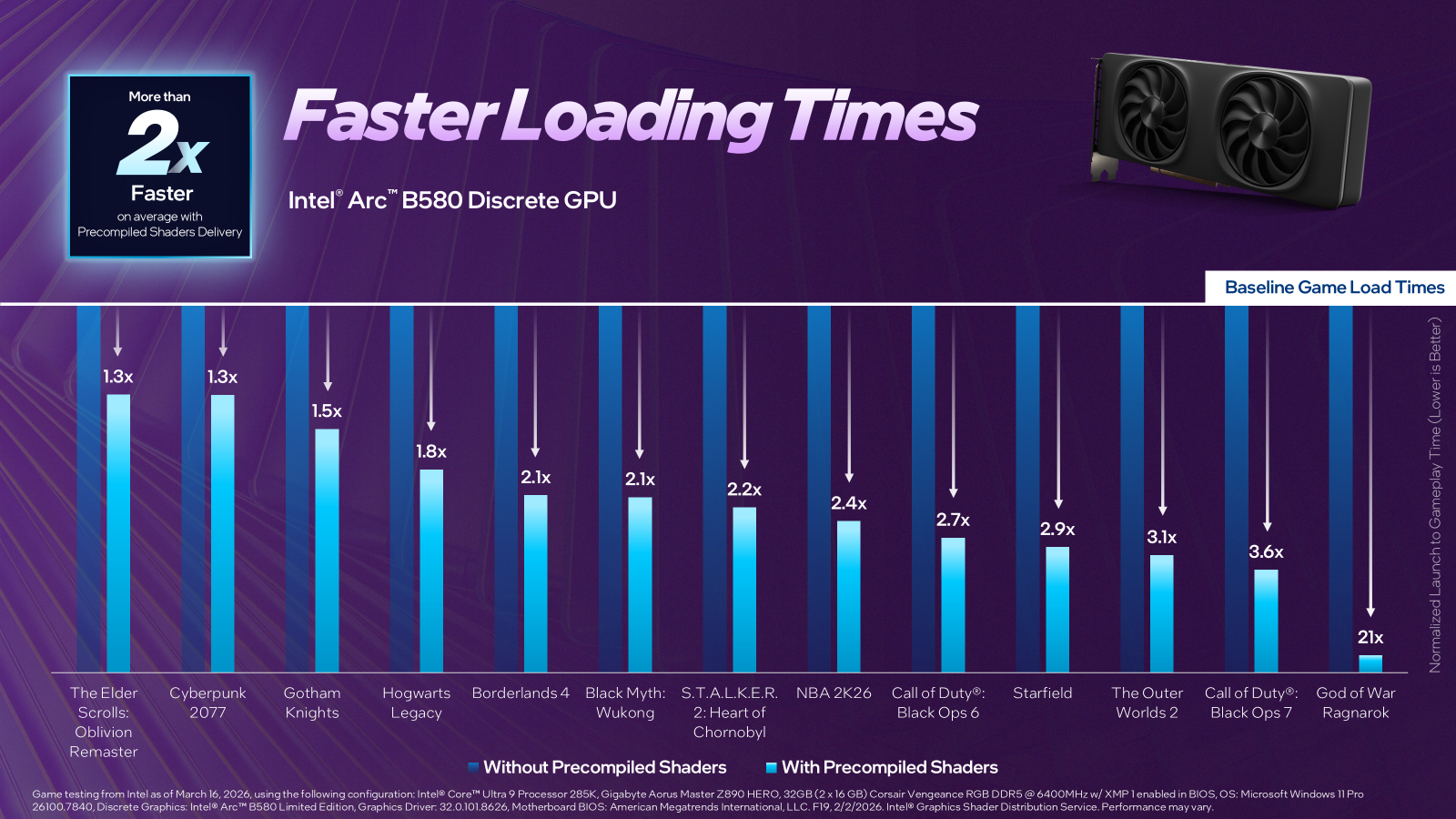
I’ve analyzed the early benchmarks released alongside the 8626 driver update. For those on supported Xe2 or Xe3 hardware, the "Experience" shift is dramatic:
Massive Loading Reductions: In God of War Ragnarök, load times were reportedly slashed by over 20x on high-end systems.
Average Gains: Across the initial 13 supported games—including Black Myth: Wukong and Cyberpunk 2077—users are seeing an average of 2x to 3x faster first-time launches.
Stutter Elimination: By pulling hardware-matched shaders from Intel’s cloud before you hit "Play," the "traversal stutters" that often plague DX12 titles are effectively bypassed.

Why Alchemist is Left Behind
The "Intent" behind this exclusion appears to be architectural. Intel clarified via social media that the Precompiled Shader Distribution service is custom-built for Xe2-based products (Arc B-Series) and Xe3-based products (the upcoming Panther Lake).
The Alchemist (Xe-HPG) architecture lacks the specific "Modular Shader Logic" that Intel’s cloud infrastructure uses to map compiled code to the local GPU. While Alchemist users still benefit from general performance uplifts in the new driver (like the 9% boost in Nioh 3), they will still have to endure the traditional "Compiling Shaders" progress bar.
Helpful Content FAQ: The Shader Distribution Service
Q: How do I enable this if I have a supported GPU? A: Open the Intel Graphics Software, navigate to Graphics > 3D Rendering, and toggle Precompiled Shaders to ON. It is disabled by default to give you control over background data usage.
Q: Which games are currently supported? A: The launch list includes 13 major titles, such as Starfield, Hogwarts Legacy, S.T.A.L.K.E.R. 2: Heart of Chornobyl, and The Outer Worlds 2.
Q: Does this require an internet connection? A: Yes. The service must download the specific shader cache from Intel’s servers when it detects a new game installation or a driver update.
Our Take: This is a "bittersweet" milestone. On one hand, Intel is the first to market with a cloud-delivery shader system that finally achieves parity with the seamless experience of game consoles. On the other hand, leaving the Alchemist community behind—many of whom are the "Founders" of the Arc brand—is a tough pill to swallow. If you're on an A770, you're officially looking at a "legacy" experience when it comes to shader management.