
Intel Nova Lake Desktop APU: 12 Xe3P GPU Cores Leaked
Tuesday, April 14, 2026Intel Nova Lake Could Bring 12 Xe3P Graphics to the Desktop — A Leaked SoC SKU That Changes the APU Game
A new leak from hardware tipster Jaykihn has surfaced something that the desktop PC market has not seen from Intel before: a Nova Lake SoC variant for the desktop platform that pairs a modest CPU configuration with 12 Xe3P integrated graphics cores. If accurate, this preliminary SKU would represent Intel's first serious foray into the desktop APU space — a segment that AMD has owned for years with its Ryzen G-series lineup — and it would do so with Intel's most advanced integrated graphics architecture to date.
The tweet is brief and explicit about its preliminary nature: "Preliminary. 4+8+4+12 Xe3p desktop SKU. Two VCCGT VRM phases required." Jaykihn is a well-regarded leaker with a strong track record on Intel CPU details, which gives the leak enough credibility to take seriously — but the word "preliminary" means the configuration could still change before any product ships. With that context established, this leak tells us a great deal about where Intel's desktop iGPU strategy may be heading with Nova Lake.
What the Leak Describes: Core Config and the Key Xe3P Detail
The leaked configuration is a 4+8+4+12 SKU — meaning 4 Coyote Cove P-cores, 8 Arctic Wolf E-cores, 4 LP-E cores, and 12 Xe3P graphics cores. The CPU side of this package totals 16 cores and 16 threads, putting it in the mid-range tier of the Nova Lake-S desktop lineup. For context, the current flagship Arrow Lake Core Ultra 9 285K has 24 cores, and the Nova Lake flagship scales up to 52 cores. This SoC SKU is clearly not a high-end compute part — its pitch is built entirely around the graphics.
The 12 Xe3P graphics cores are what makes this leak remarkable. The rest of the Nova Lake-S desktop lineup is currently reported to ship with just 2 Xe3 graphics cores across the board — a token iGPU presence that handles basic display output for users who run a discrete GPU. That is the established pattern for Intel's desktop chips going back years: minimal integrated graphics on the assumption that a dedicated GPU will be present. This SoC SKU breaks that pattern completely by pairing 12 Xe3P cores with a desktop platform CPU, creating something that functions like an APU rather than a traditional desktop processor.
The other notable detail in the leak is the requirement for two VCCGT VRM phases. VCCGT refers to the voltage domain that powers the GPU portion of the chip. Standard Nova Lake desktop SKUs with 2 Xe3 cores need only a single VRM phase for graphics. A second phase is required when the graphics subsystem is large enough to demand substantially more current — exactly the situation with 12 Xe3P cores. The two-phase VRM requirement means this SKU needs specific motherboard support beyond what a basic LGA 1954 board would offer, which has implications for compatibility and pricing that we will explore below.
What Xe3P Is and Why It Matters More Than Xe3
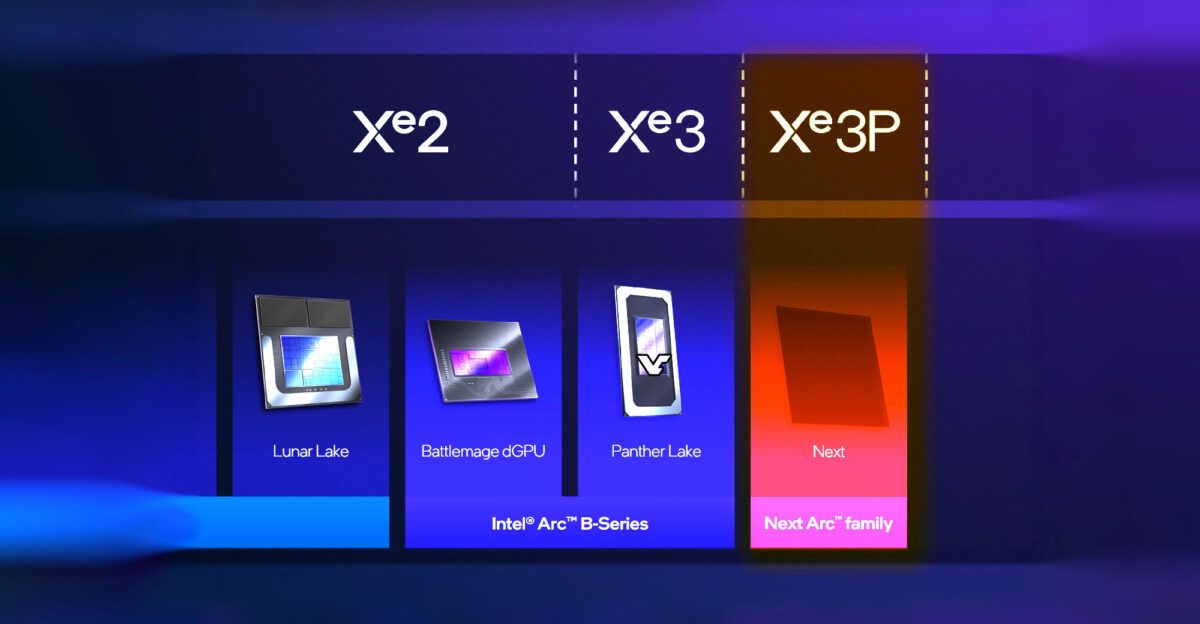
Understanding why 12 Xe3P cores is exciting requires understanding the difference between Xe3 and Xe3P. The straightforward Intel Nova Lake desktop story — before this leak — was that most SKUs would use Xe3 graphics for the main rendering pipeline, with Xe3P handling the media and display engines as separate tiles in the disaggregated design Intel introduced with Meteor Lake. In that standard configuration, Xe3P's role is fairly narrow: encode, decode, and display output rather than 3D rendering.
But Xe3P is a refined and enhanced version of the Xe3 architecture. Multiple sources, including leaker OneRaichu, have suggested that a 12-core Xe3P configuration as found in this proposed desktop SKU would deliver a 20–25% performance uplift over equivalent Xe3 designs. That gap matters because Xe3 itself — as demonstrated in Panther Lake's Arc B390 iGPU — is already a major generational step forward from everything Intel has integrated into desktop chips before.
To understand the baseline, Intel's Panther Lake Arc B390 laptop iGPU uses 12 Xe3 cores (not Xe3P). Real-world testing of that chip has produced results that are extraordinary for integrated graphics. In Cyberpunk 2077 at High settings, it runs at 50fps without upscaling assistance — a result that would have seemed impossible for an iGPU just two years ago. Against AMD's flagship mainstream laptop iGPU, the Radeon 890M in Ryzen AI 9 HX 370, Panther Lake's Arc B390 leads by 16% in PassMark GPU testing and by considerably more in actual game benchmarks. Club386's hands-on testing found Arc B390 running Cyberpunk 2077 73% faster than a similarly clocked AMD laptop chip. In F1 25 at High settings, 93fps average. These are discrete-class-adjacent numbers from integrated graphics.
Now apply the 20–25% Xe3P uplift on top of 12 Xe3 core Arc B390 performance. The result would be an integrated GPU for the desktop platform that — depending on the specific workloads — approaches or matches lower-end discrete graphics cards in gaming, handles 4K video playback and encoding effortlessly, and makes a desktop PC without a discrete GPU genuinely viable for casual gaming for the first time with Intel silicon.

The Architecture: A Tile Swap Made Possible by Chiplet Design
One of the most elegant aspects of this potential SKU is how it would be manufactured. Intel's Nova Lake is built as a modular chiplet design, with separate compute tiles, SoC tiles, and graphics tiles packaged together. The 4+8+4 CPU configuration in this SoC SKU — 4 P-cores, 8 E-cores, 4 LP-E cores — is exactly the same CPU tile already used in standard Nova Lake variants. The smallest reported Core Ultra 7 models in the Nova Lake lineup use this same 4+8+4 compute configuration.
What this means practically is that Intel does not need to design a new chip from scratch to create this desktop APU SKU. It can take an existing CPU tile that is already being manufactured and swap in a larger graphics tile — in this case, 12 Xe3P cores — in place of the minimal 2-core Xe3 graphics typically used on desktop parts. This tile-swap approach is exactly the kind of flexibility that disaggregated chiplet design makes possible, and it is precisely why AMD has been able to offer differentiated Ryzen G-series APU variants with larger integrated graphics alongside its standard Ryzen desktop lineup for several generations.
ComputerBase noted in its coverage that this is essentially Intel doing what AMD has done with AM5: using the same fundamental dies but mixing and matching tiles to create products with different CPU-to-GPU balance points. The economics are attractive — no new silicon needs to be designed, just new package configurations from existing tiles.
The Market Intel Is Targeting: AMD's Ryzen G-Series Has Owned This Space
The desktop APU market — CPUs with strong enough integrated graphics to serve as the primary graphics solution for casual gaming, media production, small form factor builds, and budget PCs — has been AMD's territory for years. AMD's Ryzen G-series for the AM5 socket, including the Ryzen 7 8700G and Ryzen 9 9950X-style APU variants with Radeon 780M and 890M graphics, fills the gap between a standard desktop CPU and a discrete GPU. These chips are the go-to solution for budget builds, small form factor PCs like mini-ITX systems, and HTPCs where adding a discrete card would compromise size, power, or cost targets.
Intel has never had a meaningful equivalent. Arrow Lake desktop CPUs ship with small Xe-based iGPUs that handle display output competently but are not competitive with AMD's Radeon 780M or 890M for gaming. Anyone wanting graphics performance from Intel desktop silicon has needed to add a discrete GPU, full stop. The proposed Nova Lake 4+8+4+12Xe3P SKU would change that calculus by giving Intel a product to put next to AMD's Ryzen G chips at retail.
There is an interesting nuance here around AMD's own recent choices. AMD's Ryzen AI 400G series for AM5 — the "G" suffix indicating APU with stronger graphics — is reportedly launching with a reduced iGPU configuration compared to earlier Ryzen G variants. AMD's attention appears to have shifted toward its Strix Halo–class chips (the Ryzen AI Max series with extremely powerful integrated graphics) at the high end, with somewhat less aggressive iGPU integration in mainstream desktop APUs. If this is accurate, Intel's timing for a 12 Xe3P desktop APU SKU is well considered — it could arrive at a moment when AMD's mainstream desktop APU offering is not at its most competitive.
What Two VCCGT VRM Phases Actually Mean for Motherboard Support
The motherboard compatibility question raised by the two-phase VCCGT requirement is worth examining in detail. Most LGA 1954 motherboards in the expected B960 and Z970 tiers will be designed around standard Nova Lake desktop SKUs with minimal iGPU power requirements. A single VCCGT VRM phase is likely what most boards will include as a baseline.
The requirement for a second VCCGT phase on this APU SKU means the processor needs to be matched with a motherboard that has been specifically designed or certified for the higher graphics power delivery. This is not unprecedented — Intel has tiered motherboard feature support before — but it adds a layer of purchasing complexity. Builders targeting this APU SKU for a discrete-GPU-free build will need to verify that their chosen motherboard explicitly supports the dual VCCGT configuration.
The most likely scenario is that this becomes a feature advertised on mid-range and higher-tier B960 and Z970 boards, possibly marketed as "APU ready" or similar branding, while the basic entry-tier boards handle the standard 2-core iGPU Nova Lake chips without the second VRM phase. This is analogous to how AMD's AM5 boards differentiate on feature support for various overclocking and power delivery options. It fragments the platform slightly but is manageable as a purchasing consideration.
How This Fits Into Nova Lake's Wider Desktop GPU Strategy
Nova Lake-S's standard GPU approach — 2 Xe3 cores across most of the lineup — has been confirmed by multiple leaks. The desktop platform with its assumption of discrete GPU use has not been Intel's showcase for iGPU development. That role has been filled by the mobile lineup: Panther Lake-H uses up to 12 Xe3 cores, and Nova Lake-H is expected to use up to 12 Xe3P cores, targeting the laptop segment where integrated graphics must handle more workloads without a discrete card.
This new SoC SKU leak suggests Intel is considering bringing that same 12-core Xe3P graphics configuration — the mobile flagship iGPU design — to the desktop platform in a specialized APU variant. The GPU tile itself is not new hardware; it is the same 12-core Xe3P tile planned for mobile use. What is new is pairing it with a desktop LGA 1954 socket platform, giving desktop users access to mobile-class iGPU performance in a socketed CPU.
Separately, Intel's more ambitious Nova Lake-AX concept — a high-end APU reportedly featuring up to 48 Xe3P cores on a massive LGA 4326 socket specifically designed to compete with AMD's Strix Halo — is a different product tier entirely. Nova Lake-AX (now potentially rebranded as Razer Lake-AX in some leaks) targets workstation-class graphics in an APU form factor. The 12 Xe3P desktop SoC SKU is a mainstream APU concept, not a Strix Halo competitor — it sits in the AMD Ryzen G-series competitive space rather than the AMD Ryzen AI Max space.
What Real-World Performance Could Look Like
Any performance estimate for this SKU is speculative at this stage — Jaykihn shared no clock speeds, memory configuration details, or performance targets alongside the preliminary specification. But the benchmarking data from Panther Lake's 12 Xe3 iGPU provides a reasonable baseline for estimation.
Panther Lake Arc B390 with 12 Xe3 cores at laptop power levels (28–45W for the SoC) achieves results like 50fps in Cyberpunk 2077 at High settings, 93fps in F1 25 at High settings, and generally approaches or exceeds lower-end discrete GPU territory in less demanding titles. A desktop SoC SKU would typically operate at higher power limits than a laptop chip — desktop TDPs have more thermal headroom — which would allow the GPU to sustain higher boost clocks and deliver better sustained performance than the mobile equivalent.
Adding the 20–25% Xe3P uplift on top of those Xe3 baseline numbers, and with the additional headroom of a desktop power envelope, a 12 Xe3P desktop SoC could plausibly deliver performance meaningfully better than AMD's current Radeon 890M in Ryzen G desktop APUs, and could approach AMD's upcoming Radeon RDNA 4 integrated graphics in next-generation Ryzen G parts. That would be a genuinely competitive desktop APU from Intel for the first time in the company's recent history.
The Bottom Line: A Preliminary SKU Worth Watching Closely
This leak is preliminary by Jaykihn's own description, and everything about it — the core count, the graphics configuration, the VRM requirements — could change before any product reaches market. Intel has not confirmed the existence of this SKU, and it may not survive to final launch if priorities shift during Nova Lake's development. The AX-class high-end APU has already undergone branding changes mid-development, illustrating how fluidly Intel's product planning can evolve.
But the underlying logic is sound and the economics are compelling. Intel has the Xe3P GPU tile. It has the 4+8+4 CPU tile. It has the LGA 1954 socket and 900-series chipset ecosystem. Combining these existing components into a desktop APU requires incremental engineering rather than a new silicon design. The market exists — AMD's Ryzen G-series has proven it — and Intel's Panther Lake Arc B390 has demonstrated that 12 Xe-architecture GPU cores in a CPU package can deliver results that genuinely compete with entry-level discrete graphics.
If Nova Lake ships in 2027 with a 12 Xe3P desktop SoC SKU alongside the standard Nova Lake-S lineup, Intel would have an answer for every segment of the desktop CPU market: the performance-per-core crown with Coyote Cove, the gaming cache champion with bLLC, the multi-threaded workstation with 52 cores, and the discrete-GPU-free build with the APU. That is a more complete desktop CPU lineup than Intel has offered in years. Whether it actually materializes in this form is the question — and the answer should become clearer as Nova Lake approaches its late 2026 or CES 2027 unveiling.
Want more Intel CPU news, GPU hardware analysis, and PC hardware coverage? Browse our other posts for the latest on Nova Lake, AMD Ryzen, and everything in the desktop CPU space.