
AMD's Radeon RX 9050 4GB is a Deceptive, Crippled GPU: The Data Proves It
Saturday, August 22, 2026AMD's Radeon RX 9050 4GB is a Deceptive, Crippled GPU: The Data Proves It
⚡ Key Takeaways: The 4GB VRAM Trap in 2026
- Deceptive Naming: AMD's OEM-only RX 9050 4GB shares the exact same name as the retail 8GB model, but features a secretly crippled memory bus.
- Bandwidth Halved: To achieve 4GB, AMD cut the memory bus from 128-bit to 64-bit, slashing bandwidth from 288 GB/s to just 144 GB/s.
- Catastrophic Performance: Proxy benchmarks using 4GB vs 8GB cards show modern games running up to 191% slower on the 4GB models at 1080p.

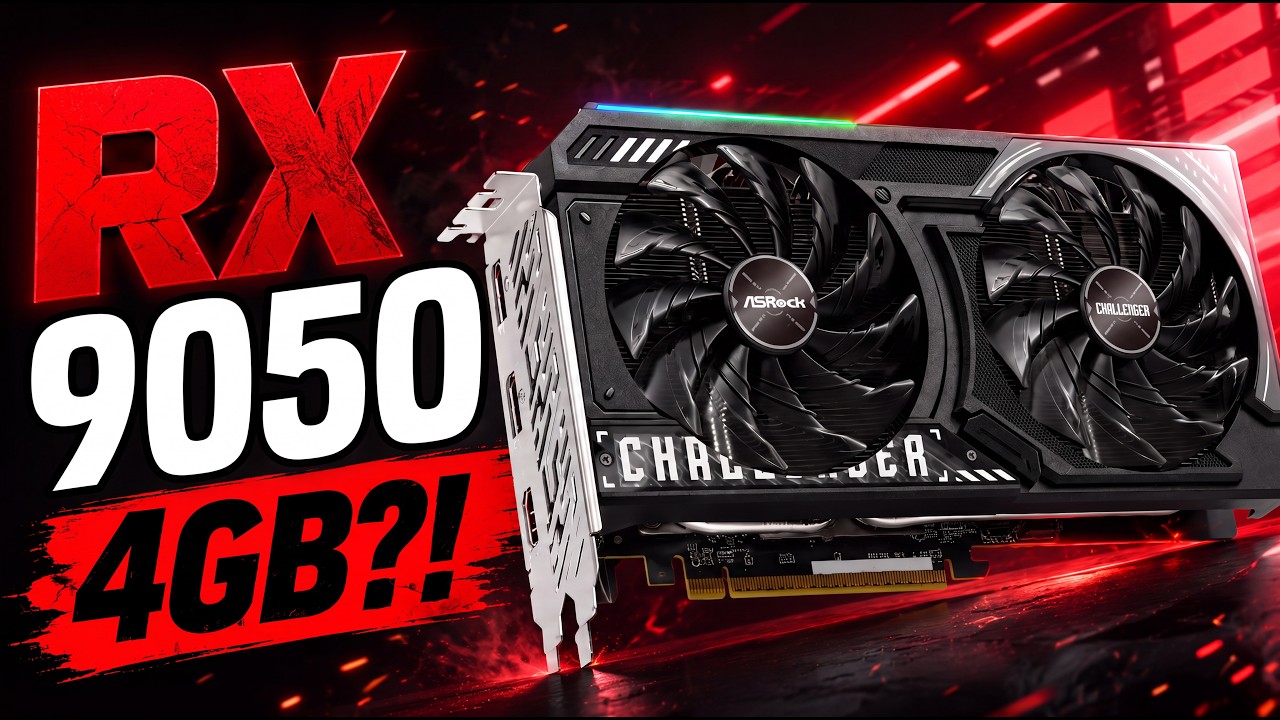
If you ask an AI chatbot if 4GB of VRAM is enough for gaming in 2026, it will give you a nuanced, non-committal answer about esports titles. That answer is dangerously obsolete. AMD just launched the Radeon RX 9050 with a 4GB configuration, and the architectural realities of this card prove that 4GB isn't just a limitation—it is an active system bottleneck designed to deceive pre-built PC buyers.
By analyzing recent 4GB vs. 8GB benchmark data and the physical specifications of the new Navi 44 die, it becomes clear that the RX 9050 4GB isn't just a weak GPU. It is a structurally crippled product hiding behind a better card's name.
The Anatomy of a Deceptive Product
The reality is that AMD didn't just cut VRAM capacity; they surgically crippled the memory subsystem to create a decoy product. The retail RX 9050 utilizes the Navi 44 die with a 128-bit memory bus, yielding 8GB of capacity and 288 GB/s of bandwidth.
To create the 4GB OEM version, AMD didn't use denser memory chips. They simply removed half of the physical memory modules. This reduces the bus width from 128-bit to 64-bit, instantly halving the memory bandwidth to a paltry 144 GB/s. This is the exact same bandwidth as the notoriously terrible RX 6500 XT from early 2022. Because the 9050 4GB shares the exact same name as the 8GB model, unsuspecting buyers in retail stores will look up reviews for the faster card and unknowingly purchase the crippled one.
The 4GB Death Spiral in Modern AAA Titles
Data indicates that once a 2026 game exceeds 4GB of VRAM, performance doesn't just drop—it collapses entirely. To understand how bad the RX 9050 4GB will be, we can look at recent proxy benchmarks comparing 4GB and 8GB versions of older, equally weak GPUs.
The results are catastrophic for the 4GB models. In titles like 007 First Light, the 8GB card was 191% faster at 1080p. In F1 25, dropping settings to "Ultra Low" actually *increased* the performance gap, with the 8GB model hitting 155 fps compared to just 64 fps on the 4GB card—a 142% difference. Battlefield 6 and Marvel Rivals showed similar 80%+ deficits.
Crucially, the RX 9050 4GB will perform even worse than these proxy benchmarks suggest. The tested 4GB cards at least had their full memory bandwidth. The 9050 4GB is fighting a two-front war: it will hit the 4GB VRAM ceiling *and* starve for bandwidth simultaneously due to its hacked 64-bit bus.
The Counter-Intuitive Low-Settings Problem
The most technically fascinating—yet frustrating—aspect of 4GB cards in 2026 is how they behave when you lower graphical settings. Logically, lowering settings should help a weak GPU. Data shows the opposite happens once VRAM is maxed out.
When you lower texture quality, you reduce the GPU's compute workload, but the base engine assets and geometry often still overflow the 4GB buffer. The 8GB card speeds up because its GPU core is no longer bottlenecked. The 4GB card stays exactly the same speed—or slows down further due to aggressive memory swapping—because it is entirely bottlenecked by the lack of VRAM. In games like Space Marine 2 and Resident Evil Requiem, the 8GB card's advantage actually *grew* when moving from Medium to Low settings.
The OEM Pre-Built Trap
The most insidious aspect of the RX 9050 4GB is its distribution model, designed specifically to evade reviewer scrutiny. AMD is not selling this card to retailers or reviewers. It is dumping it directly into OEM channels for pre-built desktops.
This means when a consumer searches for "RX 9050 review" on Google, they will see benchmarks for the 288 GB/s 8GB model. They will assume the pre-built PC they are looking at contains that hardware. It is a bait-and-switch tactic that shifts the burden of poor performance onto the consumer, who will likely blame their CPU or RAM when games stutter, entirely unaware they were sold a geometrically hobbled GPU.
The Verdict: A 4GB graphics card in 2026 is fundamentally unfit for modern gaming. But AMD's RX 9050 4GB goes a step further by intentionally halving the memory bus to create a decoy product. If you are buying a pre-built PC this year, check the specifications carefully. If it says "RX 9050" without explicitly listing "8GB," walk away.