
AMD Halo Station Packs 96 Cores, 576GB HBM3E: 100000 Plus [2026]
Updated September 13, 2026: AMD unveiled the Threadripper Halo Station at IFA 2026 on September 4: a liquid-cooled deskside AI workstation pairing a 96-core Threadripper PRO 9995WX with dual MI350P accelerators and a path to four, up to 576GB of HBM3E and 2TB of DDR5. AMD claims trillion-parameter models run on-premises. No price or date announced, with street estimates from $100,000 to $150,000. Coming in 2027. Here are the confirmed specs, the DGX Station comparison, and who should care.
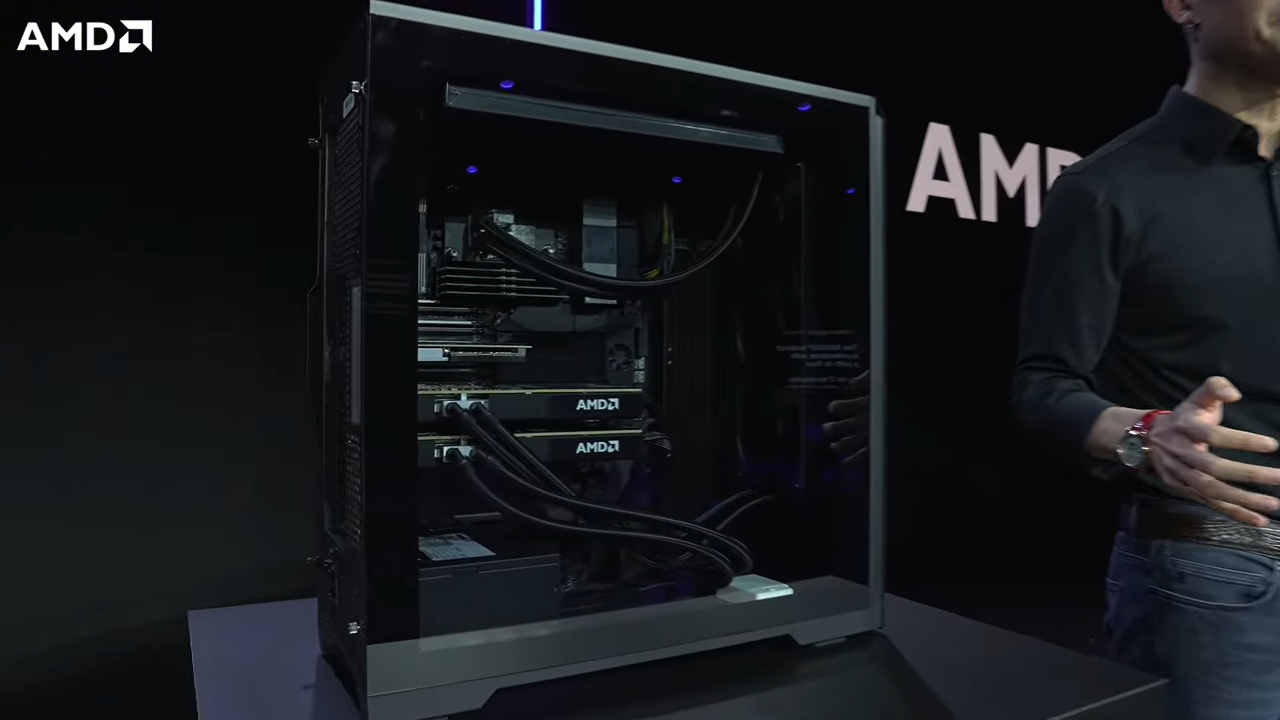
Table of Contents
- The IFA 2026 Unveil
- The 9995WX: 96 Cores at $12,000
- The MI350P Accelerators
- 2.6TB Memory, 16.4TB Per Second
- Halo vs. DGX Station
- The $100,000 to $150,000 Question
- Can It Run a Trillion Parameters
- Specs at a Glance
- Who Should Care
- Bottom Line
- Frequently Asked Questions
1. The IFA 2026 Unveil
AMD's Jack Huynh presented the Threadripper Halo Station during the company's IFA 2026 opening keynote in Berlin on September 4, calling it the most powerful workstation in the world. Tom's Hardware's Jake Roach, VideoCardz, and Igor's Lab covered the reveal the same week. AMD's official product page, dated September 4, positions it as the ultimate personal AI workstation shipping in 2027, a prototype shown first at IFA bringing datacenter-class AI compute deskside.
The configuration shown on stage: Threadripper PRO 9995WX host, two liquid-cooled Instinct MI350P accelerators with support for four, 2TB of DDR5, 288GB of HBM3E with paths up to 576GB fully equipped. Oflight's September 6 analysis separates confirmed facts from press speculation cleanly, and this article follows that discipline throughout: specs from AMD's page and keynote, prices and dates from reported estimates labeled as such.
Context matters. Lenovo's ThinkCentre X Ultra with Ryzen AI Max silicon and NVIDIA's GB300 DGX Station tower near $100,000 all chase the same buyer: local-AI developers escaping cloud inference bills. Our RTX Spark October launch coverage tracks NVIDIA's own push into deskside AI. Halo Station is AMD's answer at workstation scale.
2. The 9995WX: 96 Cores at $12,000
The host processor is the Ryzen Threadripper PRO 9995WX: 96 Zen 5 cores, 192 threads, boost to 5.4GHz, 384MB of L3 cache, 350W TDP, eight-channel DDR5 to 6400 MT/s, 128 PCIe 5.0 lanes. Tom's notes standalone 9995WX chips run $11,000 to $12,000 where findable, and Hacker News commenters flagged the $12,000 CPU alone as the price of admission. Codename Shimada Peak, per the WhatPSU writeup.
Ninety-six cores in a workstation host is server silicon with a different badge. Tom's describes it exactly that way: a server tray reconfigured into a tower with an EPYC-class host swapped for Threadripper. The PCIe lane count is what makes the system possible: 128 Gen 5 lanes feed four dual-slot accelerators plus storage and networking without the bifurcation compromises smaller platforms force.
For gamers this CPU is irrelevant and instructive at once. Irrelevant because no game uses 96 cores. Instructive because the 9995WX program funds the Threadripper line's existence, and workstation volumes keep high-core-count silicon viable for the HEDT buyers who do game on it. Trickle-down starts at $12,000.
3. The MI350P Accelerators
Each Instinct MI350P PCIe card carries 144GB of HBM3E at 4TB/s across a 4096-bit bus, 128 CDNA 4 compute units on TSMC 3nm, 8,192 stream processors, 512 matrix cores, 4.6 petaflops peak MXFP4 and MXFP6, and 600W board power configurable to 450W, per AMD's official MI350P product page. The IFA demo unit ran two cards for 288GB; the design path to four reaches 576GB. All liquid-cooled in the Halo chassis.
Tom's estimates roughly $20,000 per accelerator since AMD does not sell MI350P cards through consumer channels. Two cards plus the $12,000 CPU plus 2TB of DDR5 already clears $100,000 before storage, power, cooling, and chassis, which is where the six-figure street estimates originate. These are datacenter parts with workstation integration, priced accordingly.
Power math deserves a line. A 350W CPU plus two 600W accelerators draws over 1.5 kilowatts before system overhead, four cards push past 2.7 kilowatts. Deskside means a dedicated circuit and serious cooling, not a bedroom office. Liquid cooling is a requirement stated as a feature.
4. 2.6TB Memory, 16.4TB Per Second
AMD's headline memory figures aggregate every pool: up to 576GB HBM3E plus 2TB DDR5 RDIMM totals roughly 2.6TB of system memory, with 16TB/s accelerator bandwidth plus 410GB/s RDIMM bandwidth totaling 16.4TB/s. AMD claims 3.4 times the total memory of NVIDIA's DGX Station by this accounting. Aggregation invites skepticism since HBM and DDR5 serve different locality tiers, but the Io capacity for trillion-parameter 4-bit models is the number that matters, and 576GB clears it.
The 4TB/s-per-card figure deserves context. That is fourteen times LPDDR5X-class bandwidth per the WhatPSU writeup, and it is why the system targets local inference rather than training. Feeding a resident model fast beats shuttling weights across slow links, and HBM3E exists precisely for that access pattern. DDR5's 410GB/s handles everything the accelerators spill.
ECC runs full-chip on the HBM3E with RAS, page retirement, and SR-IOV support, per AMD's spec sheet. Workstation credibility requires it: silent data corruption in a week-long inference run costs more than the ECC overhead. Consumer GPUs skip it. This machine does not.
5. Halo vs. DGX Station
AMD's official comparison targets NVIDIA's GB300 DGX Station directly: 576GB HBM3E against 252GB, 16TB/s against 7.1TB/s, 2TB DDR5 against 496GB LPDDR5X, roughly 2.6TB total against 748GB. Per AMD's August 2026 comparison math, Halo leads on every capacity figure, some by multiples. NVIDIA's counterweight is NVLink-C2C coherence near 900GB/s plus the CUDA software moat, neither of which appears on a spec sheet.
Street pricing frames the contest. The DGX Station lists near $100,000 through resellers like MSI configurations, per Tom's. Halo estimates run $100,000 to $150,000 fully equipped. Price parity at worst, AMD argues, with multiples more memory. The honest comparison waits on shipping systems and measured throughput, since vendor arithmetic always favors the author.
Software decides more than silicon. CUDA's ecosystem lead in local inference tooling is the moat AMD's ROCm must cross, and Oflight flags it as the open question behind every capacity chart. Memory you cannot program efficiently is decoration. AMD's open-stack pitch needs developer proof, not keynote slides.
6. The $100,000 to $150,000 Question
AMD announced no price and no date beyond 2027. Outlets converge independently on $100,000-plus: Tom's builds $100,000 from core components alone with $150,000 fully configured, Oflight cites the same $100,000 to $150,000 speculation band explicitly labeled unconfirmed. Treat every dollar figure in this section as estimate, including this article's title range.
Component arithmetic supports the band. Twelve thousand CPU, forty thousand in accelerators at two cards, DDR5 2TB at current memory prices, plus enterprise storage, kilowatt-plus power delivery, liquid cooling loops, and chassis integration. Memory prices alone, tracked in our DDR5 surge coverage, add five figures to any 2TB build. Nothing about this system can be cheap while DDR5 costs what it costs.
The buyer at these prices is an organization, not a person. Cloud inference bills for frontier-model workloads cross six figures annually without effort, and a deskside system amortizes against that baseline. Personal AI workstation means company-purchased personal, and the market math works at institutional scale or not at all.
7. Can It Run a Trillion Parameters
AMD's claim: a 4-bit quantized trillion-parameter-class model fits within GPU memory. The arithmetic checks: one trillion parameters at 4 bits needs roughly 500GB before overhead, inside 576GB with four cards. Oflight's analysis targets exactly this configuration. The demo unit's two cards at 288GB would not hold it, which is why the four-card path matters more than the showcase.
Fitting is not running. KV cache, context windows, activation memory, and framework overhead consume the headroom that weight math leaves, and trillion-parameter inference at usable context lengths wants the full 576GB plus DDR5 spill, not a comfortable margin. AMD's claim reads as capacity-correct and performance-unproven, pending measured tokens per second on named models.
The honest benchmark will be named models at named contexts with measured throughput, none of which AMD has published. Until then the trillion-parameter line is a capacity statement with a performance IOU attached. Watch for independent testing if systems ship to reviewers before general availability.
8. Specs at a Glance
| Spec | Threadripper Halo Station | Source |
|---|---|---|
| CPU | 9995WX, 96C/192T Zen 5, 5.4GHz, 384MB L3, 350W, about $12K | AMD, Tom's |
| Accelerators | 2x MI350P liquid-cooled, path to 4, 144GB HBM3E each, 600W each, about $20K each | AMD, Tom's estimate |
| Memory | 2TB DDR5-6400 plus up to 576GB HBM3E, 2.6TB total, 16.4TB/s | AMD |
| Price and date | Unannounced, $100K-$150K estimated, coming 2027 | Estimates labeled, AMD for 2027 |
| Rival | DGX Station GB300, 252GB HBM3E, near $100K street | AMD comparison, Tom's |
9. Who Should Care
| Reader | Verdict | Why |
|---|---|---|
| AI labs and studios | Evaluate | 576GB local inference vs. cloud bills is the entire business case |
| Gamers | Admire only | Zero gaming relevance, six-figure price, datacenter parts |
| AMD investors | Watch software | Hardware leads, ROCm adoption decides whether it converts |
| NVIDIA watchers | Note pressure | Memory-capacity competition at price parity is new |
10. Bottom Line
The Halo Station is AMD's most aggressive workstation statement ever: 96 cores, up to 576GB of HBM3E, 2.6TB total memory, liquid-cooled deskside, aimed squarely at NVIDIA's DGX Station with capacity multiples and price parity. Everything confirmed impresses. Everything priced or dated is estimate. The trillion-parameter claim needs measured throughput, the software story needs ROCm proof, and the $100,000-plus ticket needs institutional buyers. Admire the engineering, doubt the invoice, watch 2027 shipments.
Frequently Asked Questions
Q: What is the Threadripper Halo Station?
A: AMD's liquid-cooled deskside AI workstation unveiled at IFA 2026 on September 4: 96-core Threadripper PRO 9995WX, dual MI350P accelerators with a path to four, 2TB DDR5, up to 576GB HBM3E. AMD calls it the most powerful workstation in the world. Coming in 2027.
Q: How much does it cost?
A: Unannounced. Independent estimates converge on $100,000 to $150,000 based on the $12,000 CPU, roughly $20,000 per accelerator, 2TB of DDR5 at current memory prices, plus enterprise integration. All figures are estimates.
Q: Can it run trillion-parameter models?
A: By capacity arithmetic, yes at 4-bit quantization within 576GB. Measured throughput on named models at usable contexts is unpublished. Capacity proven on paper, performance pending proof.
Q: How does it compare to NVIDIA's DGX Station?
A: Per AMD: 576GB vs 252GB HBM3E, 16 vs 7.1TB/s bandwidth, 2TB vs 496GB CPU memory, at similar street pricing near $100,000. NVIDIA counters with NVLink coherence and the CUDA ecosystem. Independent testing will adjudicate.
Q: When can you buy one?
A: AMD says coming in 2027 with no quarter specified. Reports speculate 2027 shipping without confirmation. No pre-orders, no configurators, no reviewer units announced.
Q: Does any of this matter for gaming?
A: Directly, no. Indirectly, workstation volumes sustain high-core silicon and HBM supply chains that eventually feed consumer parts, and local-AI competition pressures the software stacks gamers use. Admire, don't budget.
Byline: Indie Kings | September 13, 2026
Labels: Hardware, AMD
Related: RTX Spark Launches October: 2 N1X Configs | DDR5 Hits $400 for 32GB as Prices Soar | Zen 6 vs Nova Lake: 52 vs 24 Cores