
AMD Tetrahedral Cages Cut BVH Memory 80 GB to 1.7 GB in Research Demo [2026]
By Indie Kings | September 23, 2026
Updated September 23, 2026: AMD GPUOpen research cuts BVH memory in one demonstration from up to 80 GB to about 1.7 GB and update time from more than 300 ms to roughly 3.3 ms, per AMD Fellow Holger Gruen on September 17. The demo ray traces about 500 million animated triangles above 60 FPS at 1080p on Radeon RX 9070 XT. This is research, not a shipping-game result.
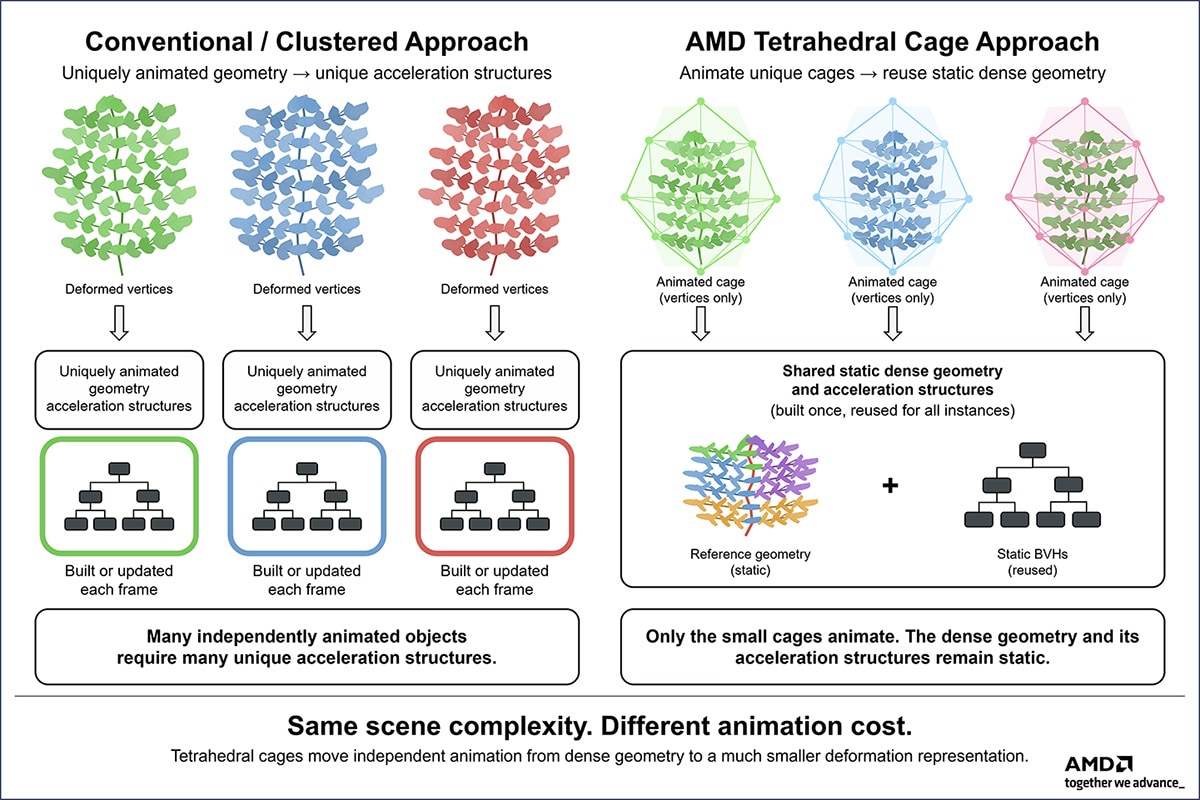
Image: Tetrahedral cage approach diagram. Credit: AMD GPUOpen.
Why BVH updates matter
Per AMD GPUOpen, a bounding volume hierarchy, or BVH, is an acceleration structure that helps ray tracing decide which geometry a ray might intersect. As scenes gain more independently animated objects, their acceleration structures can become expensive to store and update.
Per Holger Gruen's GPUOpen article, a conventional approach gives each uniquely animated object new vertex positions and therefore a unique acceleration-structure state. Dense foliage can become a bottleneck before the GPU finishes tracing rays.
This research targets a specific problem: dense geometry that needs independent motion but does not need every vertex to deform with equal precision, per the article's stated use case.
| Graphics work | Cost pressure |
|---|---|
| Ray intersection search | Needs acceleration structures |
| Independent animation | Creates changing geometry states |
| Dense foliage or crowds | Produces many repeated structures |
| Per-frame update | Can consume time before tracing |
How tetrahedral cages work
Per AMD GPUOpen, the method encloses dense geometry inside a much smaller deformable tetrahedral cage. The dense mesh and its BVH remain static and reusable while the cage deforms, per the primary explanation.
When a ray arrives, the method transforms it back into the static geometry's reference frame before intersection testing. Animation cost therefore follows cage complexity instead of the full triangle count, per the GPUOpen article.
Per the article, this is not a new graphics API. It is a representation and acceleration-structure strategy that could sit inside a renderer or DirectX Raytracing integration, subject to developer testing.
- Static part: Dense mesh plus reusable BVH.
- Moving part: Small tetrahedral cage.
- Ray path: Transform into the static reference frame.
- Payoff: Less memory plus faster per-frame updates.
Measured demonstration
Per AMD GPUOpen, the demonstration scene contains about 25,000 independently animated plants. At maximum level of detail, the plants represent about 2.8 billion triangles before selection, with roughly 500 million animated plant triangles ray traced per frame after LOD selection, per the article.
Per the same source, the scene uses primary and shadow rays at over 60 FPS at 1080p on an AMD Radeon RX 9070 XT. These numbers describe AMD's research scene, not a general gaming benchmark, stated openly.
| Metric per AMD GPUOpen | Conventional dense BLAS | Tetrahedral cages |
|---|---|---|
| BVH memory | Up to 80 GB | About 1.7 GB |
| BVH update time | More than 300 ms per frame | About 3.3 ms per frame |
| Animated triangles after LOD | About 500 million | About 500 million |
| Demonstration result | Comparison setup | Over 60 FPS at 1080p on RX 9070 XT |
Tradeoffs and limits
Per AMD GPUOpen, tetrahedral cages sacrifice fine-grained control over individual vertex animations. The method is best suited to dense foliage, grass, crowds, and distant characters where a compact cage can represent useful motion, per the research explanation.
Per the same source, precise deformation and topology changes remain different problems. A cage can preserve the dense static geometry while approximating motion, but it does not give an artist unrestricted control over every vertex, per the article.
Per Wccftech's September 20 relay, AMD is developing DXR samples and a header-only C++ library to help developers integrate the technique. Until those samples and shipping tests exist, call this a research path rather than a product feature, per the relay.
| Good fit | Poor fit |
|---|---|
| Dense foliage | Fine facial deformation |
| Grass and crowds | Every-vertex artistic control |
| Distant characters | Frequent topology changes |
What it means for games
The research points toward denser animated environments without requiring acceleration-structure memory to grow with every moving object. That could help ray tracing scenes where foliage and crowds dominate, per AMD's stated motivation.
It does not prove that future games will run faster on every Radeon card. Scene structure, shader cost, memory bandwidth, traversal quality, engine integration, and frame targets all remain separate variables, per the limits of the demonstration.
Our AMD Neural Lighting rumor draft covers a separate neural rendering path. This article covers the BVH and geometry layer, not a product announcement or performance guarantee.
FAQ
What is a tetrahedral cage?
Per AMD GPUOpen, a small deformable cage surrounds dense geometry while the dense BVH remains static.
How much memory does the demo save?
Per AMD GPUOpen, the demonstration moves from up to 80 GB to about 1.7 GB of BVH memory.
How fast are the updates?
Per the primary article, conventional updates exceed 300 ms per frame while cage updates take about 3.3 ms in this scene.
What scenes fit?
Per AMD, dense foliage, grass, crowds, and distant characters are natural candidates.
Is this in shipping games?
No evidence of that in the sources. It is a research demonstration plus DXR integration work.
Does it make every game faster?
No. The result is scene-specific and does not replace broader game benchmarks.
Bottom Line
AMD's tetrahedral cage research attacks a real ray-tracing bottleneck with a compact animation proxy. The numbers are striking, the tradeoffs are real, and the implementation path is still research.