
ASRock Rack SORANOD8-2L2T: Eight DIMM Slots on a Six Channel Socket Explained
Saturday, September 26, 2026By Indie Kings | September 26, 2026
Updated September 26, 2026: The interesting part of ASRock Rack's new SORANOD8-2L2T is not the CPU platform it supports but a deliberate compromise in its memory layout. The board carries eight DDR5 RDIMM slots on a platform that is natively six channel, which is a number that should not exist, and buying that extra capacity costs you 400 MT/s of memory speed. ServeTheHome's Ryan Smith put the reasoning plainly: a one DIMM per channel board can reach DDR5-6400, this one tops out at DDR5-5200 in exchange for addressing 2TB.
Verification note: All specifications, board dimensions, slot behaviour and the memory speed ceiling below come from ServeTheHome's hands-on review by Ryan Smith, published September 24, 2026. We have not verified pricing or availability, and none is quoted here.
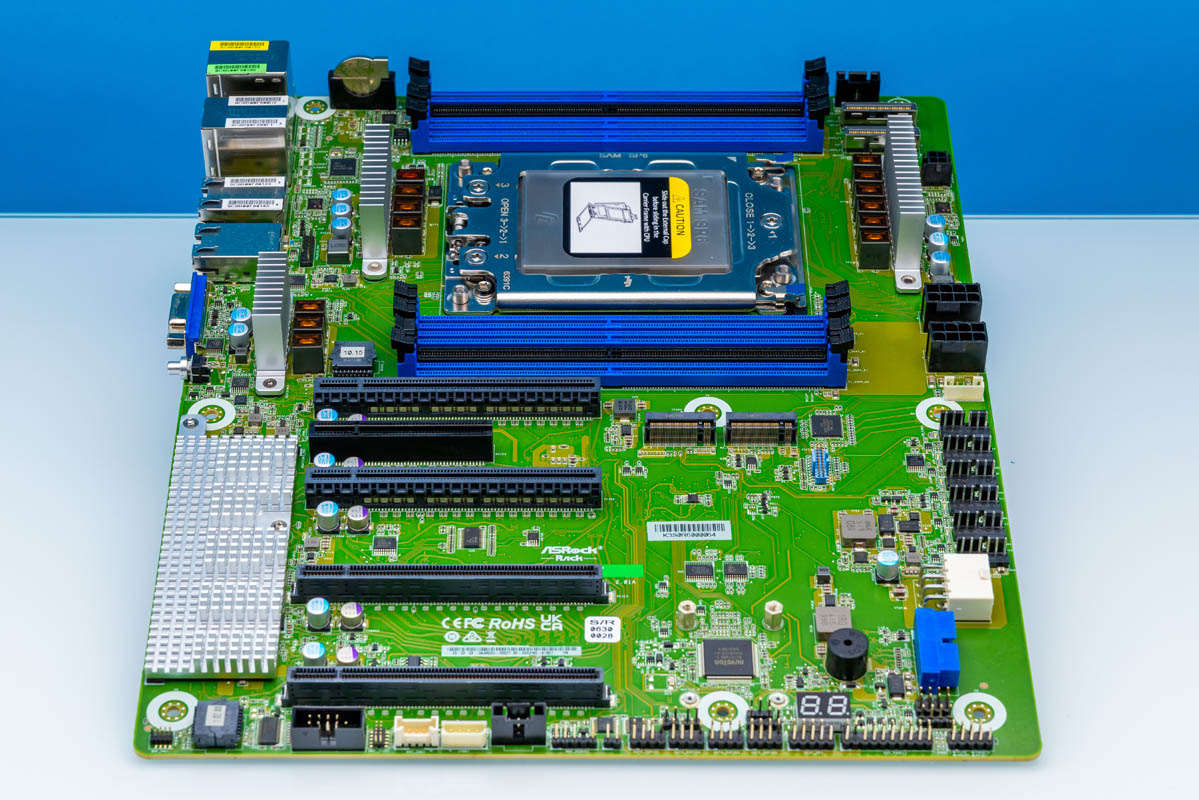
Image: ASRock Rack SORANOD8-2L2T. Credit: ServeTheHome.
What Sorano actually is
AMD launched the EPYC 8005 "Sorano" lineup a couple of months before this review, and the point of it is that Zen 5 arrived on the mid tier SP6 platform. Up to 84 CPU cores and 96 lanes of PCIe Gen5, with the full feature set of the architecture rather than a cut down version.
The upgrade path over the previous generation is the headline. Sorano replaces EPYC 8004 "Siena" processors, and the significant change is that Siena's Zen 4c cores are swapped for full Zen 5 cores. Zen 4c was a density optimised design, efficient in core count but slower per core. Moving to full fat Zen 5 is what allows Sorano to reach far higher performance levels on the same socket at the same core counts, rather than the two generations merely trading places.
Worth noting for anyone with an existing SP6 machine: Sorano is fully backward compatible with existing SP6 motherboards after a BIOS update. New boards exist anyway, and the reason is in the next section, but the compatibility means a Sorano upgrade does not force a motherboard purchase.
| Specification | ASRock Rack SORANOD8-2L2T |
|---|---|
| Processor family | AMD EPYC 8004 and 8005 |
| Socket | SP6 (LGA 4844) |
| Memory | 8x DDR5 RDIMM, 2DPC configuration, DDR5-5200 maximum, 2TB addressable |
| PCIe slots | 4x PCIe Gen5 x16 (double spaced), 1x open ended PCIe Gen5 x8 |
| Lane budget | 72 of SP6's 96 PCIe Gen5 lanes on the expansion slots |
| Storage | 2x M.2 22110 and 2280 Gen5 x4, 2x MCIO x8 reconfigurable to SATA |
| Ethernet | 2x 10GbE Intel X710-AT2, 2x 1GbE Intel I210 |
| Management | ASPEED AST2600 BMC with IPMI port and DB15 VGA output |
| USB | 2x 5Gbps USB-A rear, 2x 5Gbps USB-A front via 20 pin header |
| Power | 3x ATX12V, 4 pin micro fit signalling in place of 24 pin ATX |
| Cooling | 6x 6 pin fan headers |
| Form factor | ATX-like, 12 inches by 10 inches |
Specifications as listed by ASRock Rack and reviewed by ServeTheHome. No pricing or availability is quoted, as none was published.
Why eight memory slots on a six channel platform
This is the design decision that defines the board, and it looks like a mistake until you trace the reasoning.
SP6 is natively a six channel memory platform. That means a conventional board would offer six RDIMM slots for one DIMM per channel operation, or twelve for two DIMMs per channel. Eight is neither. ASRock Rack has fitted eight slots on every one of its SP6 boards, which makes the SORANOD8-2L2T a two DIMM per channel style layout with two channels left partly unpopulated.
The reason is physical. ServeTheHome makes the constraint concrete: a traditional seven PCIe slot layout does not leave room for twelve DIMMs, but it does leave room for eight. Since the board's four x16 slots and one x8 slot are fixed by the platform's lane budget, the DIMMs get whatever vertical space is left over. Eight slots raises addressable memory to 2TB, and the board takes the space savings as the trade.
The slot colouring is where this becomes visible to whoever builds the machine, and it is genuinely useful. The blue slots are the first RDIMM for each channel and should be populated first. The black slots are second RDIMMs on two of the six channels, so they go in last. Two tone DIMM slots are common, but because the channel mapping here is irregular, the colour coding is the only reliable guide to fill order.
What the 2TB ceiling costs you
Here is the trade in full, and it is the number to remember before buying memory for this board.
Because the layout behaves as two DIMMs per channel throughout, it incurs the memory frequency penalty that two DIMM per channel operation always incurs. A one DIMM per channel board can clock as high as DDR5-6400. The SORANOD8-2L2T's listed maximum speed is DDR5-5200.
So the choice on offer is 2TB of addressable memory at DDR5-5200, or less memory at speeds up to DDR5-6400. For a storage server, a virtualization host running many guests, or any workload where capacity is the binding constraint, that is an easy trade. For a compute node that is memory bandwidth limited, it is a real cost paid for slots nobody needed.
The slot count is the part that decides it. If you would never populate more than six DIMMs, this board is slower on memory than a one DIMM per channel design for no benefit, and you should be looking elsewhere.
Seventy two lanes and a SATA switch
On expansion, the board offers five PCIe slots: four full PCIe Gen5 x16 slots and one open ended PCIe Gen5 x8 slot. All of the x16 slots are double spaced, and using the x8 slot cuts into the space for the top slot.
That accounts for 72 of SP6's 96 PCIe Gen5 lanes, which is a large share of the platform's budget committed to expansion and a good sign for anyone fitting accelerators or high speed NICs.
The top slot has a second mode. Alongside PCIe and CXL connectivity, it can be switched to deliver sixteen SATA 6Gbps connections instead, which requires a riser card, with ASRock Rack recommending their own 1U2G-RB1U2SL-G4. In practice this lets a builder repurpose PCIe lanes as SATA ports when a system needs storage and not bandwidth.
The MCIO change that matters for storage
The pair of MCIO x8 connectors at the top of the board normally carry eight lanes of PCIe Gen5 each, which is the platform's final sixteen lanes, and those lanes are normally split between two EDSFF SSDs apiece.
What is new on the SORANOD8-2L2T, and what ServeTheHome calls out as setting it apart from its Siena predecessor, is that these MCIO slots can be reconfigured to carry SATA signalling instead. Each connector then becomes an eight port SATA 6Gbps host, for up to sixteen additional SATA drives.
That is the feature to care about if you are building high density storage. Combined with the switchable top PCIe slot, a single board can be turned into a considerably more SATA heavy machine than its lane count suggests, without adding a host bus adapter. For a storage server, that flexibility is worth more than the memory speed the board gives up.
The form factor trap
The board measures 12 inches by 10 inches and ASRock Rack classifies it as ATX-like. It is ever so slightly too wide to meet the ATX specification.
Most cases will not care, and the larger EEB form factor is routine in this space, so this is a minor point in server contexts. It is worth flagging anyway because the board is also pitched as a workstation option, and a case that accepts regulation ATX and nothing larger will not take it. The distinction only surfaces after the board is already in hand.
Five RJ45 ports and very little else
External I/O is heavily weighted toward Ethernet, which is the correct priority for a server board and the clearest signal of what this is.
The rear panel carries five RJ45 ports in total. One is the IPMI management port, attached to an ASPEED AST2600 BMC, which ServeTheHome notes remains the most prevalent BMC it encounters across boards in its labs. Two are 1GbE on a pair of Intel I210 controllers. Two are 10GbE on a single Intel X710-AT2, which delivers full 10Gbps per port and negotiates down through 5, 2.5 and 1 Gbps.
The "2L2T" in the model name refers to those two pairs of network adapters. All the network controllers and the BMC sit under a low profile heatsink at the board edge behind the PCIe slots. None of them runs particularly hot, though the 10GbE controller specifically is warm enough to need it.
USB is where the server priorities show, and they are not ambiguous. The rear has two 5Gbps USB-A ports. The front panel adds a single 20 pin header for another pair of 5Gbps USB-A. That is the entire USB complement, and for a server installation it is more than sufficient, since more than a couple of USB ports in use is rare.
It does mean the workstation positioning is secondary. Anyone building this as a desk machine will be adding USB through PCIe, which is a real cost in both slots and money. The other tell is physical: six 6 pin fan headers along the front edge, with the 6 pin variant being something of an ASRock Rack specialty. A desktop motherboard does not usually need six fan headers. This one expects a chassis around it.
Two smaller details that matter if you are the person doing the rack work. Power comes from three ATX12V connectors, two vertical and one right angled, all three required, and the right angled one is presumably aimed at server vendor needs. There is no 24 pin ATX header at all. Instead a 4 pin micro fit connector carries signalling, and the 24 pin connector from the supply plugs into an included adapter that then mates to it. ServeTheHome prefers full size ATX connectors on larger boards, but concedes that here the board edges are already packed.
Finally, the oldest-looking port on a 2026 board: a DB15 VGA output, part of the BMC. It is odd on a brand new motherboard, and the AST2600 does support DisplayPort for digital displays, but VGA still sees significant use in data centers. On a board whose BMC is the point, the port belongs.
Who this board is for
The SORANOD8-2L2T is a plainly built board, and ServeTheHome's read is that apart from the networking controllers there is very little extra hardware on it. It is designed to run a CPU, run it well, and expose all of the I/O so a builder can use it as they see fit. That is a compliment in this market rather than a criticism.
It is an upgraded version of ASRock Rack's earlier SIENAD8-2L2T, with a slightly larger board and minor I/O changes. The VRM reflects the platform: SP6 chips top out at 225 watts, and the MOSFETs sit under basic heatsinks, which is adequate because server boards are designed around substantial airflow and nobody is going to be attaching liquid nitrogen to a socket.
Two buyer profiles fit. A storage or virtualization server that needs 2TB, wants four 10GbE and 1GbE ports onboard, and values the MCIO to SATA reconfiguration more than it values memory clock. Or a builder with an existing SP6 platform who wants the Zen 5 generational jump and a board built around it rather than a BIOS update.
One profile does not fit. Anyone who wants DDR5-6400, needs more than a handful of USB ports, or wants a workstation that fits a standard ATX case should not buy this board.
FAQ
What is the ASRock Rack SORANOD8-2L2T?
A server and workstation motherboard for the AMD EPYC 8004 and 8005 families on the SP6 socket, built as an upgrade to ASRock Rack's SIENAD8-2L2T. It measures 12 by 10 inches, which ASRock Rack classes as ATX-like.
Why does it have eight memory slots on a six channel platform?
SP6 is natively six channel, so eight slots is an unusual number. ServeTheHome reports that ASRock Rack fits eight on all of its SP6 boards because a seven PCIe slot layout leaves room for eight DIMMs but not twelve, trading 2TB of addressable memory for the space. The blue slots fill first, the black slots are second RDIMMs on two of the six channels and go last.
What is the maximum memory speed?
DDR5-5200, and that is the trade for the 2TB capacity. Because the eight slot layout behaves as two DIMMs per channel, it takes the usual frequency penalty. A one DIMM per channel board can reach DDR5-6400.
How many PCIe lanes and storage connectors does it have?
Four PCIe Gen5 x16 slots and one open ended PCIe Gen5 x8 slot, all double spaced, accounting for 72 of SP6's 96 PCIe Gen5 lanes. Storage is two M.2 Gen5 x4 slots accepting 22110 or 2280 drives, plus two MCIO x8 connectors. The top PCIe slot can be switched to sixteen SATA 6Gbps via a riser, and each MCIO connector can be reconfigured from PCIe to an eight port SATA host for up to sixteen more SATA drives.
What networking is built in?
Five RJ45 ports on the rear: two 10GbE on an Intel X710-AT2, two 1GbE on Intel I210 controllers, and one IPMI management port on an ASPEED AST2600 BMC. The 10GbE controller also supports DisplayPort output for digital displays alongside the DB15 VGA port.
Is it backward compatible with older SP6 boards?
The EPYC 8005 Sorano processors themselves are fully backward compatible with existing SP6 motherboards after a BIOS update, so a platform upgrade does not force a new board. New boards like this one exist because some vendors chose to build for the newer processor, not because the older boards stop working.
Bottom Line
ASRock Rack built a server board with a strange number of memory slots and a real reason for it, and the reason is the most useful thing in this review. Eight RDIMMs is not a mistake on a six channel platform, it is a physical compromise forced by fitting four x16 slots and one x8 slot into the same board, and it buys 2TB of addressable memory at the cost of the memory clock. That is a good trade for a storage server and a bad one for a bandwidth hungry compute node, and the honest version of this article is that the board is really only correct for the first of those. Two details make it more flexible than its lane count suggests. The top PCIe slot can become sixteen SATA ports through a riser, and the MCIO connectors, which normally carry the platform's last sixteen PCIe lanes to EDSFF drives, can be flipped to SATA for up to sixteen more drives. A board that looks like a seventy two lane PCIe card carrier can therefore become a high density storage platform without a host bus adapter. Everything else about the design is unambiguous about what it is. Two 10GbE and two 1GbE ports plus an ASPEED AST2600 BMC, six 6 pin fan headers, no 24 pin ATX header, two USB ports on the rear and two on the front header, and a DB15 VGA port in 2026 because datacenters still use it. This is a server motherboard first and foremost, pitched at workstations second, and anyone buying it for a desk should know they will be adding USB through PCIe and buying a case larger than ATX. The generational story underneath is the more interesting part for the platform rather than the board. Sorano takes Siena's Zen 4c cores and replaces them with full Zen 5, which is what turns a density optimised part into a performance one, and it does so on a socket that accepts the old chips after a BIOS update. That is a considerably better position for buyers than the generation itself would suggest, because the upgrade does not force the board.
Source: ServeTheHome, ASRock Rack SORANOD8-2L2T Review: A New AMD EPYC 8005 Sorano Motherboard by Ryan Smith, September 24, 2026
Related: EPYC Venice agentic benches claim 20 percent over Vera | Threadripper Halo Station: 96 cores, 576GB | Ryzen 9800X3D gains only 2 percent from DDR5-4800 to 8000 | CUDIMMs explained: the future of DDR5 memory speeds | AM5 vs LGA1851: 2029 vs dead end