
CDPR Published Six Sets of Witcher 3 Requirements. Steam Still Lists Windows 7 and a GTX 660
Monday, September 28, 2026By Indie Kings | September 28, 2026
Updated September 28, 2026: CD Projekt Red published the official PC requirements for The Witcher 3 Remastered earlier today, and they are not a single recommended spec. They are six configurations from Minimum through Path Tracing, each with its own preset, resolution, frame rate target, CPU, GPU, VRAM, RAM and storage, and the whole thing is presented as one image on CDPR's support site. The Steam store page has not moved. It still lists a May 18, 2015 release date and the 2015 requirements, down to a Core i5-2500K, 6 GB of RAM, a GTX 660 and 50 GB of storage, and both requirement blocks still end with the footnote "System requirements will change on 2026.09.29." Every number below is from CDPR's own table. The store page is what you get if you check the wrong place first.
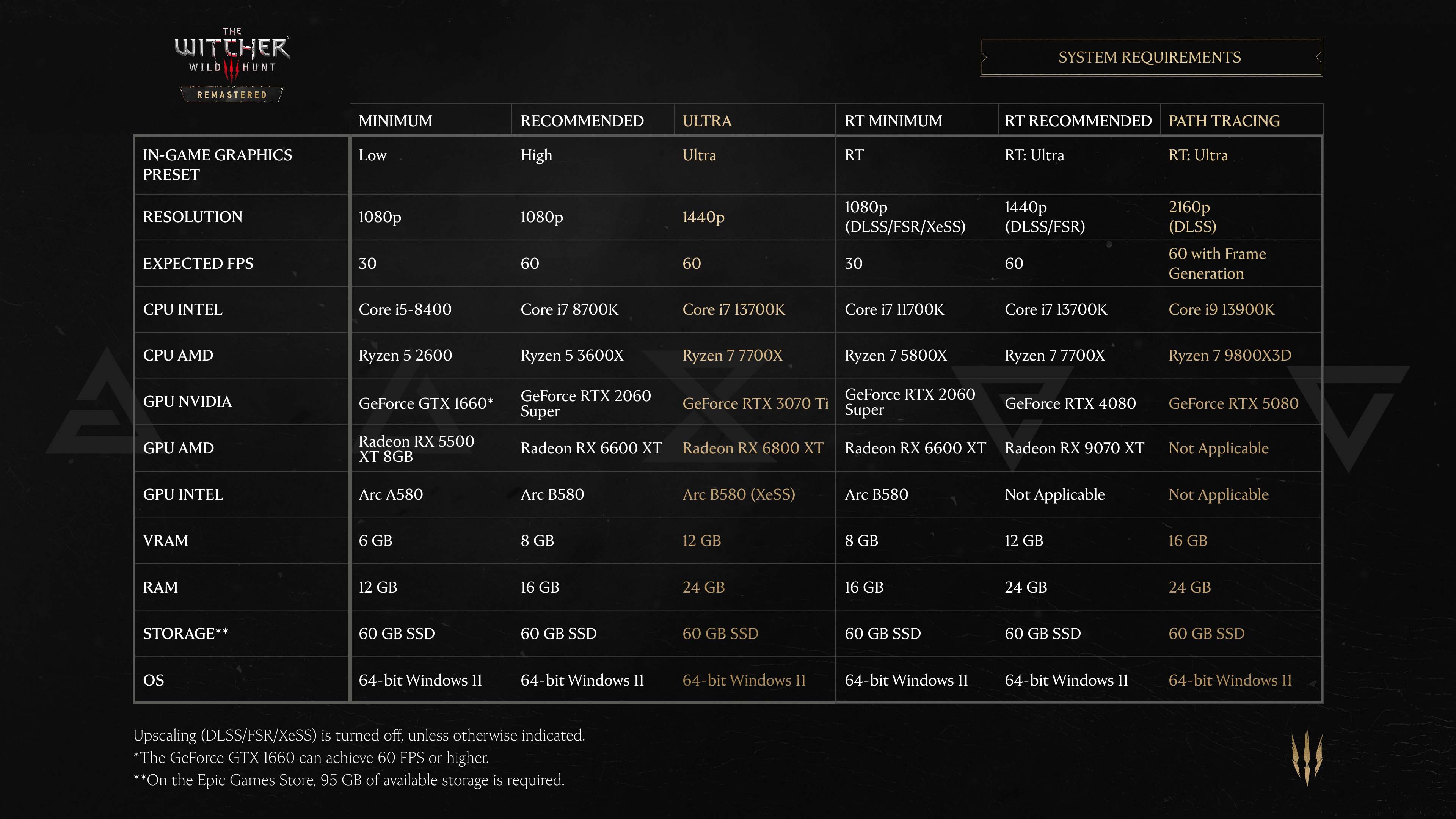
Image: The official requirements table. Credit: CD Projekt Red.
The six tiers, exactly as CDPR published them
This is the primary, reproduced without interpretation. Six columns, and the whole point of the structure is that they are not variations on one recommendation.
| Row | Minimum | Recommended | Ultra | RT Minimum | RT Recommended | Path Tracing |
|---|---|---|---|---|---|---|
| Graphics preset | Low | High | Ultra | RT | RT: Ultra | RT: Ultra |
| Resolution | 1080p | 1080p | 1440p | 1080p, DLSS/FSR/XeSS | 1440p, DLSS/FSR | 2160p, DLSS |
| Expected FPS | 30 | 60 | 60 | 30 | 60 | 60 with Frame Generation |
| CPU, Intel | Core i5-8400 | Core i7-8700K | Core i7-13700K | Core i7-11700K | Core i7-13700K | Core i9-13900K |
| CPU, AMD | Ryzen 5 2600 | Ryzen 5 3600X | Ryzen 7 7700X | Ryzen 7 5800X | Ryzen 7 7700X | Ryzen 7 9800X3D |
| GPU, NVIDIA | GTX 1660* | RTX 2060 Super | RTX 3070 Ti | RTX 2060 Super | RTX 4080 | RTX 5080 |
| GPU, AMD | RX 5500 XT 8GB | RX 6600 XT | RX 6800 XT | RX 6600 XT | RX 9070 XT | Not Applicable |
| GPU, Intel | Arc A580 | Arc B580 | Arc B580 with XeSS | Arc B580 | Not Applicable | Not Applicable |
| VRAM | 6 GB | 8 GB | 12 GB | 8 GB | 12 GB | 16 GB |
| RAM | 12 GB | 16 GB | 24 GB | 16 GB | 24 GB | 24 GB |
| Storage | 60 GB SSD | 60 GB SSD | 60 GB SSD | 60 GB SSD | 60 GB SSD | 60 GB SSD |
| OS | 64-bit Win 11 | 64-bit Win 11 | 64-bit Win 11 | 64-bit Win 11 | 64-bit Win 11 | 64-bit Win 11 |
Three footnotes sit under the table and they change how the numbers should be read. Upscaling, meaning DLSS, FSR or XeSS, is turned off unless otherwise indicated. The asterisked GTX 1660 is noted as capable of 60 FPS or higher, which is a considerably more capable card than the 30 FPS its own column promises. And the storage figure carries a second footnote: on the Epic Games Store, 95 GB of available storage is required.
CDPR's own explanation of the restructure is worth carrying because it explains the shape rather than just the contents. The stated reason is to take advantage of modern hardware while maintaining quality, and the specific trigger for the minimum GPU was driver support rather than performance: because Game Ready Driver support ended for Maxwell, Pascal and Volta, the Turing-based GTX 1660 was selected as the minimum NVIDIA GPU. And on Windows, the position is that with both Microsoft and Nvidia ending support for the operating system, Windows 10 is no longer officially supported. The qualifier matters, because CDPR adds that this does not mean the game will stop running on Windows 10 with the next update, but that they no longer develop or test on it and cannot guarantee compatibility or performance going forward.
The storage number, and why there are three of them
Storage is the one requirement that can stop you playing outright rather than merely making you play badly, and there are three different numbers in circulation. None of them is the one on the Steam page.
| Figure | Where it comes from | What it actually measures |
|---|---|---|
| 50 GB | Steam store page, app 292030 | Stale, from the 2015 original. Carries the footnote admitting it |
| 60 GB SSD | CDPR's official requirements table | The actual install requirement, all six tiers |
| 95 GB | CDPR's table, Epic Games Store footnote | Epic storefront, 35 GB above the Steam figure |
| Up to ~115 GB | CDPR preload information | The preload transfer, including the optional high resolution texture pack and path tracing data |
The distinction that matters is between what you need on disk and what you download. The 60 GB figure is the requirement, and it is an SSD in all six columns, with CDPR stating plainly that an SSD is now required, which the previous 2015 listing did not specify at all. The 95 GB on Epic is a storefront difference, and it is the kind of thing that normally only emerges from a patch note weeks later.
The larger preload figure is a different quantity again and is frequently conflated with the requirement. It covers the download before you can play, which includes components you can decline. Anyone who budgeted against the Steam page's 50 GB is short against the real 60 GB, and anyone on Epic needs 95.
Path tracing is an NVIDIA-only column
The single most consequential line in the table is the AMD and Intel entry in the Path Tracing column, and both read "Not Applicable."
That is not a performance judgement or a caveat. It is an absence, and it is the first time a mainline CD Projekt Red PC release has published a path tracing configuration that explicitly excludes two of the three major GPU vendors. The official path traced target is an RTX 5080 at 2160p with DLSS, holding 60 FPS with frame generation, and it also asks for a Core i9-13900K or a Ryzen 7 9800X3D, 16 GB of VRAM and 24 GB of RAM. It is the most expensive configuration on the sheet by a wide margin and the only one with an empty vendor cell on two rows.
The ray tracing tiers below it are less exclusive, and the pattern in the middle of the table is genuinely useful. Ray tracing is supported on all three vendors at RT Minimum, but only NVIDIA and AMD reach RT Recommended. The cheapest ray traced path is therefore the most interesting line in the table, and it is worth pulling out on its own.
The RTX 2060 Super appears twice. It is the Recommended-tier GPU for 1080p High at 60 FPS with no ray tracing, and it is also the RT Minimum GPU for 1080p RT at 30 FPS. The same card is simultaneously the recommendation for the non-ray-traced tier and the floor for the ray traced one. For anyone whose choice is between spending on a better card and enabling ray tracing, that is the most actionable single fact on the sheet: the hardware is identical, so the trade is 60 FPS without ray tracing against 30 FPS with it, on the same silicon.
Intel's Arc appears in three of the six tiers
Intel's discrete GPUs are the most generously represented third-party hardware in a CDPR requirements table, and this is worth stating precisely because the Arc B580 is a current-generation part with ray tracing hardware.
The Arc A580 is the Minimum-tier GPU, alongside the GTX 1660 and the RX 5500 XT. The Arc B580 is the Recommended-tier GPU, sits again at RT Minimum, and returns at Ultra with XeSS enabled. That is three of the six columns, and it includes a ray traced column.
The cut is at the top. Both RT Recommended and Path Tracing read "Not Applicable" for Intel, so Arc hardware has an official ray tracing floor and no official ceiling beyond it. What is absent from the table is any separate minimum tier for Arc below the A580, and there is no mention of the B-series Battlemage parts or the Core Ultra integrated Xe3 graphics anywhere in the six columns, which means the table says nothing about whether Panther Lake's iGPU qualifies for anything.
The CPU ladder is not monotonic, and that is the point
Read the CPU rows in order and the progression looks irregular, which is the most interesting structural feature of the table after the path tracing column.
On the Intel side the ladder is i5-8400, i7-8700K, i7-13700K, i7-11700K, i7-13700K, i9-13900K. Read that as Minimum, Recommended, Ultra, RT Minimum, RT Recommended, Path Tracing, and the fourth entry is a lower part than the third. The Core i7-13700K that Ultra demands at 1440p native is the same part RT Recommended uses at 1440p with DLSS, and RT Minimum settles for an i7-11700K.
On the AMD side it is Ryzen 5 2600, Ryzen 5 3600X, Ryzen 7 7700X, Ryzen 7 5800X, Ryzen 7 7700X, Ryzen 7 9800X3D, which shows the same non-monotonic shape, since the Ryzen 7 5800X at RT Minimum is below the Ryzen 7 7700X at Ultra.
| Tier | CPU | VRAM | Why the steps go this way |
|---|---|---|---|
| Ultra, 1440p native | Ryzen 7 7700X | 12 GB | Full native resolution, no upscaler, no ray tracing |
| RT Minimum, 1080p with upscaler | Ryzen 7 5800X | 8 GB | Ray tracing, but half the pixels and upscaling on |
| RT Recommended, 1440p with upscaler | Ryzen 7 7700X | 12 GB | Back to the Ultra CPU once upscaling covers the resolution |
The reason is resolution and upscaling, not silicon class. Ultra asks for 1440p at native with no upscaler, which is the most demanding thing in the table short of path tracing. RT Minimum drops to 1080p and turns upscaling on, which halves the pixel count and lets a lower CPU and less VRAM carry the ray tracing cost. RT Recommended then climbs back to 1440p but keeps the upscaler, which buys back the resolution without the native-resolution penalty, so it lands on the same CPU and VRAM as Ultra.
The RAM row behaves the same way and is unusually modest for a modern release. The ladder is 12, 16, 24, 16, 24 and 24 GB, so 24 GB is the ceiling and the path traced configuration asks for no more RAM than Ultra does. Anyone who read a 16 GB system requirement for this game from early coverage, which several outlets did before the tiers were published, is over-provisioned by 4 GB and under no obligation to change.
How the targets were measured, and what that means for you
CDPR is unusually forthcoming about the conditions behind the frame rate numbers, and the disclosure is worth passing on rather than burying.
Three statements, all from the same support page. The expected FPS targets are based on CDPR's QA tests, with occasional frame rate fluctuations possible depending on scene and gameplay. Performance may vary depending on system configuration and any changes to graphics settings or output resolution, and the page states that higher resolution will significantly affect FPS. And the measurement conditions differ by column: RT Minimum, RT Recommended and Path Tracing were measured with DLSS, FSR or XeSS set to Auto, while all other configurations use native resolution with upscaling turned off in the respective presets. The Path Tracing configuration specifically was measured with upscaling and frame generation both switched on.
That last detail is the one to internalise before comparing the 60 FPS figure. The path tracing column's 60 is achieved with upscaling and frame generation enabled, so it is not a native 2160p path traced 60. Read strictly, a path traced 2160p frame on that hardware without frame generation would be below 60.
The GTX 1660 footnote belongs here too. The asterisk on the Minimum column resolves to the note that the GTX 1660 can achieve 60 FPS or higher, against a published target of 30. The most likely reading is that the minimum column is set conservatively for the weakest listed GPU, which is the RX 5500 XT, rather than being a measurement of the 1660 specifically. That is inference rather than something CDPR states, and the honest version is that the minimum tier is a floor and the Nvidia card in it has headroom nobody has measured publicly.
You can roll the game back to 1.32, and 4.04
A small item on the same page that is likely to matter more to some owners than any of the specifications above.
CDPR documents an earlier version revert path: depending on platform it is possible to revert to version 1.32, listed as "Classic", and states that upon the release of the Remastered it will also be possible to revert to the 4.04 version.
That is an unusual and genuinely useful provision. It means the remastered update does not strand anyone whose hardware cannot meet the new requirements, and it means the 2022 next-generation update stays reachable as a separate, much lighter build. Anyone whose machine sits between the old 2015 minimum and the new one has a supported path forward rather than a decision to buy new hardware.
What the Steam page still says, and why it is a trap
Now the part that makes this worth an article rather than a table transcription, verified against the Steam API on September 28, 2026 after CDPR had already published.
| Line | Steam still lists | CDPR actually says | Gap |
|---|---|---|---|
| App name | The Witcher 3: Wild Hunt - Complete Edition | Remastered | Renamed, at least |
| Release date | May 18, 2015 | September 29, 2026 | Eleven years |
| Minimum OS | 64-bit Windows 7, Windows 8 (8.1) | 64-bit Windows 11, all six tiers | Four generations |
| Recommended OS | 64-bit Windows 10/11 | 64-bit Windows 11 | Windows 10 dropped entirely |
| Minimum CPU | Core i5-2500K or A10-5800K | Core i5-8400 or Ryzen 5 2600 | 2011 part versus 2017 |
| Minimum RAM | 6 GB | 12 GB | Double |
| Minimum GPU | GTX 660 or HD 7870 | GTX 1660, RX 5500 XT or Arc A580 | 2012 versus 2019 hardware |
| DirectX | Version 11 on minimum, 12 on recommended | Native DirectX 12, DX11 removed | Self-contradictory, and wrong |
| Minimum storage | 50 GB | 60 GB SSD | And an SSD is now required at all |
| Epic storage | Not mentioned | 95 GB | Absent from Steam entirely |
Both the minimum and the recommended blocks on the Steam page still end with the identical footnote: "System requirements will change on 2026.09.29." So the staleness is documented, deliberate, and dated to today, which is precisely what makes the page hazardous this evening rather than merely careless. A reader who skims sees a plausible 2015 specification sheet and concludes their old hardware still qualifies. A reader who reads the footnote learns the correct numbers exist and are dated. Nobody is misled by accident.
The DirectX row is the one that shows the page is attached to a different product rather than being a loose estimate. It asks for DirectX 11 on minimum and DirectX 12 on recommended, which contradicts itself, and the remaster is native DirectX 12 with DX11 removed entirely. The same clean break brought parallel pipeline state creation, a shader cache prebuilt on first boot, and DirectStorage streaming on NVMe drives, which is the reason an SSD is now a hard requirement rather than a recommendation. The 2015 numbers describe the 2015 game attached to the 2026 listing.
There is no separate Remastered app
One structural fact before anyone checks their library tonight.
Searching the Steam store for "Witcher 3 Remastered" returns nothing at all. Searching for "Witcher 3" returns exactly two apps: 292030, now titled The Witcher 3: Wild Hunt - Complete Edition, and 2684660, The Witcher 3 REDkit. There is no third entry, so the remaster arrives as an update to the app you already own and your library entry is renamed rather than duplicated, with both expansions included in the Complete Edition.
Nintendo Switch 2 does the opposite. The Remastered there is a separate 42.3 GB download appearing as its own Home menu icon rather than patching the existing install, so keeping the original alongside it uses the storage twice. Same game, same launch day, same free upgrade, two opposite delivery models, and only the PC one is visible from the platform's search box.
FAQ
What are the official PC requirements for The Witcher 3 Remastered?
CD Projekt Red publishes six tiers, not one. Minimum is 1080p at 30 FPS on Low with a Core i5-8400 or Ryzen 5 2600, GTX 1660, RX 5500 XT or Arc A580, 6 GB VRAM, 12 GB RAM and 60 GB of SSD storage. Recommended is 1080p at 60 FPS on High with a Core i7-8700K or Ryzen 5 3600X, RTX 2060 Super, RX 6600 XT or Arc B580, 8 GB VRAM and 16 GB RAM. Ultra is 1440p at 60 FPS on Ultra with a Core i7-13700K or Ryzen 7 7700X and 12 GB VRAM. RT Minimum is 1080p at 30 FPS on the RT preset. RT Recommended is 1440p at 60 FPS on RT: Ultra. Path Tracing is 2160p at 60 FPS with frame generation, needing an RTX 5080, a Core i9-13900K or Ryzen 7 9800X3D and 16 GB VRAM. All six require 64-bit Windows 11 and 60 GB of SSD.
Do I need an SSD, and how much space?
An SSD is now a hard requirement, which the previous Steam listing did not mention at all. The storage figure is 60 GB for all six tiers, with the important exception that the Epic Games Store requires 95 GB. The Steam store page still says 50 GB, which is stale. Separately, CDPR's preload transfer runs up to roughly 115 GB because it includes the optional high resolution texture pack and the path tracing data, and that figure is a download size rather than a requirement.
Can I run path tracing on an AMD or Intel card?
Not officially. Both the AMD and Intel cells in the Path Tracing column read "Not Applicable." The published path traced configuration is NVIDIA-only and asks for an RTX 5080 at 2160p holding 60 FPS with frame generation. Ray tracing below that is supported on all three vendors at RT Minimum, but RT Recommended is NVIDIA and AMD only, so Arc hardware has an official ray tracing floor and no ceiling beyond it. The RTX 2060 Super appears at both Recommended and RT Minimum, so the same card buys 60 FPS without ray tracing or 30 FPS with it.
Is Windows 10 still supported?
Not officially, and this is a change. All six published tiers require 64-bit Windows 11, and CDPR states that because both Microsoft and Nvidia have ended support for the operating system, it will no longer officially support Windows 10. The stated qualifier is that this does not mean the game will stop running on Windows 10 with the next update, but that Intel no longer develops or tests on it and cannot guarantee compatibility or performance going forward. The Steam page still lists 64-bit Windows 7 as the minimum.
What happens if the remaster is too demanding for my PC?
There is a documented revert path. Depending on platform it is possible to revert to version 1.32, listed as "Classic," and CDPR states that upon the Remastered's release it will also be possible to revert to version 4.04. That keeps the 2022 next-generation update reachable as a separate, much lighter build, so the remaster does not strand anyone whose hardware sits between the old 2015 minimum and the new one.
Will there be a separate Remastered entry in my Steam library?
No. There is no separate Remastered app on Steam. A store search for "Witcher 3 Remastered" returns nothing, and "Witcher 3" returns only app 292030, renamed to The Witcher 3: Wild Hunt - Complete Edition, and The Witcher 3 REDkit. The remaster is an update to the app you already own, with both expansions included, so your library gets one renamed entry rather than two. On Nintendo Switch 2 it is the opposite, a separate 42.3 GB download with its own Home menu icon, so keeping the original alongside it costs the storage twice.
Bottom Line
CD Projekt Red published the real requirements earlier today and they are not the ones most people will read tonight. They are six configurations, from Minimum through Path Tracing, each with its own preset, resolution, frame rate target, CPU, GPU, VRAM, RAM and storage, presented as a single table on the support site and acknowledged in the same post as the official changelog. The Steam store page has not moved. It still shows a May 18, 2015 release date, 64-bit Windows 7, a Core i5-2500K, 6 GB of RAM, a GTX 660, 50 GB of storage and a self-contradictory DirectX line asking for 11 on minimum and 12 on recommended, all of it eleven years out of date, with both blocks still ending in a footnote that says the requirements will change on 2026.09.29. That footnote is the reason this is worth reading rather than merely noting. The staleness is documented and dated, which makes the page more dangerous this evening than a neglected page would be, because a skimming reader sees a plausible 2015 spec sheet and concludes their old hardware still qualifies.
The single most consequential cell in the table is an absence. The AMD and Intel entries in the Path Tracing column both read "Not Applicable," so the official path traced target is NVIDIA-only and asks for an RTX 5080 at 2160p holding 60 with frame generation, alongside a Core i9-13900K or Ryzen 7 9800X3D and 16 GB of VRAM. It is the most expensive configuration on the sheet and the only one with an empty vendor cell on two rows. Ray tracing below that is broader, with all three vendors supported at RT Minimum and only NVIDIA and AMD reaching RT Recommended, which means Arc hardware has an official floor and no official ceiling.
Intel's representation is the surprise worth carrying, because it is generous. The Arc A580 is the Minimum-tier GPU and the Arc B580 is the Recommended-tier GPU, appears again at RT Minimum, and returns at Ultra with XeSS enabled, which is three of six columns including a ray traced one. What the table does not mention anywhere is Battlemage or Panther Lake's integrated Xe3, so it says nothing about whether the newest Intel iGPUs qualify for any tier.
Two facts beat the rest for anyone deciding what to buy. First, the RTX 2060 Super appears twice, as the Recommended-tier GPU for 1080p High at 60 FPS with no ray tracing and as the RT Minimum GPU for 1080p RT at 30 FPS. Same silicon, so the real trade is 60 FPS without ray tracing against 30 with it, which is a settings decision rather than a hardware one. Second, the CPU ladder is not monotonic, because Ultra demands a Core i7-13700K or Ryzen 7 7700X at 1440p native while RT Minimum settles for an i7-11700K or Ryzen 7 5800X. That is not an inconsistency, it is the resolution and upscaler settings doing the work, and it is why RT Recommended lands back on the Ultra CPU once DLSS or FSR covers the resolution. The RAM ceiling across the entire table, path tracing included, is 24 GB, so the 16 GB minimum that several outlets reported before the tiers existed is generous by half again.
The measurement disclosure is the part that should change how anyone quotes these numbers, and CDPR volunteered it. Only RT Minimum, RT Recommended and Path Tracing were measured with DLSS, FSR or XeSS set to Auto; every other configuration uses native resolution with upscaling off. The path tracing figure specifically was measured with upscaling and frame generation both on, which means the 60 in that column is not a native 2160p path traced 60 and a frame without frame generation is below it. The GTX 1660 footnote, that it can achieve 60 FPS or higher against a published target of 30, most likely reflects the minimum tier being set for the RX 5500 XT rather than a measurement of the 1660, which is inference rather than something CDPR states.
Storage has three numbers in circulation and none of them is the one on the store page. The real requirement is 60 GB of SSD across all six tiers, with an SSD now a hard requirement where the old listing mentioned nothing. Epic Games Store requires 95 GB, a 35 GB difference that the Steam page does not mention at all. And the roughly 115 GB figure floating around is the preload transfer, which includes the optional high resolution texture pack and path tracing data, so it is a download size rather than a requirement. Anyone who budgeted against Steam's 50 GB is short, and anyone on Epic needs nearly double.
And the item most likely to matter more to an existing owner than any specification is a sentence in a support article. Depending on platform it is possible to revert to version 1.32, listed as "Classic," and with the Remastered's release it will also be possible to revert to version 4.04. That keeps the 2022 next-generation update reachable as a separate, much lighter build, so nobody whose hardware falls between the old minimum and the new one is forced to buy anything. The other structural detail is the one that shows up in everyone's library tomorrow: there is no separate Remastered app on Steam at all. App 292030 was renamed to Complete Edition and the remaster is an update to it, so PC gets one entry with both expansions bundled, while Switch 2 gets a separate 42.3 GB download with its own icon and pays for the storage twice. Same free upgrade, same launch day, two opposite delivery models, and only the PC one is findable from the platform's search box.
Source: The CD Projekt Red support article, Updated PC requirements for The Witcher 3: Wild Hunt, created roughly five hours before publication on September 28, 2026 and updated shortly before, is the primary and sole source for every specification in this article: all six tiers and every row of the table including presets, resolutions, frame rate targets, CPU, GPU, VRAM, RAM, storage and OS, the three footnotes on upscaling, the GTX 1660's 60 FPS capability and the 95 GB Epic Games Store figure, the reason the GTX 1660 was selected as the minimum NVIDIA GPU given the end of Game Ready Driver support for Maxwell, Pascal and Volta, the withdrawal of official Windows 10 support and the accompanying qualifier about the game continuing to run, the SSD now being required, the QA basis for the frame rate targets and the differing measurement conditions between ray traced and non-ray traced configurations, and the version revert path to 1.32 "Classic" and to 4.04. The requirements are published as a single image on that page and the image is reproduced here as that page's own asset. The CD Projekt Red forum thread announcing the update is the source for the publication date and for the fact that the store page had not caught up at the time of writing. The Steam store page for app 292030 and its appdetails API response, queried September 28, 2026 after the requirements were published, are the source for the current app name, the May 18, 2015 release date, every stale requirement listed, the DirectX 11 against DirectX 12 inconsistency, the 50 GB storage figure, the footnote "System requirements will change on 2026.09.29" appearing in both the minimum and recommended blocks, the DLC list, and the absence of a separate Remastered app confirmed by store searches for "Witcher 3 Remastered" returning no result and "Witcher 3" returning only 292030 and 2684660. The 42.3 GB separate Switch 2 download is as previously reported on this site. The earlier figure of roughly 115 GB is CDPR's preload transfer size as previously reported on this site, and is distinguished here from the install requirement rather than conflated with it. No specification is estimated, no retailer link is reproduced, and no frame rate beyond CDPR's own published targets is claimed
Related: Witcher 3 Remastered Sept 29: Free Upgrade, 30 Changes [2026] | Witcher 3 Remastered Switch 2 Locks Sept 29: 42GB, 40FPS, Free Upgrade [2026] | Witcher 3 Remastered: Free Upgrade, Sept 29 Launch [2026] | Switch 2 File Sizes Led by Witcher 3 Remastered at 43.5GB [2026] | The Witcher 3 Remastered: Release Date, Features, & Upgrade Details