
DLSS 5 Neural Rendering Runs on Intel Arc 140V Xe2 at 10.5 FPS Without CUDA [2026]
Sunday, September 20, 2026By Indie Kings | September 19, 2026
Updated September 19, 2026: Developer UzbekUnknown has published dlss-nr-on-intel, an independent reimplementation of DLSS 5 neural rendering that runs on an Intel Arc 140V integrated GPU under Linux with no NVIDIA hardware, no CUDA, and no NGX. Per the official repository README and per Wccftech coverage dated September 19, 2026, the pass runs on Intel XMX matrix units through Vulkan and hits about 10.5 FPS in Tekken 7 at 640x360.
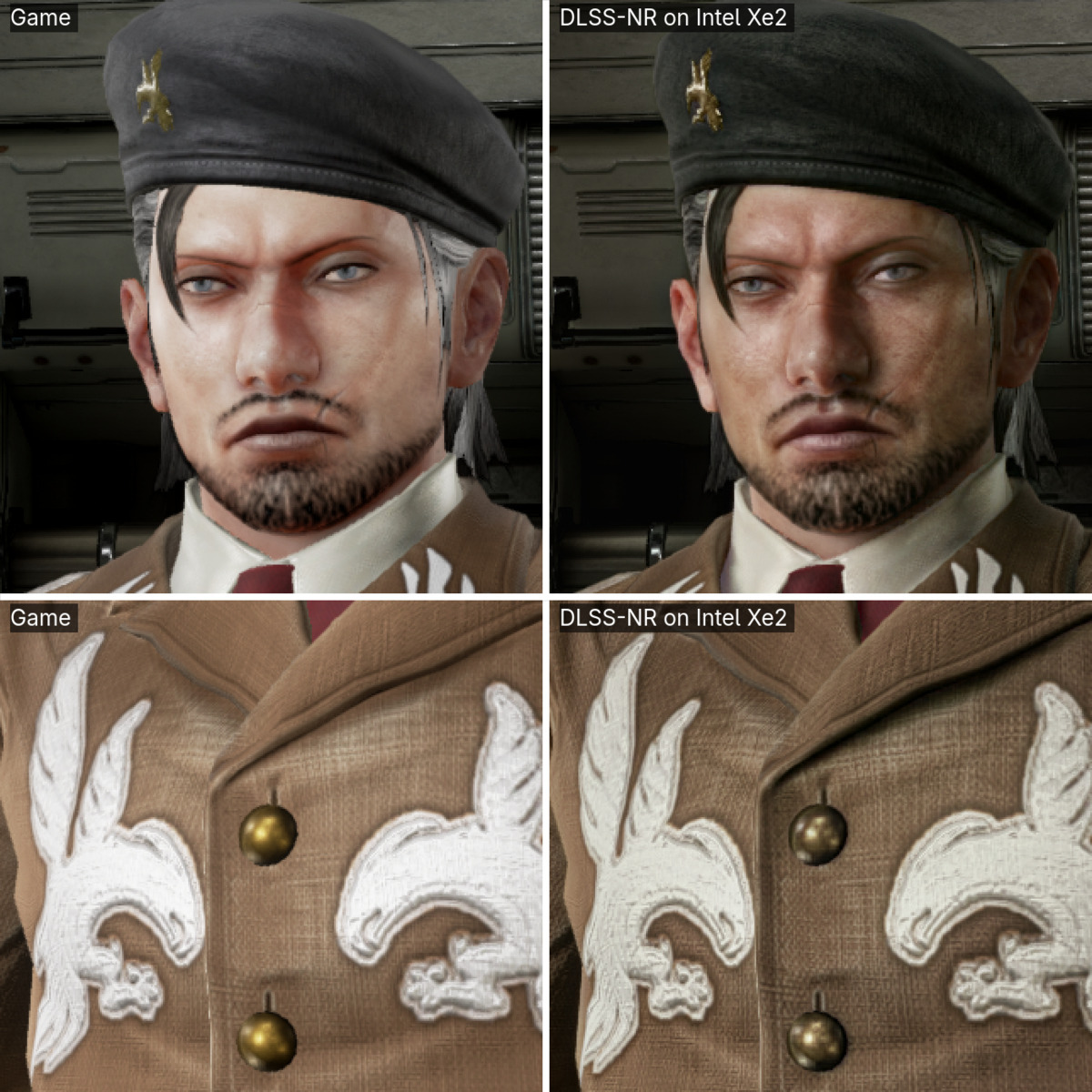
Image: Tekken 7 through DLSS neural rendering on Intel Arc 140V, game frame versus re-rendered frame. Credit: UzbekUnknown via GitHub.
What was built for Intel Xe2
Per the official repository README at github.com/uzbekunknown/dlss-nr-on-intel, the project runs NVIDIA DLSS 5 neural rendering inference on an Intel Arc 140V in Lunar Lake with Xe2 graphics under Linux. The author states it was developed and measured on Arc 140V with Mesa ANV, and that an Arc B580 reports the same cooperative matrix configurations.
Per Wccftech on September 19, 2026, reporter Sarfraz Khan relays the same project and notes the tester used a Core Ultra 7 256V processor that hosts the Arc 140V. Wccftech frames it as the third step in a weeks-long modder sequence after DLSS 5 neural rendering on older RTX GPUs and then on AMD RX 9000 series.
The repository holds 19 stars and 4 forks with 154 commits at the time of this writing. The author calls it a research port, not a product, and states all breakdowns and analysis are written by AI.
How it runs without CUDA
Per the repository README, the graph is a symmetric U-Net with five Swin stages at 32, 64, 128, 256, and 512 channels down to a ViT-1D bottleneck and back, 71 blocks total, recovered from the DLL and anchored on the independent MLX-DLSS extraction of the same binary. Every GEMM runs on XMX in FP16 with FP32 accumulate through the VK_KHR_cooperative_matrix Vulkan extension.
The pass injects at vkQueuePresentKHR, per the README, so it attaches to anything that presents with Vulkan, including a Windows game under Proton. Two processes cooperate: a daemon holds the model and a Vulkan layer inside the game hands it each frame over a unix socket.
The repository contains code only. Per the README, it ships no NVIDIA binaries and no weights derived from them, and the reader checks for fully logical weight files and refuses packed files. You must extract the logical weight file from your own copy of nvngx_dlssnr.dll, which decodes to 649 named tensors and 145,755,123 parameters with large matrices stored as FP8 E4M3.
| Component per README | What it does | Requirement |
|---|---|---|
| Vulkan layer in game process | Captures each present and sends it to daemon | ENABLE_NR_LAYER=1 in game environment, valid socket and trigger paths |
| Daemon holding model | Runs 71-block U-Net on XMX and returns residual head | Intel GPU with VK_KHR_cooperative_matrix fp16 x fp16 to fp32, Linux, Vulkan loader |
| Composition step | Adds synthesized head to game frame, game pixels never resampled | Render scale 0.05 to 1, default 1 per repo knob table |
What it looks like in three games
Per the repository README, stills were captured at full resolution in Tekken 7 on Unreal Engine 4 through D3D11 at 1920x1080, Dead or Alive 5 Last Round on D3D9 at 1920x1080, and Mortal Kombat 1 on modified Unreal Engine 4 through D3D12 with VKD3D-Proton at 1600x900. Wccftech embeds the same three comparisons and credits GitHub as news source.
The repository measured texture as high-frequency energy normalized for brightness change, because brightness moves and fools the eye. On Tekken 7 the character gains texture while the background stays almost alone. On Mortal Kombat 1, whose faces already carry fine detail, face detail goes down while color shifts as the warm filmic grade and skin glow come out.
The author states the honest summary is that the three games do not get the same treatment, and whether any result is better is taste, not measurement. The pass is photographic where the games are stylized, per the README.
| Image per README | Region | Brightness change | Relative texture |
|---|---|---|---|
| Tekken 7 | Face | 78 to 57 | Plus 22 percent |
| Tekken 7 | Jacket weave | 90 to 71 | Plus 50 percent |
| Tekken 7 | Embroidery | 135 to 115 | Plus 36 percent |
| Tekken 7 | Background | 35 to 34 | Minus 9 percent |
| DOA5 close-up | Face | 107 to 90 | Plus 4 percent |
| MK1 | Omni-Man face | 131 to 132 | Minus 14 percent |
| MK1 | Homelander face | 131 to 131 | Minus 24 percent |
How fast it runs and what it costs
Per the repository README, rates were measured through the socket on September 18, 2026 with src/bench/live_rates.py as median of five frames for the whole round trip a game waits for. The table runs from 13.9 FPS at 512x288 down to 2.4 FPS at 1920x1080, with Tekken 7 measured at 10.5 FPS at 640x360 in a live fight.
Per Wccftech, performance on Arc 140V collapses to 3 to 5 FPS at 720p, which matches the repository range once the game adds its own frame cost on top of daemon cost. The repository states cost follows the output extent and that a 1920x1080 frame takes hundreds of milliseconds, so the author advises setting the game window small with the compositor stretching to the panel.
Memory cost is about 2.3 GiB of device buffers at 720p, per the README, shared from system RAM on the integrated GPU. The graph itself is described as finished as an optimization target, with GEMM at 216 ms of 488 ms at 720p and register bound, and tiling, staging, integer weights, and OpenCL paths measured and closed.
- 512x288 at 0.35 render scale: 72 ms, 13.9 FPS daemon alone, per README September 18 measurement.
- 640x360 at 0.50 render scale: 80 ms, 12.5 FPS daemon alone, and 10.5 FPS live in Tekken 7 fight.
- 854x480 at 0.50 render scale: 105 ms, 9.5 FPS daemon alone.
- 1920x1080 at 0.55 render scale: 412 ms, 2.4 FPS daemon alone.
How to try it and what you supply
Per the README, you need an Intel GPU exposing VK_KHR_cooperative_matrix with fp16 x fp16 to fp32, Linux, Python 3 with NumPy, a C compiler, glslangValidator, the Vulkan loader, and ImageMagick for still tools. A probe program answers whether your GPU qualifies before the rest is built.
Build clones Vulkan-Headers and MLX-DLSS checkouts, then runs make with about 190 checks, per the README. Weights come only from your own DLL through the MLX-DLSS extract and unpack tools into a logical safetensors file, and make test skips weight-dependent parts without them.
Run uses a daemon plus a Steam launch option generated on your own machine by nr-photo, per the README, because the line carries the absolute path to your clone. Copying a launch line from a forum silently fails since the path points nowhere. Controls include nr-panel, nr-ctl, and nr-toggle, with knobs for render scale, profile, intensity, detail strength, colour strength, temporal history, hold, and cut limit.
FAQ
Does this run DLSS 5 on Intel without NVIDIA hardware?
Yes, per the repository README. The inference pass runs on Intel XMX through Vulkan cooperative matrix with no NVIDIA GPU, no NGX, and no CUDA.
Is this an official NVIDIA port?
No. Per the README, it is an independent reimplementation, not affiliated with or endorsed by NVIDIA, and it distributes no NVIDIA code or weights.
What GPU was it measured on?
Intel Arc 140V in Lunar Lake with Xe2 on Mesa ANV under Linux, per the README. Wccftech relays the tester used a Core Ultra 7 256V.
How fast is it in a real game?
Tekken 7 runs at 10.5 FPS at 640x360 live, per the README, and Wccftech reports 3 to 5 FPS at 720p. Daemon-alone rates range from 13.9 FPS at 512x288 to 2.4 FPS at 1080p.
Do I need to supply files?
Yes. Per the README, you must bring your own nvngx_dlssnr.dll and extract the 649-tensor logical weight file. Nothing runs until that step completes.
Who wrote the code and analysis?
Per the README, AI agents produced the code, measurements, and notes, with Claude Opus 5 and Astra credited, while the author supplied the machine, binary, direction, and decisions.
Bottom Line
DLSS 5 neural rendering now has a working Intel Xe2 path through an independent Vulkan reimplementation, per the official repository and Wccftech relay. It proves the graph runs on XMX without CUDA across three real games, but at 2 to 13 FPS depending on extent it is a research milestone, not a playable mod. If you own an Arc 140V and a legal DLL copy, the repo gives you measured tools to reproduce it.
Related: DLSS 5 on AMD explained with 1000 stars and 33 FPS | DLSS 5 mods explode with dual GPUs and AMD mode | Intel Xe2 Arc 140V iGPU for Lunar Lake