
Intel Nova Lake Slips: 52-Core Flagship Late 2027, 28-Core First [2026]
Saturday, September 12, 2026Updated September 13, 2026: A leaked Intel partner slide reported by HotHardware on September 5 pushes Nova Lake's 52-core flagship to late 2027, with 28-core models opening the Core Ultra 400 lineup in early 2027 instead. Dual compute tiles explain the stagger: Intel has never shipped two tiles on a consumer desktop CPU. A leaked CPU-Z screenshot of the 28-core 4950K shows roughly 1,000 single-thread and 20,000 multi-thread points. Intel VP Robert Hallock promises desktop first and one of Intel's most significant desktop launches ever. Here is the timeline, the silicon, and what it means for AMD's lead.
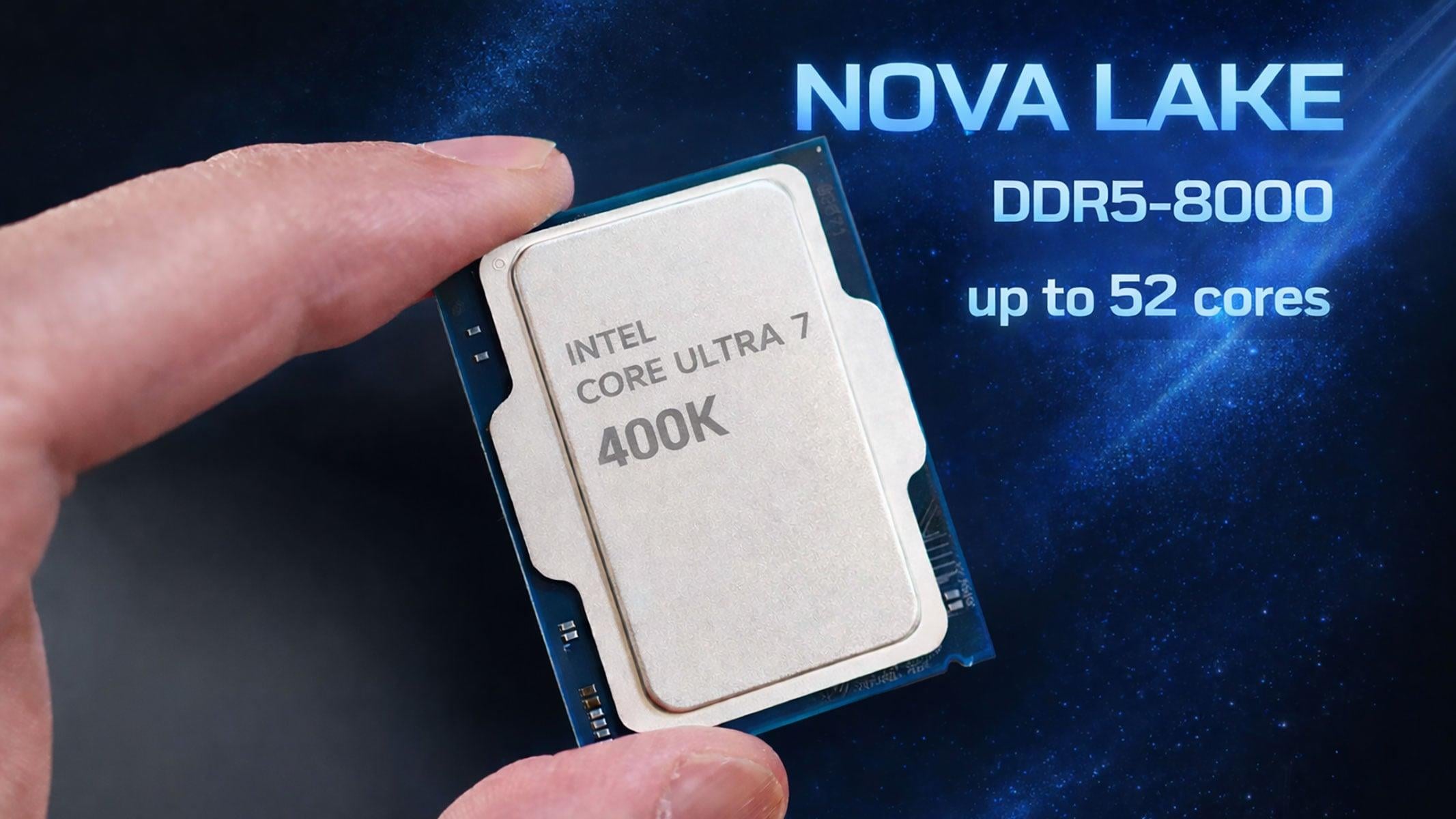
Table of Contents
- The Leaked Slide
- The Staggered Timeline
- Why Two Tiles Delay Everything
- The 4950K CPU-Z Leak
- The Silicon: Cores, Cache, Platform
- Hallock: Desktop First
- What It Means Against AMD
- Launch Timeline at a Glance
- The Lineup
- Bottom Line
- Frequently Asked Questions
1. The Leaked Slide
HotHardware's Zak Killian reported September 5 on a leaked Intel partner presentation slide, surfaced by X user wxnod with machine translation, detailing Nova Lake release cadence. The slide's message: no Nova Lake before year end, 28-core models first, dual-tile 52-core flagships later in 2027. Most contents confirm prior reporting rather than breaking new ground, which is precisely what makes it credible: a partner-facing schedule aligning with independent leaks.
VideoCardz's July reporting had already sketched the same stagger with review embargo windows: 28-core DS package January to March 2027, 28-core K-series March to April, 16 and 8-core late March to May, 52-core DS late May to September. The wxnod slide matches that shape. Two independent leak vectors converging on one timeline upgrades rumor to working plan.
Our Zen 6 vs Nova Lake comparison framed the 52-vs-24 core contest before this schedule slipped the flagship. The core counts stand. The dates moved. This article is the timing update.
2. The Staggered Timeline
Early 2027 opens with 28-core models, both the DS package and unlocked K-series, covering January through April. The mainstream 16 and 8-core variants follow late March through May. The 52-core dual-tile flagship lands late May at the earliest, September at the latest. Intel's biggest desktop gun fires three to five months after its own lineup opens.
The stagger inverts the usual halo-first playbook. Flagships normally launch first to set perception while volume parts follow. Intel leads with the middle because the middle is manufacturable now, a concession the slide makes structurally rather than verbally. Enthusiasts waiting for 52 cores wait through two prior launches.
AMD's counter-schedule sets the competitive frame. Zen 6 desktop with up to 24 cores is expected in the same window, and Intel's plan reads as sequenced response: credible single-tile competition first, dual-tile core-count overkill the moment AMD's 24-core parts land. The 52-core delay is not just manufacturing. It is positioning.
3. Why Two Tiles Delay Everything
Fifty-two cores require two compute tiles, something Intel has never shipped on a consumer desktop CPU. Multi-tile packaging introduces interconnect latency, power delivery complexity, thermal density concentrations, and yield multiplication: two tiles must both bin well for one flagship package. Server parts absorb these costs at server margins. Desktop flagships must survive retail pricing.
HotHardware's analysis names the strategy plainly: single-tile chips first to contest AMD in gaming and match Zen 5 in multi-core, then dual-tile beasts to outpace Zen 6 purely on core count once AMD commits its lineup. Launch order as competitive sequencing rather than manufacturing accident. The tiles explain the delay. The delay enables the trap.
Memory scaling complicates the core-count story. Even today's 16 and 24-core parts show strong multi-core scaling sensitivity to memory subsystems in some workloads, and 52 cores demand commensurate bandwidth. DDR5-8000 support and expanded PCIe 5.0 lane counts in the platform specs address exactly this. Cores without feeding are decoration, and Intel's platform work acknowledges it.
4. The 4950K CPU-Z Leak
TechSpot's Skye Jacobs reported August 20 on a CPU-Z screenshot from leaker laurentschoice showing a Core Ultra 9 4950K: 8 performance plus 20 efficiency cores totaling 28, scoring roughly 1,000 single-thread and 20,000 multi-thread points. Against public submissions, that beats the i9-14900KS near 950 single-thread and the Ryzen 9 9950X3D2 near 17,000 multi-thread. Meaningful gains on both axes if the numbers hold.
Three caveats apply in order. Engineering samples run ahead of release with unfinal clocks, cache behavior, power limits, and scheduling. CPU-Z is a narrow synthetic that rewards specific paths. And the 4950K name itself may change: four-digit numbering would break the three-digit Core Ultra scheme introduced in 2024, and Intel renames liberally before launch. Treat the scores as directional evidence of intent, not product benchmarks.
Directionally, the intent is clear. Stronger single-core plus a large multithread jump targets both of Intel's weak points at once: gaming responsiveness and productivity throughput. A 28-core opener that beats current flagships on both would make the early-2027 launches competitive independent of the delayed 52-core halo.
5. The Silicon: Cores, Cache, Platform
The flagship configuration combines 16 Coyote Cove performance cores, 32 Arctic Wolf efficiency cores, and 4 low-power efficiency cores for 52 total, replacing Lion Cove and Skymont, per Tom's July synthesis of VideoCardz reporting. Coyote Cove and Arctic Wolf are entirely new architectures, the generational break the core counts advertise.
Cache is the gaming story. Nova Lake adopts Big Last Level Cache up to a reported 288MB of L3, Intel's answer to AMD's 3D V-Cache that HotHardware notes the DIY community treats as mandatory for high-frame-rate and poorly optimized titles. BLLC proven inside Ryzen validates the concept; Intel's implementation decides whether the gaming gap actually closes. Our Intel CPU coverage tracks the pricing side of the same lineup.
Platform moves with it: LGA 1954 socket with 900-series boards spanning Z990 to B960, DDR5-8000 support, up to 24 PCIe 5.0 lanes, Thunderbolt 5, Xe3 Celestial integrated graphics, and forward socket compatibility claimed for future generations. New socket costs early adopters a motherboard, priced in our motherboard hike coverage, against promised longevity. Razor Lake's reported 2027 compatibility with Nova Lake platforms would honor that promise fast.
6. Hallock: Desktop First
Intel VP Robert Hallock told Tom's Hardware in August that the new core comes to desktop first, pointedly ahead of servers: "I have a new core. It's coming to desktop first. I mean, I hope enthusiasts do the math about that one, and that's all I'm going to say." TechSpot's writeup frames the inversion against industry direction, where AI demand pushes vendors server-first and enthusiasts wait. Intel reverses the queue.
Hallock added that the Nova Lake team matches Arrow Lake Refresh's group, which drew better reception than recent Intel desktop efforts, and called the coming processors potentially "one of the most significant desktop CPU launches we've ever had." Executive superlatives are free, but the team continuity claim is checkable: Arrow Lake Refresh's warmer reviews give the boast a foundation.
Desktop-first also reads as a response to reliability scars. The 13th and 14th generation instability issues damaged enthusiast trust, and TechSpot notes the context explicitly. Leading with desktop signals confidence the new architecture avoids old failure modes. Server customers get caution. Enthusiasts get the experiment. That ordering only makes sense if Intel believes the silicon.
7. What It Means Against AMD
AMD's position is the redirect target of every Nova Lake decision. The DIY community's 3D V-Cache requirement, which HotHardware calls exaggerated but real for esports and unoptimized engines, is the specific deficit bLLC attacks. Zen 6's 24 cores set the multi-core bar the 52-core flagship exists to clear. AM5 socket longevity contrasts with LGA 1954's forced migration.
Intel's sequencing concedes the present while contesting the future. Single-tile 28-core parts fight Zen 5-era AMD on arrival. The dual-tile flagship waits for Zen 6, then answers 24 cores with 52. It is a responsive strategy rather than a leading one, built on the assumption AMD's cadence stays predictable. If Zen 6 slips or stuns, the sequencing breaks.
Beyond 2027 the roadmap hints at Intel's endgame. DigiTimes via TechSpot outlines Razor Lake late 2027, Titan Lake and Moon Lake in 2028, with Titan Lake reportedly unifying performance and efficiency cores into single Copper Shark architecture plus Nvidia RTX GPU tile integration. The hybrid era that complicated gaming optimization since Alder Lake may end two generations out. Nova Lake is the bridge, not the destination.
8. Launch Timeline at a Glance
| Window | Models | Source |
|---|---|---|
| Jan - Mar 2027 | 28-core DS package opens the lineup | VideoCardz via Tom's, wxnod slide |
| Mar - Apr 2027 | 28-core unlocked K-series | VideoCardz via Tom's |
| Late Mar - May 2027 | 16-core and 8-core mainstream | VideoCardz via Tom's |
| Late May - Sept 2027 | 52-core dual-tile flagship DS | VideoCardz via Tom's, wxnod slide |
| Q4 2027 | Razor Lake desktop follows, platform compatible | DigiTimes via TechSpot and PCMag |
9. The Lineup
| Tier | Cores | Role |
|---|---|---|
| Flagship DS | 52 (16P plus 32E plus 4LPE), dual tile | Zen 6 answer, late 2027, multi-core overkill |
| Opener (4950K class) | 28 (8P plus 20E), single tile | Early 2027 gaming and productivity lead |
| Mainstream | 16-core and 8-core | Volume 2027, bLLC across stack implied |
| Platform | LGA 1954, DDR5-8000, 24 PCIe 5.0 lanes | New boards required, longevity promised |
10. Bottom Line
Nova Lake's leaked schedule trades halo-first tradition for competitive sequencing: 28 cores early 2027 to fight today's AMD, 52 dual-tile cores late 2027 to ambush Zen 6, mainstream filling between. The CPU-Z leak suggests the opener already beats current flagships. Hallock's desktop-first pledge and bLLC answer the gaming deficit directly. Nothing is confirmed until Intel speaks, and two leak vectors plus an executive on record make this the closest thing to a roadmap the company has. AMD's 24-core response window is now the clock the whole desktop market runs on.
Frequently Asked Questions
Q: When does Intel Nova Lake launch?
A: Per the wxnod partner slide and VideoCardz embargo reporting: 28-core models January through April 2027, mainstream 16 and 8-core late March to May, 52-core flagship late May to September 2027. Nothing in 2026. All leaks, Intel unconfirmed.
Q: Why is the 52-core model so late?
A: It needs two compute tiles, a first for consumer desktop, with packaging, power, thermal, and yield complexity. Intel leads with manufacturable single-tile parts and sequences the flagship against AMD's Zen 6 arrival.
Q: How fast is the leaked 4950K?
A: Roughly 1,000 single-thread and 20,000 multi-thread CPU-Z points per the laurentschoice screenshot, ahead of the 14900KS and 9950X3D2 on those axes. Engineering-sample caveats apply: clocks, cache, power, and scheduling are unfinal.
Q: What is bLLC and why does it matter?
A: Big Last Level Cache up to a reported 288MB of L3, Intel's counterpart to AMD's 3D V-Cache for high-frame-rate and unoptimized games. Concept proven on Ryzen. Implementation quality decides the gaming outcome.
Q: Will Nova Lake need a new motherboard?
A: Yes, LGA 1954 with 900-series boards. Intel reportedly promises forward compatibility with Razor Lake in late 2027, which would repay the migration fast. Current board pricing context sits in our motherboard coverage.
Q: What comes after Nova Lake?
A: Razor Lake desktop late 2027, Titan Lake and Moon Lake in 2028 with a possible unified Copper Shark architecture ending hybrid cores, plus Nvidia RTX GPU tile integration in mobile. Per DigiTimes via TechSpot, all unconfirmed.
Byline: Indie Kings | September 13, 2026
Labels: Hardware, Intel
Related: Zen 6 vs Nova Lake: 52 vs 24 Cores | Intel 10 Percent CPU Hike October 5 | X870E vs Z890: 120Gbps vs 40Gbps