
RTX Mega Geometry 2.0 Adds Geometry Streaming and Gears of War E-Day Ray Traces Nanite
Saturday, September 26, 2026By Indie Kings | September 25, 2026
Updated September 25, 2026: NVIDIA released RTX Mega Geometry 2.0, which adds streaming of continuous level-of-detail clusters for high-density meshes. It ships alongside RTX Kit 2026.3, and NVIDIA confirmed that Mega Geometry is coming to Gears of War: E-Day, which will be the first game to ray trace Nanite.
Source note: Details come from NVIDIA's GeForce news post and developer material, reported by VideoCardz. NVIDIA says the E-Day integration improves image quality and rendering performance but published no benchmark results, so the performance claim is unverified.
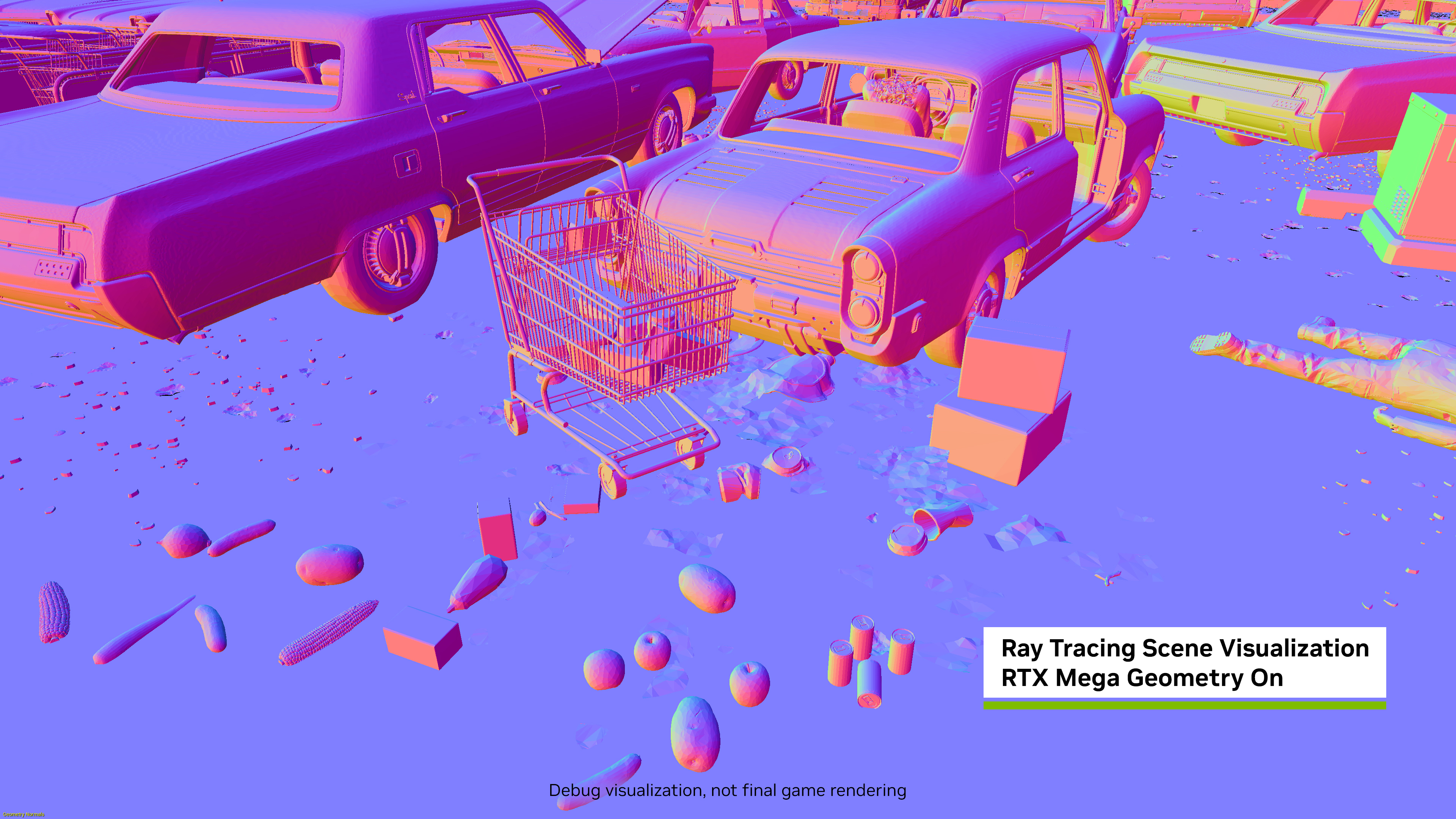
Image: RTX Mega Geometry cluster visualization in Gears of War: E-Day. Credit: NVIDIA.
What actually changed in 2.0
RTX Mega Geometry is NVIDIA's cluster-based geometry pipeline, built around dividing a mesh into clusters and building an acceleration structure over those clusters rather than over individual triangles. The 2.0 release adds the piece that has been the practical limit on that approach: continuous level-of-detail streaming.
The previous behaviour was discrete. A mesh was built once at one level of detail. The new behaviour lets a developer load geometry clusters at different levels of detail as the scene requires, so detail can follow the camera and the scene rather than being fixed at load time.
| Aspect | Before 2.0 | With 2.0 |
|---|---|---|
| Level of detail | Discrete, fixed at build time | Continuous, selected per cluster as the scene requires |
| Streaming | Not available | Clusters load at different detail levels dynamically |
| Target workloads | Static high-density meshes | Ray traced scenes needing detail that varies with view |
| Shipping title confirmed | None before this | Gears of War: E-Day |
This is the piece that makes the technique useful for ray tracing rather than just for asset management. Ray traced shadows and reflections need geometric detail at the exact moment they are traced, and a fixed level of detail forces you to either pay for detail everywhere or accept errors where the mesh is coarse.
The Zorah demo and what clusters are
NVIDIA demonstrated the feature with a newly released textured glTF version of Zorah, the Metro Exodus creature. The sample exists specifically to show the mechanic, and the interesting part is the visualization rather than the final render.
A mesh that would previously have been one indivisible object is divided into clusters. Each cluster can be refined or coarsened independently. In the visualization NVIDIA published, you can see the dense mesh broken into discrete pieces, which is the clearest available explanation of how the technique actually works.
Our earlier coverage of Unreal Engine 5 explains the same family of ideas at the engine level, where Nanite does the same thing for the standard pipeline. Mega Geometry is NVIDIA's hardware-accelerated path to the same outcome, and the two now interact in E-Day.
Gears of War E-Day and the Nanite claim
The confirmed shipping target is Gears of War: E-Day, developed by The Coalition. NVIDIA's developer post includes a discussion with the studio about integrating the technology alongside DLSS, and NVIDIA's own announcement frames it as the first game to ray trace Nanite.
That last point is the significant one. Nanite ray tracing has been a target for a long time, and the practical objection has always been cost: tracing rays against fully virtualized geometry is expensive. Mega Geometry is aimed squarely at that problem.
What is missing is evidence. NVIDIA says the integration improves image quality and rendering performance, and the developer post provides no benchmark numbers. So we have a confirmed feature, a named studio, and a vendor performance claim with nothing behind it yet.
Worth noting for context: NVIDIA's public demonstration of the E-Day Mega Geometry feature came from Jacob Freeman of the GeForce team on August 25, 2026, and the reception in the comments was mixed. Some viewers judged the visual difference to be minor. That is an early impression from a promotional clip, not a review, and it should not be treated as a verdict either way.
The rest of RTX Kit 2026.3
Mega Geometry shipped as part of a larger toolkit update. RTX Kit 2026.3 covers neural rendering, path tracing, and texture processing, and the changes span lighting, character rendering, and shader development.
| Component | Version | What changed |
|---|---|---|
| RTX Mega Geometry | 2.0 | Streaming of continuous level-of-detail clusters |
| RTX Dynamic Illumination | 3.1 | DLSS Ray Reconstruction integration, plus improvements to ReSTIR PT |
| RTX Neural Texture Compression | 0.10 beta | DirectX 12 Agility SDK preview with Linear Algebra, letting Tensor Cores accelerate neural texture decompression in DirectX shaders |
| RTX Character Rendering | 1.4 | Improved far-field hair BCSDF sampling and energy conservation |
| RTX Neural Shading | 1.4 | Support for the latest DirectX Linear Algebra preview toolchain, with shader and sample dependency updates |
| RTX Texture Filtering | 1.3 | Collaborative Texture Filtering for better quality when magnified |
| In-Game Inferencing SDK | Update | RTX Spark support in developer preview, Gemma4 support, a Stable Diffusion plugin with sample code, updated llama.cpp components |
The ReSTIR PT and Ray Reconstruction work in Dynamic Illumination 3.1 is the piece most likely to affect shipping games soonest, because it improves the sampling of path-traced lighting rather than the representation of geometry. The character rendering update is narrow but pointed at a persistent problem, since hair that is wrong at distance is one of the most common giveaways in a ray traced scene.
The ARM64 thread running through the SDK
Two components in this update added Windows ARM64 support: Neural Texture Compression 0.10 and Texture Filtering 1.3. That is the quiet but possibly more consequential story in the release, and it connects to a broader shift.
Windows on ARM has been a hard platform for graphics developers for a simple reason: it is small enough that you can ignore it, and NVIDIA's previous answer to the question of ARM64 support was largely to not answer it. Adding it to two rendering components in the same release as a major geometry feature suggests the platform is being treated as something to ship on rather than something to defer.
It is worth being precise about what this does and does not mean. It does not mean ARM64 Windows PCs can run these features today. It means the tools to build for them are now in the same release train as the features, which removes a step from the critical path. Tools first, games considerably later, is the normal order.
What developers have to do next
The most important caveat in this release is not technical, it is procedural. These are developer tools. Their availability does not automatically add any of these features to existing games.
- Mega Geometry requires a developer to adopt it. No game gains streaming geometry from an SDK update alone.
- Neural Texture Compression is a beta at version 0.10, which in NVIDIA's numbering means the interface may still change.
- Neural Shading depends on a DirectX preview toolchain. Building against a preview means building against something that is not final.
- The E-Day performance claim has no benchmarks behind it. We will report them when independent testing exists.
FAQ
What is new in RTX Mega Geometry 2.0?
Streaming of continuous level-of-detail clusters for high-density meshes, so developers can load geometry clusters at different levels of detail as a scene requires.
Which game will use RTX Mega Geometry?
Gears of War: E-Day, developed by The Coalition, which NVIDIA says will be the first game to ray trace Nanite.
Has NVIDIA published performance data for E-Day?
No. NVIDIA says the Mega Geometry and DLSS integration improves image quality and rendering performance, but the developer post includes no benchmark results.
What else is in RTX Kit 2026.3?
RTX Dynamic Illumination 3.1 with DLSS Ray Reconstruction and ReSTIR PT improvements, Neural Texture Compression 0.10 beta, Character Rendering 1.4, Neural Shading 1.4, Texture Filtering 1.3, and In-Game Inferencing SDK updates.
Does this add features to games that already exist?
No. These are developer tools, and their availability does not automatically add the features to existing games.
Why does Windows ARM64 support matter here?
Neural Texture Compression 0.10 and Texture Filtering 1.3 both added Windows ARM64 support, putting ARM64 into the same release train as the major rendering features rather than deferring it.
Bottom Line
Mega Geometry 2.0 is the release that makes cluster-based geometry practical for ray tracing, because continuous level-of-detail streaming removes the compromise that forced a fixed detail level on every mesh. The catch is that a technique being ready and a game shipping it are different events, and only one confirmed title is on the horizon. E-Day is the test case that matters, since it is the first game NVIDIA says will ray trace Nanite, and it arrives carrying a vendor performance claim with no published benchmarks behind it. The secondary story is arguably larger: ARM64 support landing in two rendering components in the same release suggests NVIDIA has stopped treating Windows on ARM as a platform to defer, and the tools are now ahead of the hardware that would use them.
Sources: VideoCardz, NVIDIA RTX Mega Geometry 2.0 adds geometry streaming for detailed ray-traced scenes, by WhyCry | NVIDIA GeForce News, Gamescom 2026 announcements and trailers
Related: Intel TSNC: neural texture compression shrinks textures 18x | Unreal Engine 5 Nanite and Lumen explained | DLSS 5 vs FSR 4 vs XeSS 3 upscaling guide