
AMD FSR 4: Handheld Rollout Lands Before Its Handheld Architecture Does
By Indie Kings | October 17, 2026
Updated October 17, 2026: AMD has confirmed FSR 4 is coming to APUs, integrated laptops, and gaming handhelds by the end of 2026, per an interview AMD's Jack Huynh gave to South Korean outlet The Elec. At the same time, leaked specs for the next Ryzen Z3 handheld chip describe an "RDNA 4m" GPU that leakers say is really RDNA 3.5 with RDNA 4 style matrix hardware, meaning the upscaling software arrives before the handheld architecture that was built for it.
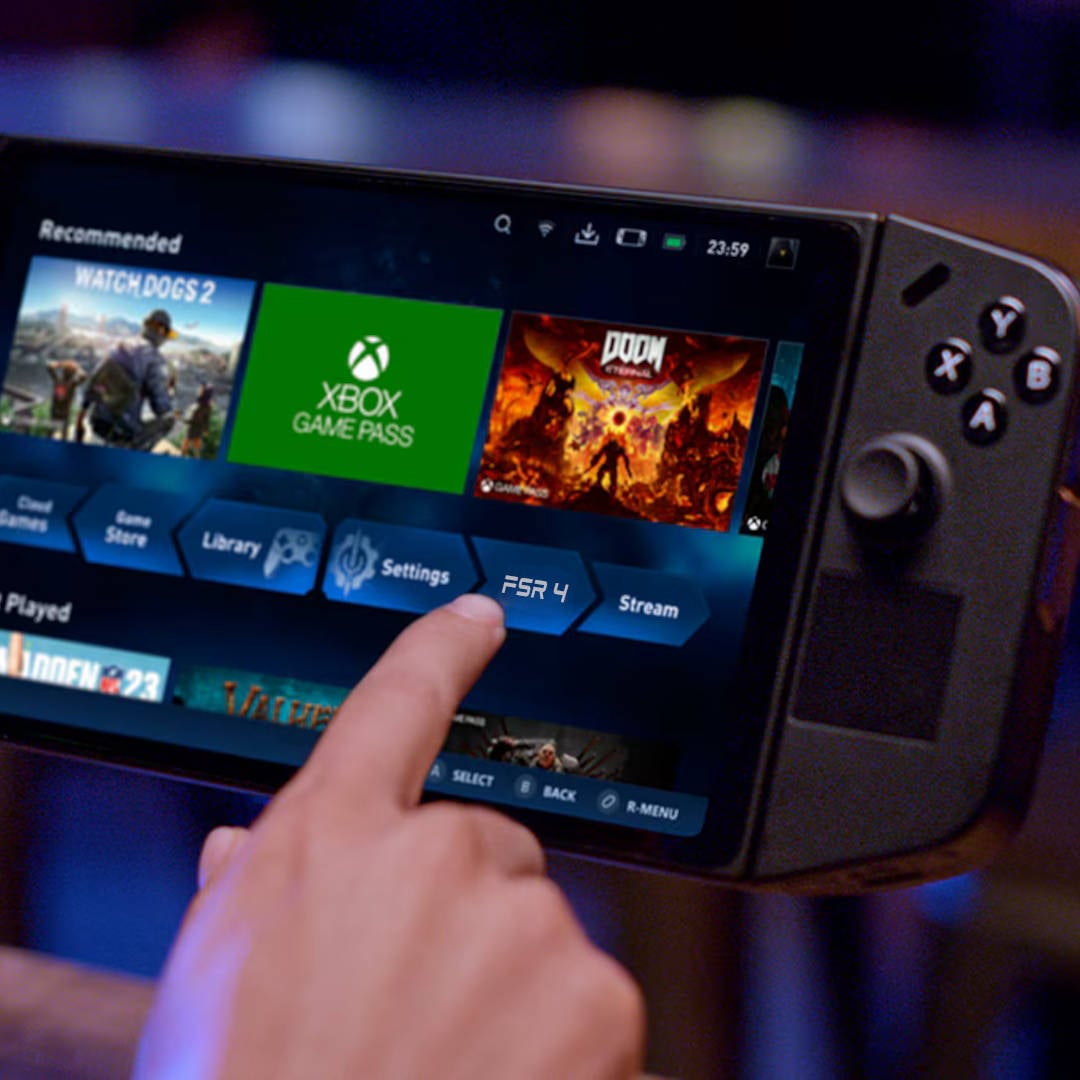
Image: AMD Ryzen Z1 gaming handheld, credit Club386
What AMD's Jack Huynh confirmed about FSR 4
Per Club386's October 8 report, AMD has confirmed that FSR 4, the company's machine learning based upscaler, is coming to APUs, laptops with integrated GPUs, and handhelds in 2026. That closes a gap that has existed since FSR 4 launched, because the feature has until now been reserved for Radeon 9000 and 7000 series discrete graphics cards.
The confirmation comes from Jack Huynh, senior vice president and general manager of AMD's Computing and Graphics Group, in an interview with South Korean media outlet The Elec. Per Club386's translation, Huynh said: "We will expand FSR 4 across our product lineup, including APUs, gaming laptops and handheld devices, by the end of this year." Today's APUs, the chips behind most handhelds and compact systems, are usually powered by RDNA 3.5 or RDNA 3 graphics.
Why FSR 4 skipped APUs in the first place
FSR 4 debuted exclusively on RDNA 4 based GPUs such as the Radeon RX 9070 XT, and the reason was silicon level: RDNA 4 features native FP8 processing, which accelerates the neural network calculations the upscaler relies on. Desktop RDNA 3 cards did not have that, so FSR 4 could not run there at launch.
Pressure from last generation GPU owners and community made mods changed the picture. Those mods proved FSR 4 was viable on older hardware, and per Club386, AMD used the same trick the modders did, adapting the FSR 4 neural model to run efficiently on RDNA 3's INT8 processing. That release covered desktop RDNA 3 cards but still left out APUs with RDNA 3.5 or RDNA 3 graphics, which are the chips inside low power laptops, compact desktops, and gaming handhelds.
The lighter FSR 4 model built for APUs
The APU rollout is not simply a port. Per Club386, Huynh said AMD has developed a dedicated model that makes FSR 4 lighter on APUs, with the team focused on keeping the upscaler's image quality and low latency while it does so. That detail matters because integrated GPU compute budgets are small, and an oversized neural model would eat performance FSR 4 is supposed to save.
Performance impact remains an open question per the report. FSR 4 runs more efficiently on RDNA 4 than on RDNA 3 even with AMD's optimisations, and the iGPUs in APUs are smaller than any discrete card, so more optimisation may be needed to avoid wasting valuable performance on a handheld's power budget.
Ryzen Z3 leak: Medusa Point with Zen 6 and RDNA 4m
Per Club386's October 2 report, tech leakers Gotou_3rd and CaptainMcShotgun claim on X that AMD's Ryzen Z3 series uses a semi custom version of the Medusa Point architecture, combining Zen 6 and Zen 5 LP (low power) CPU cores with RDNA 4m GPUs. At least two variants are expected: the Ryzen Z3 and the Ryzen Z3 Extreme. At least one is said to carry four Zen 6 cores and two Zen 5 LP cores, twelve threads in total, alongside twelve RDNA 4m compute units.
The leakers did not clarify whether both chips share the same core layout, so per Club386 the clearest stated difference is the power budget: the Z3 Extreme is allowed up to 25W against 15W for the standard Z3. The smaller envelope, per the report, may finally enable compact handhelds with more playtime.
Caution is warranted. Club386 notes that Gotou_3rd and CaptainMcShotgun are emerging leakers without a track record to confirm their sources, though the outlet points out that renowned leaker Kepler added details to the leak without flagging mistakes, and AMD's plans could change regardless.
RDNA 4m is RDNA 3.5 in all but name
Here is the catch in the name. Per Club386, leaker Kepler_L2 describes the Z3 series RDNA 4m GPU as akin to "RDNA 3.5," calling it "RDNA4m aka RDNA 3.5+" on X. In other words, despite the RDNA 4 branding, the GPU is not truly based on the RDNA 4 architecture inside desktop Radeon RX 9000 cards.
There is a partial bridge, though. Per Videocardz relayed via Club386, the RDNA 4m GPU is reported to feature RDNA 4 style ALUs for matrix operations. If correct, that means Z3 chips could officially support FSR 4 AI upscaling in full FP32 mode, which would boost handheld performance. The Z3 carries an older GPU base with RDNA 4's compute bits grafted on, precisely enough to run the new software.
The generational boredom continues beyond the Z3, per the same report. CaptainMcShotgun claims RDNA 3.5 refreshes could continue until 2030, and known leaker Golden Pig previously shared a slide indicating RDNA 3.5 is planned to remain in use beyond 2028.
Ryzen Z3 vs Ryzen Z2 Extreme: the numbers
The leaked Z3 configuration actually looks like a reduction on paper compared with the current top handheld chip, but the smaller package tells a different story about where AMD is heading.
| Spec | Ryzen Z3 (leaked) | Ryzen Z3 Extreme (leaked) | Ryzen Z2 Extreme (current) |
|---|---|---|---|
| CPU | 4x Zen 6 + 2x Zen 5 LP (stated for at least one variant) | 4x Zen 6 + 2x Zen 5 LP (unclear if same layout) | Not stated in report |
| Threads | 12 | 12 (if same layout) | Not stated in report |
| GPU | 12 RDNA 4m CUs | Possibly 16 RDNA 4m CUs | 16 RDNA 3.5 CUs |
| Power budget | Up to 15W | Up to 25W | Not stated in report |
| Package | FF6, 25 x 25mm | FF6, 25 x 25mm | FP8, 25 x 40mm |
Per Club386, the Z3 series targets the smaller FF6 package measuring 25 x 25mm, versus the 25 x 40mm FP8 package of the Ryzen Z2 Extreme. Less board space inside a handheld leaves room for better cooling or larger batteries. The twelve CU figure may look like a downgrade from the Z2 Extreme's sixteen, but the outlet notes it is possible only the standard Z3 ships with twelve, with the Extreme at sixteen.
The full FSR 4 rollout timeline
Stacking the reports, AMD's upscaler is expanding in a defined sequence, from hardware built for it down through adapted ports:
| Hardware | FSR 4 status per current reports | Timing |
|---|---|---|
| Radeon RX 9070 XT and RDNA 4 GPUs | Launch exclusive, native FP8 support | At FSR 4's debut |
| Radeon 7000 series (RDNA 3 desktop) | Official release using INT8 adaptation | After community mods proved viability |
| APUs, integrated laptops, gaming handhelds (RDNA 3.5 / RDNA 3) | Official rollout with a dedicated lighter model | By end of 2026, per Jack Huynh |
| Radeon 6000 series (RDNA 2) | Planned FSR 4 support | 2027, per AMD |
Why these two stories belong together
The tie between the two reports is the gap between AMD's software strategy and its handheld hardware reality. On the software side, AMD is pushing its most advanced feature family, a machine learning upscaler engineered for RDNA 4, onto integrated graphics tiers trained around older architectures, one tier at a time: RDNA 3 desktops first via an INT8 adaptation, then APUs and handhelds by the end of 2026 with a dedicated lighter model, then RDNA 2 by 2027.
On the hardware side, the next handheld generation leaks as architecture dressed in new clothes: an "RDNA 4m" GPU that leakers describe as RDNA 3.5 plus RDNA 4 matrix ALUs, enough to run FSR 4 in full FP32 mode without being a true RDNA 4 part. The software is being taught to run everywhere; the silicon it was originally built for has not actually reached a handheld yet. Candidates for that silicon are being pushed out instead, with RDNA 3.5 refreshes reportedly planned until 2030 per the leakers.
Our take: This is a sensible compromise for handheld owners, and we suspect it will be judged by whether AMD's lighter APU model keeps FSR 4's image quality on a 15W budget. A twelve CU iGPU does not have the headroom desktop cards use, so real benchmark numbers on a shipping handheld will matter more than any confirmation quote. We are also sympathetic to buyers tired of RDNA 3.5 refreshes: if the "4m" naming is meant to signal a jump that silicon is not delivering, calling it RDNA 3.5 outright would be more honest.
FAQ
Is FSR 4 officially coming to gaming handhelds?
Yes. Per AMD's Jack Huynh in an interview with The Elec relayed by Club386 on October 8, 2026, FSR 4 will expand to APUs, gaming laptops, and handheld devices by the end of 2026.
Why was FSR 4 limited to RDNA 4 GPUs at launch?
RDNA 4 featured native FP8 processing needed to accelerate FSR 4's neural network calculations. AMD later adapted the model to run on RDNA 3's INT8 processing, using the same approach community mods had demonstrated.
How is FSR 4 on APUs different from FSR 4 on desktop cards?
Per Huynh, AMD developed a dedicated model that makes FSR 4 lighter on APUs while keeping image quality and low latency, because integrated GPUs are much smaller and performance budgets are tight.
Does the Ryzen Z3 have a full RDNA 4 GPU?
No, per the leakers. Kepler_L2 describes the Z3's "RDNA 4m" graphics as akin to RDNA 3.5, or "RDNA 3.5+." It reportedly adds RDNA 4 style ALUs for matrix operations, which would let it run FSR 4 in full FP32 mode.
What are the leaked Ryzen Z3 specs?
Per Gotou_3rd and CaptainMcShotgun, the series pairs Zen 6 and Zen 5 LP cores with RDNA 4m graphics, with the Z3 Extreme allowed up to 25W against 15W for the standard Z3, and a new 25 x 25mm FF6 package replacing the Z2 Extreme's 25 x 40mm FP8.
When is FSR 4 coming to RDNA 2 and the Radeon 6000 series?
Per the company via Club386, AMD's next step after APUs is the RDNA 2 based Radeon 6000 series, which is set to receive FSR 4 in 2027.
Bottom Line
AMD has officially committed to FSR 4 on APUs, integrated laptops, and handhelds by the end of 2026, with a dedicated lighter neural model meant to protect frame rates on small integrated GPUs. The catch, per fresh leaks from Gotou_3rd, CaptainMcShotgun, and Kepler, is that AMD's next handheld chip, the Ryzen Z3, packs an "RDNA 4m" GPU that is effectively RDNA 3.5 with RDNA 4 matrix operations, not a true RDNA 4 part. FSR 4 is reaching handhelds just as the handheld architecture generation is still carrying an older GPU base, patched up with just enough RDNA 4 compute hardware to run the new upscaler in full FP32 mode.
Sources
- AMD will officially expand FSR 4 to gaming handhelds and APUs in 2026, Club386, Fahd Temsamani, October 8, 2026 (source: The Elec interview with Jack Huynh, via VideoCardz)
- AMD's new Ryzen Z3 handheld chip reportedly still doesn't have a full RDNA 4 GPU, Club386, Fahd Temsamani, October 2, 2026 (source: Gotou_3rd and CaptainMcShotgun on X, via VideoCardz)