
LiberNT: A ReactOS Fork Built Around Windows 11
By Indie Kings | October 21, 2026
Updated October 21, 2026: LiberNT is a ReactOS-derived operating system that targets Windows 11 compatibility instead of the older NT5-era behavior that has long defined ReactOS. Its latest debug build, published October 14, runs on amd64, arm64 and riscv64, with experimental Windows 11 driver-model work, NTFS updates and a WoW64 path that uses FEX on Arm.
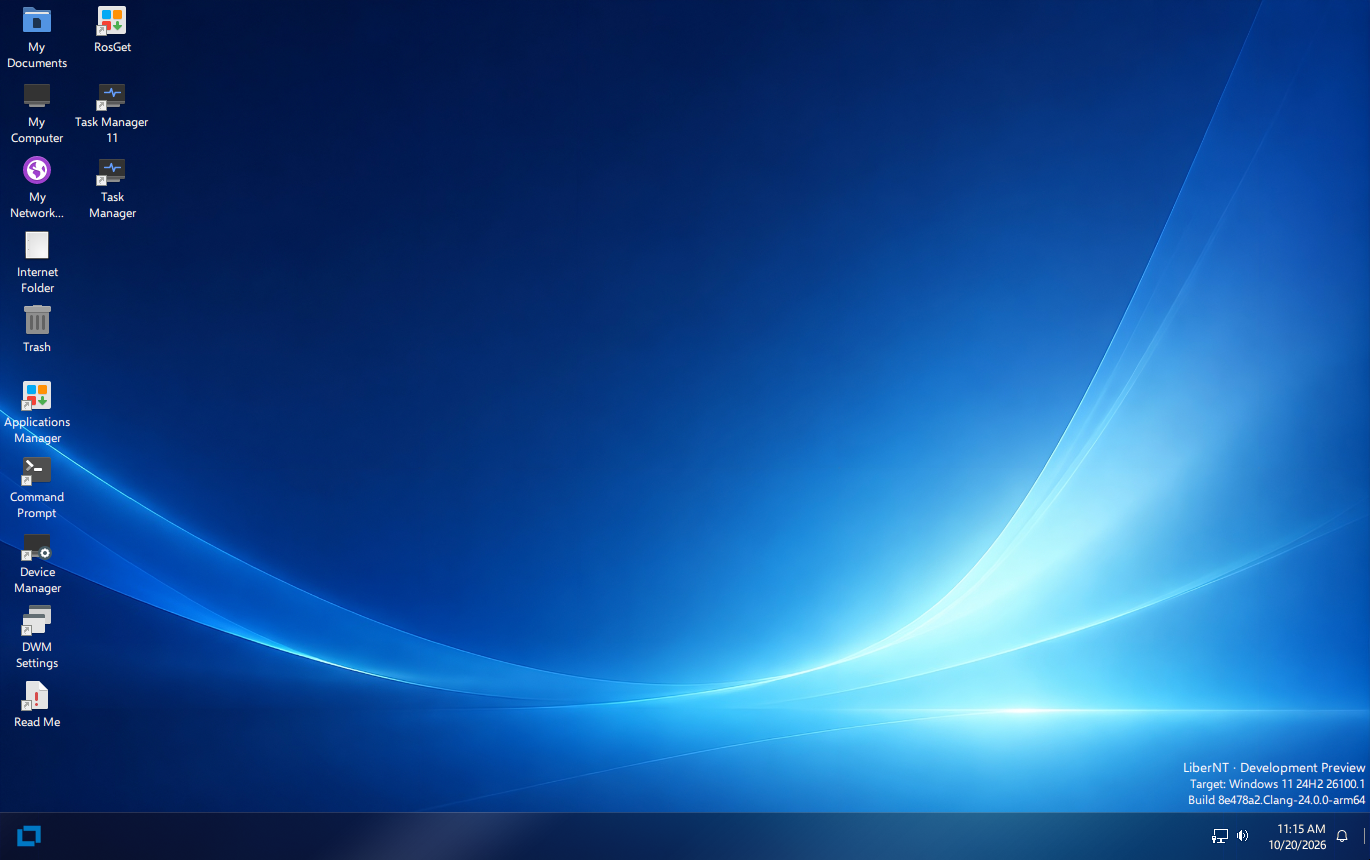
The LiberNT desktop on arm64 in QEMU, build nt10.0-043-2555. Credit: LiberNT/GitHub.
What LiberNT is
LiberNT is a free operating system built on the Windows NT architecture. Its README calls it a fork of ReactOS focused on modern hardware support, modern platform support and modern Windows NT compatibility work that can later be submitted upstream. It is not a Linux distribution and does not use the Linux kernel.
The project targets Windows 11 compatibility with room for experimental features. It focuses on 64-bit platforms, with prebuilt images for amd64, arm64 and riscv64. The repository is licensed under GPL-3.0, was created on May 4, 2026, and showed 456 stars and 30 forks when checked on October 21, 2026.
The legal footing is explicit. Per the README, LiberNT follows a clean-room approach: it studies Windows behavior through Microsoft's public documentation, SDK and WDK headers, public symbols and black-box testing. The project says it does not copy or transcribe proprietary Windows code, and it does not copy GPL code from Linux.
| LiberNT at a glance | Status per project |
|---|---|
| Base | Fork of ReactOS, GPL-3.0 |
| Compatibility reference | Windows 11 (NT10); Linuxiac reports Windows 11 24H2 |
| Prebuilt architectures | amd64, arm64, riscv64; PowerPC release images |
| Boot | UEFI and BIOS; GOP framebuffer and early display |
| Storage and buses | NTFS, NVMe, StorPort, SD/eMMC, PCIe, USB xHCI |
| Graphics | WDDM with Mesa; Direct3D 10, 11 and 12 work listed in release notes |
| x86 on Arm | WoW64 with FEX, a build option |
Windows 11, not NT5
ReactOS has historically targeted the Windows NT5 era, the architecture behind Windows XP and Server 2003. LiberNT's main branch is named main-nt10, and the project's release notes say the Windows 11 platform is now the default target. The October 5 build added the Windows 11 kernel export set on 64-bit targets, a native Direct3D 12 runtime and Direct3D 11.2 through 11.4 support.
That is a deeper change than a theme or a start menu. Windows 11 compatibility touches the kernel exports, the driver model, the graphics stack and the user-mode contracts that applications depend on. The October 14 release notes list a new console stack built on condrv.sys and conhost, Direct3D 10 on the native runtime, a Direct3D 11.1 display driver interface, and NTFS support for replaying the Windows 11 LFS 2.0 log so volumes mount read-write.
Linuxiac reported that LiberNT uses Windows 11 version 24H2 as its compatibility reference. The README does not name the exact build, so treat 24H2 as Linuxiac's reporting rather than a specification published by the project. The broader claim, that Windows 11 is the reference instead of NT5, is stated in the README.
The platform list
LiberNT's platform scope is wider than a typical ReactOS fork. The project ships prebuilt images for amd64, arm64 and riscv64, and includes PowerPC images in its release builds. The ARM64 work includes Raspberry Pi support and the RP1 I/O controller, which is the kind of board bring-up that matters for embedded and single-board use.
The boot path supports UEFI and BIOS, with a GOP framebuffer and early display support. Storage and bus work covers NVMe, StorPort, SD/eMMC, PCIe, Plug and Play and USB xHCI. Graphics use the Windows Display Driver Model with Mesa, and the ARM64 build can run x86 applications through WoW64 with FEX when that option is enabled.
LiberNT Setup is designed to behave like Windows Setup. Per the README, it lists drives, creates, deletes, formats, shrinks and extends partitions, and installs the system on NTFS with the EFI system partition it needs. Release images come as a preinstalled disk image, a VHD for virtual machines and a bootable installation ISO.
What works and what does not
The release notes show steady progress across the stack. The October 8 build added NVMe controller installation, NTFS compression and short-name tunneling, Windows 11-style driver installation and a writable LiveCD RAM drive. The October 14 build added NTFS replay for Windows 11 volumes, Direct3D 10 on the native runtime, xHCI fixes and more WoW64 handle handling.
Application compatibility is much narrower than those platform notes suggest. Linuxiac reported that the project's compatibility database had only five entries, all tested against a specific development build. Google Chrome, the open-source strategy game 0 A.D. and Command & Conquer: Yuri's Revenge were reported to work. Steam was listed as usable. The RPCS3 PlayStation 3 emulator started but was not classified as usable.
Linuxiac also reported that LiberNT replaces several ReactOS core components, including a new NVS memory manager and kernel pool implementation, a new cache manager, a new NTFS driver and an updated StorPort implementation with NVMe support. Those are Linuxiac's characterizations of the project; the README and release notes confirm the NTFS, NVMe and graphics work but do not use the same component names.
Experimental status
The README is blunt about readiness. The builds on the releases page are debug pre-releases for testing, and users are told to run them in a virtual machine or on spare hardware rather than a computer they depend on. That warning applies to the current October 14 build, not just an early alpha.
LiberNT also discloses its use of AI. Per the README, AI helps review and write code, and everything it writes is reviewed by a human. Before anything reaches the main branch, a person runs and validates the end-to-end tests. Contributors are asked to say in the pull request which parts AI helped with and how they tested them.
The project is active. The repository was pushed on October 21, 2026, and the release history shows multiple builds in October alone. That pace is encouraging for a young fork, but it also means the compatibility picture can change from build to build. A feature listed in one release note is not a promise that every application will work.
Our take: ReactOS has spent decades chasing Windows XP and Server 2003 compatibility. LiberNT is interesting because it aims at the modern NT10 contract, where 64-bit kernel exports, the driver model and the graphics stack matter more than running 20-year-old applications. The risk is that Windows 11 compatibility is a much larger surface, and five compatibility entries is not evidence that it has been covered. The project's own warning is the right frame: test it in a VM, not on your main PC.
FAQ
What is LiberNT?
LiberNT is a free operating system built on the Windows NT architecture and based on ReactOS. It targets Windows 11 compatibility, with prebuilt images for amd64, arm64 and riscv64.
Is LiberNT a Linux distribution?
No. It does not use the Linux kernel. It implements the Windows NT architecture and is a fork of ReactOS, which is itself an open-source Windows-compatible operating system.
Which architectures does it support?
The project ships prebuilt images for amd64, arm64 and riscv64, and includes PowerPC images in its release builds. ARM64 includes Raspberry Pi support.
Can it run Windows applications?
Some. Linuxiac reported that Chrome, 0 A.D. and Command & Conquer: Yuri's Revenge worked in the project's compatibility database, while Steam was usable and RPCS3 started but was not classified as usable. The database had only five entries.
Is it ready for daily use?
No. The current builds are debug pre-releases, and the README says to run them in a virtual machine or on spare hardware rather than a computer you depend on.
Does LiberNT copy Windows code?
No, per the README. The project says it uses public documentation, SDK and WDK headers, public symbols and black-box testing, and that it does not copy or transcribe proprietary Windows code or GPL code from Linux.
Bottom Line
LiberNT is a GPL-3.0 ReactOS fork targeting Windows 11 (NT10), with prebuilt amd64, arm64 and riscv64 images, UEFI and BIOS boot, NTFS and NVMe support, WDDM graphics and a WoW64 path that uses FEX on Arm. Its compatibility list is tiny and its builds are debug pre-releases, so it is a project to test in a VM, not a Windows replacement. The interesting part is the target: a clean-room NT implementation aiming at Windows 11 rather than the NT5 era.
Related: ReactOS Merges Wine 10.0 DirectX Stack: 498,000 Lines In, 119,000 Out.
Sources: LiberNT repository and README; LiberNT nt10.0-043-2555 release notes, October 14, 2026; Linuxiac, October 21, 2026; GitHub API metadata fetched October 21, 2026. All sources checked October 21, 2026.