
Project Reclaimer: Halo 3 Multiplayer on PC Rebuilt to Run 128 Players
By Indie Kings | October 23, 2026
Updated October 23, 2026: Project Reclaimer, a free standalone launcher that turns Halo 3 from Halo: The Master Chief Collection into an 128-player PC game with its own server browser, campaign co-op for sixteen and an expanded Forge, has pushed through two network updates in the 0.9.22 and 0.9.23 releases. Version 0.9.23 reworked how dedicated servers send packets after 0.9.22 fixed the big servers that dropped everyone after each game.
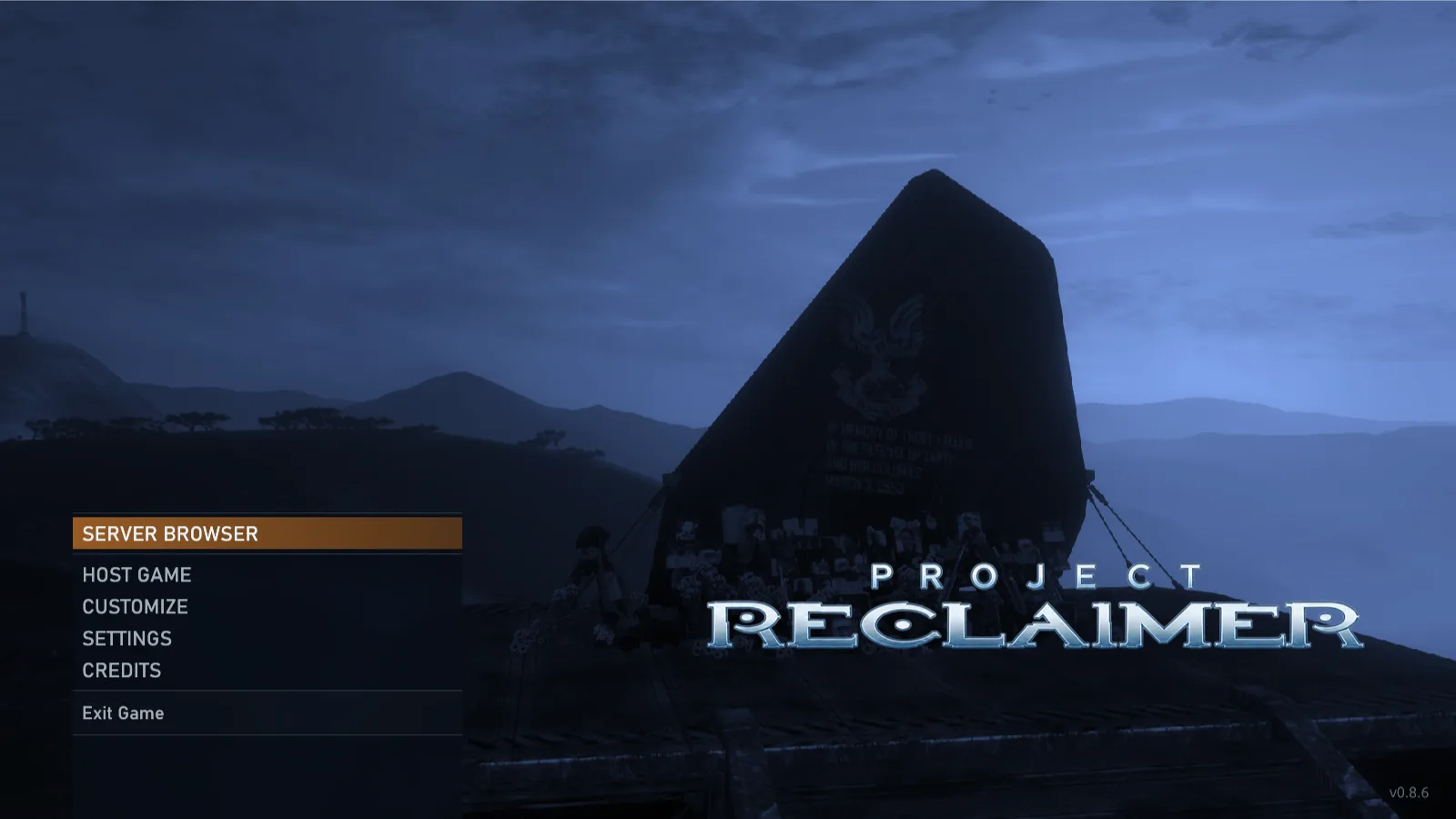
Image: Project Reclaimer's own main menu, screenshot captured from the site's release screenshots.
What Project Reclaimer is, and what it loads
The site's own description is the headline: a standalone launcher for Halo 3 from Halo: The Master Chief Collection, positioned to be the best way to play Halo 3 multiplayer on PC. It adds games for up to 128 players, four-player split screen that plays online, both campaigns plus Firefight in co-op, a theater that records every game, dedicated servers with a browser, playlists with lobby voting, scripted game modes, an expanded Forge with AI, moderation and anti-cheat, and all of it sits on top of your own copy of the game.
That last clause is the load-bearing one. The download contains only the launcher's own software, and the site is explicit that the download and the site contain only the project's own software and assets and assets: no game program files, maps, models, textures, audio or fonts. The launcher finds your Steam installation of Halo 3 multi-player and campaign from your disk and loads them itself, and the requirement that every player has their own copy is in the how-to-play guide, not just the fine print.
Our take: this is the shape a Halo 3 PC mod has to take to survive the Microsoft-player relationship. Loading the game you bought from your own disk, avoiding redistribution and keeping the game files untouched is the arrangement the site's legal page spells out in plain English. The FAQ elsewhere on our page also names ElDewrito as the reference for this project's tools, which is a citation line rather than a shipping arrangement, and this launcher is in a different position because it ships none of the game content in the first place.
128 players, one engine
Halo 3 shipped in 2007 for sixteen players. Project Reclaimer pushes the same engine to 128: two full teams of 64 or a free-for-all that actually mixes them. A 128-player game runs on your PC as a hosted game, with a dedicated server reaching 127 because the 128th slot belongs to the server itself. The Forge and the scripted game modes carry over to that size, which puts a Halo 3 engine behind what the site calls every screen in a full game: scoreboard that uses up to two full-size columns with scrolling rows, an in-game roster, carnage report and lobby that all scale, with chat, compressed voice, votes, moderation, ranks and stats for every one of the 128.
Sizing is not cosmetic. Since 0.9.17 the game allocates room for 2,048 shared objects and four times the effects budget of stock Halo 3, because a crowded fight empties the explosions, light volumes and spawned objects that a 16-player shooter budgets for, and things spawned with the old budget not appearing at all was the actual symptom.
| Capacity | Where it applies |
|---|---|
| 128 | Players in a game you host |
| 127 | Players on a dedicated server, with the server holding the 128th slot |
| 64 v 64 | Team games with two full teams |
| 8× | Halo 3's sixteen-player limit |
| 2,048 | Shared objects allowed in a full game, up since 0.9.17 |
Server browser, dedicated servers, masters
The server browser polls every community server it finds, so the map, game variant, player list and ping you see are live, and a compact grid gives you sixteen at once with search by server or player and filters for full, empty, private, modded, VPN-blocking or distant servers and servers on another version, plus favorites and direct connect. It opens from the game menu, so a group of you can switch from one server to another without leaving first.
Dedicated servers have real management tooling. One folder and one config file can spawn any number of servers on Windows, or Linux with Docker, one container per server, each with its own playlist, map, password and ping limit. They install the Workshop mods their playlists require, can update themselves to each new release, report to two master servers with backup master fallback, and, because community hosts live and die by port forwarding, the masters can try to introduce players to a listed server whose host never opened the ports.
Anti-cheat is part of the package rather than a response. Every server and hosted game has protection on by default, with enforcement the host controls: kicks and bans cover player ID, address and PC at the same time, so a new profile does not get around them.
Campaign, ODST and Firefight co-op
Campaign came with 0.9.19 and is the surprise of the group. Every mission of Halo 3 plays from your installed game, ODST's eleven missions join the list if that game is in MCC too, and campaign mods from the Steam Workshop or your Mods folder sit alongside them. Solo co-op lobby goes to sixteen players with up to four in split screen per PC, on a hosted game or on a dedicated server since 0.9.11, with join-in-progress and a hosted server that queues the next mission itself. Hosts pick mission, rally point and difficulty, and difficulty modifiers for enemy health and damage exist that grow with each player in co-op.
Character is not fixed. You play your own customized Spartan or Elite from the Customize screen, in your own armor, colors and emblem, or as a campaign-mod character, and co-op players without a campaign mod download it as they join. Halo 3's own split screen splits the view two, three or four ways, and Project Reclaimer extends it into the campaign and online play with per-player keybindings and sensitivity.
Forge built out of battle-tested parts
Forge is where the project shows its depth. The pieces are blocks in six shapes with 1,049 variants across every size, and every surface it uses comes from a real multiplayer map, picked by picture with the texture scaled to fit. The placement menu is its own, per the site, but the controls in common with ElDewrito are the ones that matter: Space grabs, right-mouse turns, left-mouse selects, prefabs, magnets and undo, and it installs the Forge maps and variants of ElDewrito into Maps and Game Modes folders for conversion.
The interesting part to me is the AI, which is not the usual Forge afterthought. You can place Spartans, Elites, Marines, Grunts, Jackals, Brutes and Hunters, set each one's team, targets, weapon, respawn time, and whether it moves, and it all works on dedicated servers too. Our read on it: it is a chase mode rather than a precision battle composer yet, but as a base for scripted modes it did not exist in stock Forge at all.
Every map's objects and other skies are on the table, and Forge can set a map's gravity, look, exposure and fog before you build. The object budget in Forge is the real story: the actual 640-limit cap lifted to 5,000 frozen objects, whose material and size you can still change where they stand.
Six scripted game modes
Six modes ship with the game. Gun Game climbs all twenty-four of Halo 3's weapons, with a melee kill from behind setting the victim back one. Growth starts everyone at a tenth of their size and grows you by the size of each player you kill. One in the Chamber is the single-bullet round you know, with one round per kill. Zone Control scores whoever holds the hill alone. Flood Infection is the campaign-Flood infection mode everyone expects. And a faction battles game mode gives every side a class choice before each life, with fourteen UNSC and fourteen Covenant classes including the Hunter added by 0.9.12.
All six are data files you can edit. A script describes what happens on spawn, kill and death, and the version-2 kernel adds class rosters, deployment points, faction names and environment for an entire round: timers, loops, invisible zones, HUD elements and team changes. The Megalo language of Halo: Reach's ReachVariantTool is a second supported input, and the site publishes the supported subset and a Megalo authoring guide for what it does accept.
The Theater, a real PC-era addition
Halo's Theater is unusually good at what it does and unusually slow to work with afterward. Project Reclaimer keeps the idea above the level of nostalgia by making the saved films actual video. Since 0.9.22 a film can export as an MP4 file, and pressing R while you watch writes an MP4 of your own camera at that moment, which is the part that Halo 3 never had. The HUD can be hidden for clean captures, and new players start with a random look and a two-word name, with a dice in the Customize screen for when even that feels like a decision.
What 0.9.22 and 0.9.23 actually fixed
The homepage's 0.9.22 note is one line with a big footprint: big servers no longer drop everyone after a game. The 0.9.23 fixes list on the download page carries the rest of that work in small items: servers that lose every player at once restart within seconds, a server crash when a player fires at a target that just left is gone, Exit Game closes the game completely, custom games open again after playing on a server, flipping through maps in a custom game lobby no longer runs out of memory, and character mods downloaded while joining show up at once. Small enough that you notice them when they break rather than when they land.
0.9.23 is a networking patch. A dedicated server now sends its packets from a thread that schedules players into turn, so the tick rate stays closer to 60 with many players, and a joiner catching up no longer holds up everyone else. Graphics data and sound settings the game would have sent again unchanged are no longer sent, each packet on the network carries a two-byte header instead of forty-three bytes of repeating address information, and recorded games no longer stutter for a moment every ten seconds while the Theater stores a keyframe.
One coalition lives in the notes: players and servers must update to 0.9.23 together, because different versions cannot play together. Anything you run a community around, players have to agree to carry one version between them at any time.
Setup, and what the site asks of you
Requirements are modest and specific. Windows 10 or 11 x64, plus your own Steam install of Halo: The Master Chief Collection with the Halo 3 Campaign and Halo 3 Multiplayer items installed in Steam's natural order. ODST stays optional. There is a graphics-driver floor of OpenGL 3.0 for the new menus, and about 350 MB of space on disk for the caches the first launch generates. The install goes in its own folder, not inside the game's installation folder, and every file you download has a SHA-256 checksum on the download page which the how-to-play page tells you to check first. From 0.8.7 on the launcher updates itself from the main menu, and a versioned installer name keeps old shortcuts working.
The site's own rules are worth repeating in plain law. Use it only with a copy of the game you own. Don't share the small file set a dedicated server copies from your own installation, because the site's phrasing is that those copies are for your own use: don't share them with others. You are also responsible for your own host, for your moderation policy, and for the laws where you run it.
The legal posture is careful, and so should you be
The legal page disclaims the usual affinity labels: this is an independent fan project not affiliated with, endorsed by, sponsored by or supported by Microsoft, Xbox Game Studios, Halo Studios, 343 Industries, Bungie, Activision or Valve or any of their subsidiaries and partners, and it uses trademark names in plain text only, describing compatibility. It is also honest about the work-in-progress nature of the software: it ships as is, with no warranty of any kind, and you use it at your own risk.
Our take on the risk portion is worth being explicit about, because the site's own disclosure does part of the work but not all of it. The site privacy section tells you that joining a server exposes your nickname, player ID and IP address to its host, that host logging of chat is on by default and configurable, and that a host-side device fingerprint exists, used only for kicks and bans, shown only in the host's moderation tools, and kept only if you were kicked or banned. That is a strong anti-abuse reservation, and it is one of the reasons this game requires you to be okay with community hosts, not just community tech. Treat every server as someone else's machine that is listening to your traffic. If you care about your Battle.net or Microsoft account standing, the project says nothing about Microsoft having reviewed it, and you should not be the person to find out what the boundary is on an account you cannot reopen. Play on it on a separate account if you can, keep the game files unmodified to match the site's distribution promise, and read the anti-cheat section as that of a third-party system, not as SAFETY clearing from Microsoft.
FAQ
Do I need to buy or install Halo 3 separately?
You need your own Steam copy of Halo: The Master Chief Collection, with the Halo 3 Campaign and Halo 3 Multiplayer components installed, which is how Steam packages them under that game. The launcher loads the game from your own installation; the download contains no game files.
What is the player count?
Up to 128 players in a game you host, and 127 on a dedicated server, since the server itself is the 128th slot. Team games run two teams of 64, or everything can be a free-for-all.
Which platforms are the dedicated servers on?
Windows, or Linux with Docker using one container per server. Each server has its own playlist, map, custom game or campaign mission, optional password and ping limit, and updates itself.
Does ODST come along?
Yes, if you have Halo 3: ODST installed in MCC its eleven campaign missions join the list, plus a Firefight page with its ten maps, playable solo or host co-op, on your PC or on a dedicated server.
Is the source code available?
Not yet. The site says the source stays private for now, with the goal of eventually releasing the project as open source. Until that happens you are using someone else's binary without a building option.
Should I worry about Microsoft or Steam policy?
The project is not endorsed by any of the Halo rights holders, and the launcher has no accounts of its own, only local profiles. Where your Microsoft account standing is concerned, weigh it yourself. Use your own purchased copy, don't share server file sets, and consider a separate account for community servers.
Bottom Line
Project Reclaimer is the practical answer to the question of what a PC Halo 3 multiplayer community should look like. The core insight is simplest: treat the engine as the platform and never eliminate it, because an out-of-date engine for a 16-player game on a modern PC is waiting to become the target of a modded server with 128 players, a new campaign co-op lobby and Forge that got an editor's list of features. Our take: it is a large and cross-cutting feature set, and most of of it is aimed at making big community games run well, which is what the 2,048-object budget, server scale fixes and anti-cheat point toward.
The limits are real and worth remembering when you look at the polish. The source is private today, the build is early and the FAQ is right to send you to the Discord, and your network posture depends on community hosts, not on you. But every item already shipping has a real release note behind it, self-updating from inside the launcher since 0.8.7, and for Halo 3 player counts alone we judge it the most complete option we have summarized this year, this blog's framing rather than the site's. If you love the game, try it. Use your own copy, don't share the server files, and treat the account you use as one you would be willing to lose.
Sources
- Project Reclaimer homepage: overview, 128-player section, screenshots and 0.9.22 notice, accessed 23 October 2026
- Project Reclaimer Download page: 0.9.23 notes, installer naming, SHA-256 and release process, accessed 23 October 2026
- Project Reclaimer How to play guide: requirements, setup folders, self-update process, accessed 23 October 2026
- Project Reclaimer Legal & privacy page: trademark disclaimers, no game content, data and device-fingerprint disclosures, accessed 23 October 2026
Related: ElDewrito 0.6 (Halo Online) - Release Trailer | Halo 3 on The Master Chief Collection Arriving July 14th | Halo 2 Decompilation: 9,383 Functions Match Byte for Byte on Original Xbox