
Samsung 2027 Memory: 80% Already Booked Before the Year Starts
By Indie Kings | October 21, 2026
Updated October 21, 2026: Samsung has reportedly booked about 80% of its planned 2027 memory output through long-term agreements, according to KB Securities, leaving hyperscalers to compete for the last 20%. The estimate lands as Micron faces a one-day strike at its Taoyuan plant in Taiwan on October 22 and Dell's CEO warns the shortage could last four years.
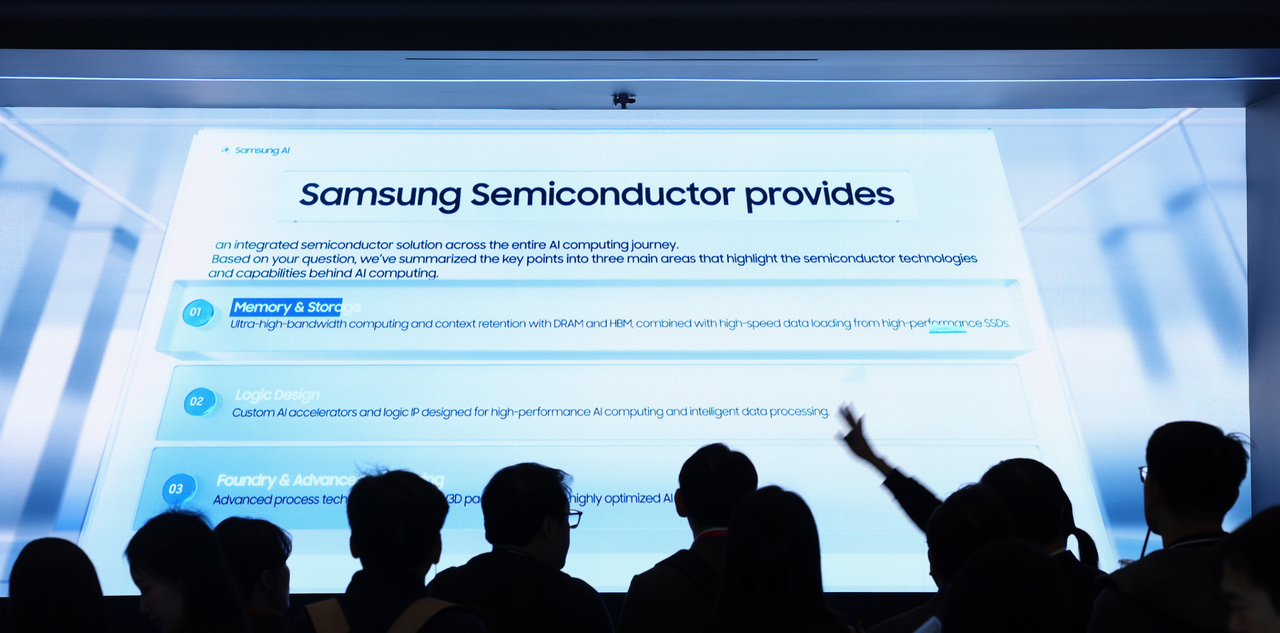
Samsung Electronics' semiconductor booth at SedEx2026 in Seoul. Credit: Newsis via The Korea Herald.
The 80% number
KB Securities estimates that Samsung has already secured roughly 80% of its planned 2027 memory production through long-term agreements. Kim Dong-won, head of research at the brokerage, said the figure covers five-year contracts for 70% of Samsung's planned conventional DRAM and NAND output, plus supply commitments for all of its projected high-bandwidth memory production.
"Samsung is estimated to have already secured approximately 80 percent of its planned memory production for 2027 through long-term supply agreements," Kim said in a report released Tuesday, per The Korea Herald. The remaining 20% is not sitting on a shelf. Kim said competition among hyperscalers for that uncontracted output is still going.
The brokerage also expects Samsung's 2027 operating profit to reach 555 trillion won, or about $417.6 billion, up 51% from an estimated 367 trillion won this year. That is a forecast from KB Securities, not company guidance. The useful part for buyers is the contract coverage, because it shows how little 2027 memory is still available at spot prices.
| Samsung's 2027 memory segment | Covered by long-term agreements | Contract detail |
|---|---|---|
| Total planned memory output | About 80% | Remaining 20% still contested by hyperscalers |
| Conventional DRAM and NAND | 70% | Five-year contracts with global technology companies |
| High-bandwidth memory | 100% | Entire projected HBM output under supply commitments |
Source: KB Securities estimate reported by The Korea Herald, October 20, 2026.
HBM takes the rest
HBM is the part of the memory market that AI accelerators have pulled away from the PC supply chain. KB Securities expects Samsung's HBM average selling prices to rise 100% to 150% year over year in 2027, with HBM4 reaching 80% of the company's HBM revenue, per The Korea Herald.
The industry pattern is the same at Samsung's rivals. Micron CEO Sanjay Mehrotra said on the company's September 30 earnings call that more than 75% of Micron's planned 2027 output had already been committed, according to The Korea Herald. SK hynix said in July that it had finalized long-term agreements with around 10 major customers.
That matters to gaming PCs even though HBM does not go into a GeForce card. HBM and conventional DRAM compete for wafer starts, packaging capacity and the same limited pool of memory test equipment. When data center buyers lock up HBM and a large share of DRAM, the consumer market gets what is left, and it pays the spot price for it.
PC Gamer's report draws a consumer consequence from the same note: a double-digit quarter-over-quarter price increase for consumer memory after the new year. That is PC Gamer's forecast, not a shelf tag. It does mean the start of 2027 is the window to watch, because that is when the 2027 contracts and the consumer allocation start to show up in retail pricing.
Micron's one-day strike
Micron's Taoyuan union will hold a one-day strike in Taiwan on October 22, Reuters reported via Tom's Hardware. Workers are asking for concrete terms for this year's bonus and a transparent formula for sharing future profits. Talks between the company and the union ended without an agreement in September, and employees approved industrial action in early October.
The timing is awkward because fabs are built to run around the clock. Tom's Hardware reported that the strike will have a minor impact on Micron's memory output, because a one-day warning strike does not necessarily stop all manufacturing if management prepares for it. The Taichung union, which represents Micron's largest Taiwan site, is scheduled to meet the company for mediation on the same day, but it has not authorized a strike.
Micron employs about 15,000 people in Taiwan, and its plants there make commodity DDR5 and LPDDR as well as HBM. A single day at one site is small next to Samsung's 2027 contract book. It is still a labor risk sitting on top of a supply chain that has already sold most of next year forward.
Dell's four-year warning
Michael Dell told CNBC's David Faber that the mismatch between demand and supply gets worse next year. "I do think it gets worse next year in terms of demand and supply," Dell said, according to Benzinga's report on the interview published by Yahoo Finance on October 16. When Faber asked specifically about memory, Dell added: "Maybe it's a four-year problem because there's just not enough supply."
Dell's reasoning is about construction time. New fabs take about four years to build, so plants planned today may not begin production until 2029 or 2030. Dell is also carrying a record $95 billion backlog of AI server orders, which gives the company a direct financial reason to care about every DRAM and HBM allocation it can secure.
That does not mean every memory product stays scarce for four years. It means the capacity being added now is aimed at the AI buildout, and the consumer market should expect to compete for the marginal supply. The 80% contract figure and Dell's four-year comment are two versions of the same signal: buyers with multiyear agreements are locking in supply before it reaches the spot market.
What buyers should watch
Three dates matter more than the daily spot-price headlines. The first is October 22, when the Micron strike and the Taichung mediation happen. The second is Samsung's detailed third-quarter earnings on October 29, which will show how much of the HBM optimism is already in the numbers. The third is the start of 2027, when the new consumer memory pricing is expected to land.
For PC builders, the practical read is narrower than "buy everything now." DDR5 kit prices can move independently of HBM contract prices, and availability varies by capacity and speed bin. The contract data points to higher prices after the new year, not to an instant shortage of every kit on a retailer's shelf.
The bigger risk is a repeat of 2026: a headline about one factory or one strike gets treated as the whole story, while the actual constraint is multiyear allocation. Watch the contract coverage, the HBM4 ramp and the fab timelines. Those are the numbers that set the floor for consumer prices.
Our take: the memory market has moved from spot pricing to forward contracts, and that changes how these stories should be read. One repair shop or one labor action is noise next to 80% of 2027 output being booked before 2026 ends. The caveat is that KB Securities is making an estimate, not publishing Samsung's order book, and the uncontracted 20% could still be allocated in ways that surprise the spot market.
FAQ
How much of Samsung's 2027 memory output is already booked?
About 80%, according to a KB Securities estimate reported by The Korea Herald on October 20, 2026. The figure covers long-term supply agreements, not confirmed revenue.
Who is buying the remaining 20%?
Hyperscalers and other large buyers are still competing for the uncontracted output, according to KB Securities. The remaining supply is the part that will be priced closest to the spot market.
Will consumer RAM prices rise again?
PC Gamer projects a double-digit quarter-over-quarter increase for consumer memory after the new year, based on the KB Securities note. That is a forecast, and retail pricing can lag or diverge from contract pricing.
Why does HBM matter to gaming PCs?
HBM does not go into gaming GPUs, but it uses DRAM wafers and advanced packaging capacity that also serve conventional memory. When HBM is fully committed, it tightens the overall memory supply chain.
What is the Micron strike about?
Micron's Taoyuan union is holding a one-day strike on October 22 over 2026 bonus terms and a clearer profit-sharing formula. Reuters reported that the stoppage would have a minor impact on Micron's memory output.
Is the shortage really a four-year problem?
Michael Dell said it could be, because new fabs take about four years to build and may not produce until 2029 or 2030. That is his assessment, not a fixed timeline for every memory product.
Bottom Line
Samsung's 2027 memory book is about 80% full, HBM is fully committed and the last 20% is being fought over by hyperscalers. Micron's one-day Taoyuan strike is small next to that contract math, but it adds labor risk on October 22. Dell's four-year warning explains why the capacity being built now will not rescue 2027. For PC builders, the signal is higher consumer memory prices after the new year, with availability depending on the capacity and speed bin.
Related: Micron Says RAM Shortage Runs to 2028 With Much Higher Prices [2026] and AMD: GDDR6 Memory Costs to Board Partners Jump 10% From October 1.
Sources: KB Securities estimate reported by The Korea Herald on October 20, 2026; PC Gamer on October 21, 2026; Tom's Hardware on October 21, 2026; Benzinga via Yahoo Finance on October 16, 2026. All sources fetched October 21, 2026.