
Why MSI Claw Beats Steam Deck This Prime Day
Updated October 7, 2026: PC Gamer hardware writer Andy Edser says the OG MSI Claw A1M is the handheld he would buy over a Steam Deck this Prime Day, thanks to its $562.99 Best Buy price, 1 TB SSD, 16 GB of LPDDR5x memory, and a Core Ultra 7 155H chip. Indie Kings recapped his column below, with every figure tied back to his reporting.
By Indie Kings | October 7, 2026
Why the Steam Deck slipped, per the columnist
Andy Edser opens his October 7, 2026 column for PC Gamer with a blunt framing: the Steam Deck used to be the budget handheld champion, but no longer. He pins the slide on the memory crisis, which he describes as one of the more painful aspects of the current cycle for handheld gaming PCs.
Per Edser, the knock-on effect hit Valve directly. The LCD Steam Deck model is now gone from Valve's store pages, and what remains on the shelf is the OLED lineup, which he says starts at $789 for the 512 GB version. He is careful to praise the hardware itself: the Steam Deck OLED is a lovely thing, in his words, and still a capable handheld.
His complaint is price-to-silicon fit. The AMD APU inside the Deck is showing its age by October 2026, and Edser argues the price no longer reflects that. That gap between old chip and current price is exactly what opens the door for rivals, and the column names the MSI Claw A1M as the alternative he would pick without a second thought at this Prime Day pricing.
The broader context he sketches matters for buyers. Many handheld gaming PCs are priced out of reasonable consideration right now because of memory-induced price increases. Any machine that lands near or below $600 stands out, and Edser's column treats the Claw A1M's $562.99 Best Buy listing as the standout of the event.
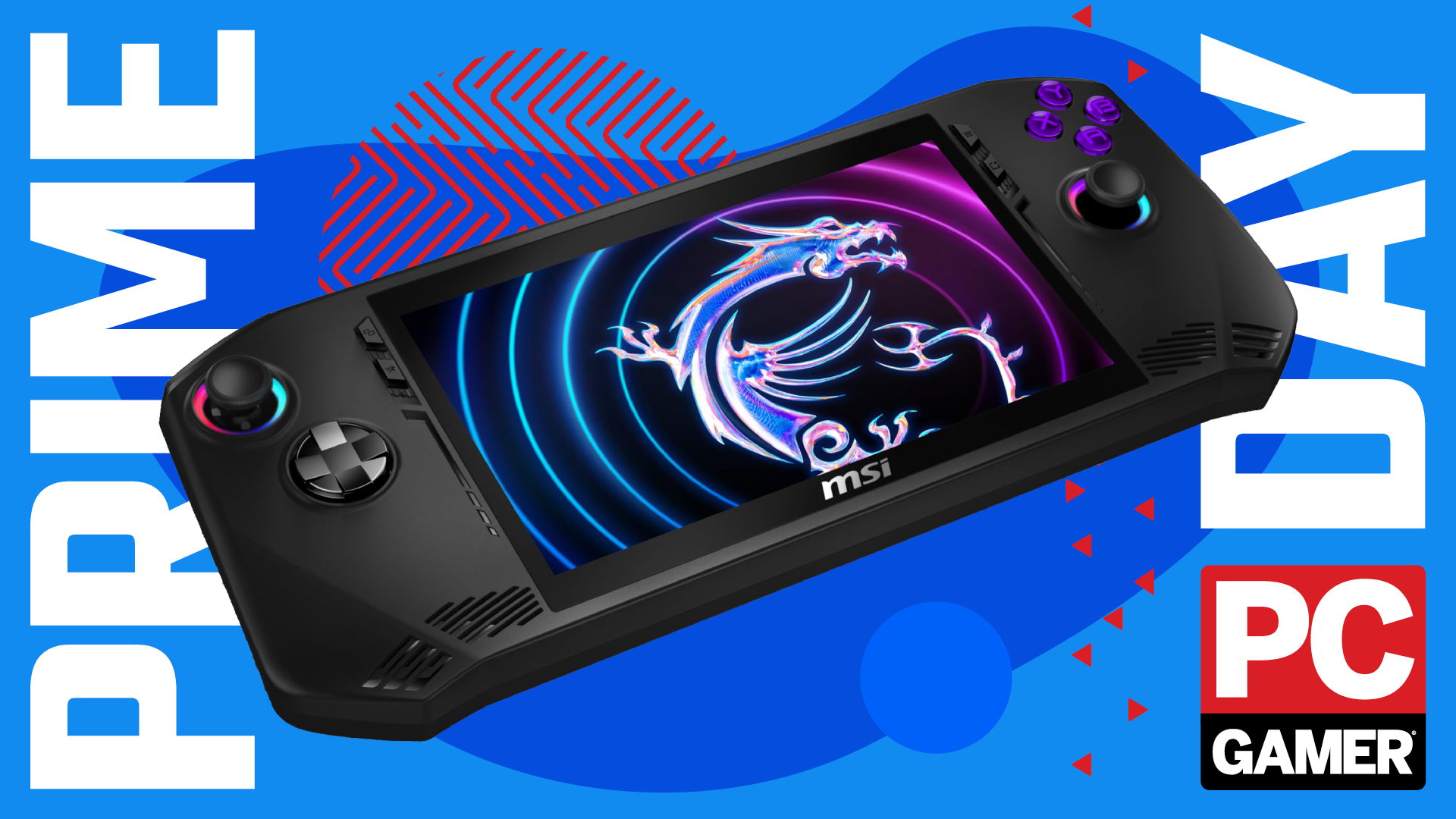
The value case for the Claw
Edser found the MSI Claw A1M at Best Buy for $563, marked down from $749.99, a saving he lists as $187. He frames the purchase as a straight value call: at this price, he would pick the Claw over Valve's machine without a second thought.
The pitch centers on the package inside the shell. The unit carries an Intel Core Ultra 7 155H, a Meteor Lake-era processor, with eight Xe cores handling graphics. That is the same eight-Xe-core graphics count Edser notes for the newer Core Ultra 7 165H, which is a useful benchmark for shoppers trying to gauge where the older chip sits.
He does not oversell it. The Core Ultra 7 155H is not, in his phrasing, the most impressive of graphics-munching chips. But his read is that it should do fine with handheld gaming staples, and that XeSS upscaling assistance keeps more demanding games in reach. For indie game libraries in particular, he says it does just fine.
For the sort of cash the Deck OLED now commands, roughly $789 and up, the Claw at $562.99 undercuts by a wide margin while shipping with double the storage of the base Deck OLED. That is the heart of Edser's argument: the Deck's value crown moved, and the Claw picked it up for this Prime Day.
Key specs, per columnist
The column lists a compact spec line for the MSI Claw A1M. Indie Kings reproduces it below exactly as Edser frames it, since it is the deal's core reference point.
| Spec area | MSI Claw A1M, per Andy Edser |
|---|---|
| Processor | Intel Core Ultra 7 155H (Meteor Lake) |
| Graphics | Intel Arc, 8 Xe cores, XeSS upscaling |
| Display | 7-inch, 1080p, 120 Hz panel (not OLED) |
| Memory | 16 GB LPDDR5x |
| Storage | 1 TB SSD |
| Operating system | Windows 11 native; SteamOS possible with fiddling |
| Listing price | $562.99 at Best Buy, was $749.99, save $187 |
Every entry in that table comes straight from Edser's column. The one trade-off he flags openly is the display: you do not get a fancy OLED screen on the Claw. His reaction is that the 7-inch 120 Hz 1080p panel looks pretty good though, so he would not feel too shortchanged there.
Screen and storage, and why 16 GB plus 1 TB matters
Handheld buyers have been burned by tight base storage across the market, and Edser's column leans hard on the Claw's roominess. Sixteen gigabytes of LPDDR5x and a proper 1 TB SSD is, in his words, plenty of game installs. He greets the 1 TB drive with audible relief.
Compare the rivals he names. The ROG Xbox Ally (non-X) tempts at $599, but it carries 512 GB of storage, which is half what the Claw offers. The Deck OLED starts at $789 for its own 512 GB version. On sheer gigabytes per dollar, Edser's table of facts puts the Claw well ahead at Prime Day prices.
OS flexibility is the other quiet win he highlights. The Claw ships as a Windows 11 native machine, so it plays nicely with PC storefronts out of the box. Edser adds that you could always cram SteamOS on it with a bit of fiddling if you want a console-style experience, though he does not push that as the main reason to buy.
| Machine | Screen | Storage | Price named by Edser |
|---|---|---|---|
| MSI Claw A1M | 7-inch 1080p 120 Hz, no OLED | 1 TB SSD, 16 GB RAM | $562.99 at Best Buy |
| Steam Deck OLED (base) | OLED | 512 GB | starts at $789 |
| ROG Xbox Ally (non-X) | 7-inch 1080p 120 Hz | 512 GB | $599 |
| MSI Claw 8 AI+ A2VM / Claw 8 EX AI+ CG3EM | newer Claw models | not discounted | $1,000+ |
That table mirrors the comparison Edser draws inside the column rather than introducing new numbers. One note on the Deck: the LCD model is gone, so the OLED's $789 entry is the realistic new floor for Valve hardware, per his account of the current store pages.
Performance context, per Edser
Edser is upfront about where the OG Claw sits in MSI's own lineup. The newer Claw 8 AI+ A2VM and Claw 8 EX AI+ CG3EM overtake it considerably in the performance stakes, and so do many other handhelds. If raw benchmark rank is your only axis, the A1M comes last among MSI's current family.
But price reframes everything. The later MSI models are still $1,000+, and the broader handheld gaming PC market is still wracked by memory-induced price increases. Against that backdrop, Edser says the OG Claw makes a whole lot of sense for $563. Performance per dollar, not raw performance, is the column's thesis.
He also keeps expectations in check on both sides. The Claw is not exactly a graphics powerhouse, he writes, but neither is the Steam Deck, and the Deck does very well as long as you keep expectations reasonable. He applies the same fair standard to the Claw: keep expectations reasonable, use XeSS where it fits, and the Meteor Lake chip handles handheld staples fine.
For the Indie Kings audience, that is the practical translation: this is not a AAA-at-max-settings box. It is a machine for indie libraries, emulation-adjacent use, and well-tuned settings in heavier games, the kind of portfolio where an eight-Xe-core Arc part with XeSS upscaling punches above its sticker price.
Rivals and alternatives, per the PC Gamer column
Edser names three direct comparators in the column. First, the newer MSI Claw 8 AI+ A2VM and Claw 8 EX AI+ CG3EM, which beat the OG model on performance but sit at $1,000+, well above Prime Day budget territory. Second, the Steam Deck OLED at $789 for 512 GB, which he likes as hardware but not at current pricing relative to an aging APU.
Third, the ROG Xbox Ally non-X at $599. Edser calls it very tempting at that price, then disqualifies it on storage: he would want more than 512 GB of installs on a handheld, which leaves the Claw's 1 TB as the tiebreaker. His verdict sentence is that for this sort of cash he would save some pennies and pick up the Claw instead, and that readers should give it some serious consideration too.
He also gestures at the wider market wound. Related PC Gamer coverage he links estimates that Steam Deck sales have plummeted by around 80 percent since the massive price hikes earlier this year, and the memory supply crisis has not spared Valve. That environment is why a 2019-era-class Intel chip in a $563 handheld suddenly looks like the smart buy of October 2026.
Edser's buy-vs-wait framing is simple. Newer silicon exists, most visibly in the Claw 8 series and in AMD-based rivals, but it costs nearly double. If you want to play this month rather than next year, and your library leans indie or mid-tier, the column's recommendation is clear: the OG Claw is the value move this Prime Day.
FAQ
Why is Edser recommending the MSI Claw over the Steam Deck?
Because of price and specs. The Claw A1M is $562.99 at Best Buy with 1 TB of storage and 16 GB of RAM, while the only new Deck left is the OLED starting at $789 for 512 GB.
What chip is inside the MSI Claw A1M?
An Intel Core Ultra 7 155H, a Meteor Lake-era processor with eight Xe cores for graphics. Edser notes it matches the graphics core count of the newer Core Ultra 7 165H.
Does the Claw have an OLED screen?
No. It uses a 7-inch 1080p 120 Hz panel that Edser says looks pretty good though, so he does not feel shortchanged.
How much did the Claw A1M drop for Prime Day?
It was $749.99 and is now $562.99 at Best Buy, a saving Edser lists as $187.
Is the OG Claw faster than MSI's newer handhelds?
No. Edser says the Claw 8 AI+ A2VM and Claw 8 EX AI+ CG3EM overtake it considerably in performance, but those models are still $1,000+.
Can I run SteamOS on the Claw?
Yes, with effort. It ships as a Windows 11 native machine, but Edser says you could cram SteamOS on it with a bit of fiddling.
Bottom Line
Andy Edser's October 7, 2026 PC Gamer column makes a narrow, well-sourced case: the Steam Deck OLED is lovely but aging and now starts at $789, while the OG MSI Claw A1M at $562.99 pairs a Core Ultra 7 155H with 16 GB of RAM and a full 1 TB SSD. Newer handhelds beat it on raw performance, but they cost $1,000 or more. Per Edser, the Claw is the value pick this Prime Day, and Indie Kings agrees with the logic of that call for indie-first libraries.
Sources: PC Gamer column by Andy Edser, "I'd buy this MSI Claw over a Steam Deck this Prime Day," October 7, 2026, at https://www.pcgamer.com/hardware/handheld-gaming-pcs/id-buy-this-msi-claw-over-a-steam-deck-this-prime-day/. All prices, specs, and model names above are attributed to that column.