
Highball: Windows Games on Apple Silicon With a CC0 Compatibility Database
By Indie Kings | November 4, 2026
Updated November 4, 2026: Highball is a native macOS app and CLI that sets up Wine, DXMT, D3DMetal and DXVK for you, installs Steam or connects your Epic library, and tells you honestly what runs, what does not, and which renderer to use. It stands at 2,146 stars, 89 forks and 95 open issues under GPL-3.0, and the latest releases are 0.10.25 on November 3 and 0.10.24 on November 1. Its real product is not the app. It is an open CC0 compatibility database.
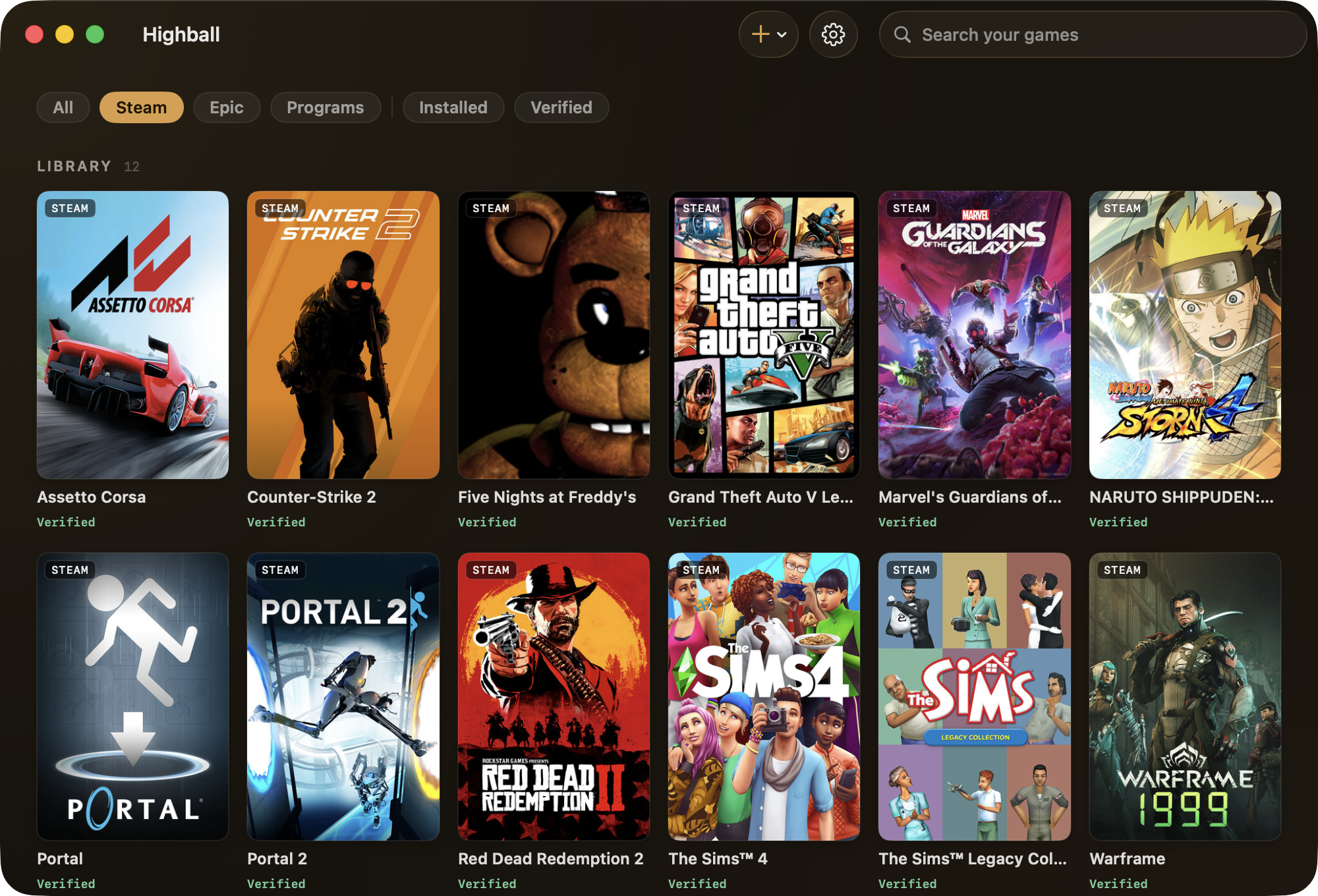
Image: Highball's Library under the Steam filter, twelve games in one cover grid, each with its source badge and the open database's verdict, all Verified. Credit: gauthierpiarrette/GitHub.
Per the official repository README, Highball runs Windows games on Apple Silicon. It is free, open source, and never locked to one Wine build. The app sets up Wine, DXMT, D3DMetal and DXVK for you, installs Steam or connects your Epic library, and tells you honestly what runs, what does not, and which renderer to use. The difference from every other tool in this niche is the data. Every verdict in the app comes from an open CC0 compatibility database: verified runs, per-game renderer verdicts, and a kernel-anti-cheat blocklist, with provenance on every claim.
That database is a standalone dataset any tool can build on, browsable at the project site. The idea is that you can check whether your game runs before downloading a byte. Verified runs, community reports and machine-derived predictions are labelled separately, so you always know which kind of claim you are looking at, and the kernel-anti-cheat titles are flagged as impossible before you download 80 gigabytes. For a category that has historically run on forum posts and anecdotes, a machine-readable CC0 dataset with provenance on each claim is a genuine contribution.
The database is the product
The README says it in one line: the database is the product. Recipes, meaning declarative instructions of the form "Steam needs sync none, this game needs DXVK", are versioned CC0 data that anyone can use, CrossOver users included. The author says they do not know of another machine-readable CC0 recipe dataset for Wine on Mac. That claim is narrow enough to be checkable and it is the correct thing to be proud of.
The provenance discipline is visible in the contribution rules. A verified recipe carries lastVerified with the engine id, the macOS version and the chip, so stale data is visible rather than silently wrong. Game results filed through the CLI open a pre-filled compatibility report that accepted submissions are folded into by CI. Per-launcher quirks are tracked in each recipe's knownIssues field rather than in a wiki. The database has its own repository, and the app's recipes and database are licensed CC0 while the app itself is GPL-3.0.
That licence split is deliberate and it is the structural answer to the failure mode of every tool in this space. The app is GPL-3.0 and the data is CC0, so anyone can rebuild and redistribute it for free. The README states that Highball has no paid tier and never will, because a locked paid tier could never hold against those two licences. It is a credible commitment rather than a promise, which is a rarer thing.
| Renderer | What it is | How Highball treats it |
|---|---|---|
| WineD3D | The built-in Wine renderer | Directory overlay, selected per launch |
| DXVK | Vulkan-based translation layer | Directory overlay, selected per launch |
| DXMT | D3D11 on Metal | Directory overlay, selected per launch |
| D3DMetal | Apple's Game Porting Toolkit layer | Gated behind explicit acceptance of Apple's license, never redistributed |
The concrete numbers are the kind of thing the database makes possible. Cyberpunk 2077 runs at 60 to 82 fps on an M5 with D3DMetal and FSR 2.1. Red Dead Redemption 2 plays on an M1 Pro after a MoltenVK fix that is now a pull request upstream. Renderer switching, 32-bit apps through Wine's WoW64, Windows runtimes, ReShade, an Epic library through Legendary and a GOG library through gogdl all work.
One button, and the long first run
Installation is one button after the download. Drag the app to Applications, open it, press Get started, and Highball installs Rosetta if needed, downloads the engine and prepares a Windows environment, then asks where your games are: Steam, Epic, or a Windows program you have. It is notarized for macOS 14 and later, and it is also available through Homebrew as a cask.
The first run takes a while, and the README says so without softening it. The engine download is a few hundred megabytes, and Steam's first launch unpacks its own 235 megabyte client. Under Rosetta that can take 15 to 25 minutes. The strip at the bottom of the window shows the step, the elapsed time and the range it usually takes. If it stalls, relaunch and it resumes. Everything the app creates lives in one folder under the user's Library Application Support, and nothing touches system directories. Deleting that folder is a full uninstall.
The interaction details are right. Command and Control keys are mapped to Ctrl and Option to Alt inside Windows apps so Alt-based game bindings keep working, and that mapping can be turned off per environment for Wine's default behaviour. The CLI does everything the app does, from installing an engine and accepting the Apple license to creating a bottle from a recipe and running Steam in it. Recipes and database paths resolve relative to the current directory, with the database repository expected as a sibling folder.
Six launchers, six different answers
Steam and Epic work on the default engine, with Epic going through Legendary. Rockstar, the EA app and Ubisoft Connect draw their sign-in windows in an embedded browser that needs Highball's Wine 11 engine, built from the CrossOver 26.3 tree. The app offers that engine when a game needs it, and lets you move an environment to it in Settings. Rockstar signs in and runs GTA V and Red Dead Redemption 2. The EA app signs in and runs The Sims 4. Ubisoft Connect and Battle.net show their sign-in windows but no game has been played through them yet. GOG Galaxy still comes up black, so you cannot sign in through it.
Connect GOG does Galaxy's jobs instead, through Heroic's gogdl and comet: you sign in on GOG's page in your browser, and your GOG library installs straight into an environment with its covers, achievements and cloud saves. GOG games installed from offline installers show up as GOG games too. Each launcher case is tracked in its recipe's knownIssues, which means the gaps are documented next to the data rather than in a FAQ.
The architecture is small enough to state in one paragraph. The CLI and the app are thin views over HighballKit. An engine is a manifest-defined bundle of Wine, runtime libraries and renderer overlays laid out under an engines folder. A bottle is a Wine prefix plus a bottle.json file. Renderers are directory overlays selected per launch by prepending to the DLL path. Recipes are declarative JSON steps covering installer, registry, winetricks, sync, renderer, pin, copy, file and note, applied to a bottle. D3DMetal is gated behind explicit acceptance of Apple's Game Porting Toolkit license and is never redistributed in the repository.
Built to survive what killed Whisky
The niche has a cautionary tale: Whisky was archived in 2025. Highball is built to avoid the ways these tools tend to die, and the README lists them. Engine-agnostic, with every patch public. Engines are assembled from pinned, SHA-256-verified builds, using upstream releases where they exist, and where a game needed a fix nobody ships yet, the patch and the build script are in the repository's spike folder, the artifact is a checksummed release asset, and the patch goes upstream. The README names a MoltenVK change for Red Dead Redemption 2 and a Wine change for Guardians of the Galaxy as examples, and notes that an engine update is a JSON pull request. The database is the product and is CC0. The project is additive to the ecosystem: bugs go upstream, donation links point at the upstream Wine builds and DXMT, and if you want commercial-grade support you should buy CrossOver, which is described as the paid and supported option that funds most of Wine's Mac work.
The funding model is the part worth underlining. Highball has no paid tier and never will. The app is GPL-3.0 and the data is CC0, so anyone can rebuild and redistribute it for free. When the author of a free tool in this space tells you to buy the commercial alternative for support, that is a signal about the project's incentives that no feature list conveys.
The licence stack is stated cleanly. App, CLI and HighballKit are GPL-3.0. Recipes and database are CC0-1.0. Wine is LGPL, DXMT is MIT and LGPL, DXVK is Zlib, and D3DMetal is Apple-licensed, non-commercial, downloaded separately and never modified. Nothing is fudged.
Where a 0.10 series project stands
Highball was created on August 23, 2026, is written in Swift, and is GPL-3.0. It holds 2,146 stars, 89 forks and 95 open issues, and the README's beta badge says "Beta, working end to end", with a one-button setup into Steam login and game, the graphics mode picked per game from the database, msync-accelerated launches, and auto-updating. Release 0.10.23 on October 31 drew 3,807 downloads, 0.10.22 on October 20 drew 12,065, and the two November pre-releases drew 53 and 170 respectively. The project pushes almost daily.
The open issues count is the honest counterweight to the star count. Ninety-five open issues in a project this size means rough edges are expected, and the README's own beta label says so. The first-run time under Rosetta, the black GOG Galaxy window, the two launchers with no game played through them yet, and the need to accept Apple's Game Porting Toolkit license before D3DMetal is usable are all documented rather than discovered.
Our take: we think the CC0 recipe database is the real contribution here, and it matters more than the app. Engine-agnostic assembly from pinned and verified builds, every patch public and pushed upstream, and a data layer anyone can reuse including CrossOver users. That is how this category survives its next Whisky. The app is the convenient front end for a dataset that outlives it.
FAQ
Is Highball free?
Yes. Per the repository README, there is no paid tier and never will be. The app, CLI and HighballKit are GPL-3.0 and the recipes and database are CC0-1.0, so anyone can rebuild and redistribute it for free.
What do I need to run it?
An Apple Silicon Mac on macOS 14 or later. The app is notarized, and it installs Rosetta 2 if needed. The first run downloads a few hundred megabytes of engine and unpacks Steam's client, which can take 15 to 25 minutes under Rosetta.
Which launchers work?
Per the README, Steam and Epic work on the default engine. Rockstar and the EA app sign in and run games on the Wine 11 engine, while Ubisoft Connect and Battle.net show sign-in windows with no game played through them yet. GOG Galaxy comes up black, and GOG is handled instead through gogdl and comet.
What makes the database different from a compatibility list?
It is a machine-readable CC0 dataset with provenance on every claim. Verified runs, community reports and machine-derived predictions are labelled separately, verified recipes carry lastVerified with engine, macOS version and chip, and kernel-anti-cheat titles are flagged as impossible before you download them.
Can I use the data in other tools?
Yes. Per the README, the recipes and database are CC0-1.0 and are a standalone dataset any tool can build on, including CrossOver. The author states it is the only machine-readable CC0 recipe dataset they know of for Wine on Mac.
How is this different from Whisky?
Whisky was archived in 2025. Highball is designed to avoid the common failure modes: engines are engine-agnostic and assembled from pinned, SHA-256-verified builds, every patch is public and pushed upstream, and the compatibility data is CC0 rather than locked inside the app.
Bottom Line
Highball is the tool we would point a Mac owner at first, and the reason is the compelling part: an open CC0 compatibility database with provenance on every claim, in place of the forum guesswork that has defined this niche. The app adds one-button setup, a per-game renderer verdict, kernel-anti-cheat flags, and an engine-agnostic design assembled from pinned, verified upstream builds. At 2,146 stars and a 0.10.25 pre-release on November 3, 2026, it is moving fast.
The caveats are the open ones. A beta label, 95 open issues, a long first run under Rosetta, two launchers with no game played through them yet, and GOG Galaxy black. None of those should be a surprise, and all of them are documented in the recipes rather than hidden. The most useful thing in the project is also the most durable: the dataset, which survives even if the app does not.
Related: Why Windows on ARM Can’t Match Apple Silicon’s Success, The Steam Machine Is The ULTIMATE Emulation Box (EmuDeck 2026 Guide)
Sources: per the official Highball repository README at github.com/gauthierpiarrette/highball, fetched in full on November 4, 2026; repository metadata (2,146 stars, 89 forks, 95 open issues, GPL-3.0, created August 23, 2026, language Swift) re-verified via the GitHub API on November 4, 2026; release notes and download counts for 0.10.25 (November 3, 2026) and 0.10.24 (November 1, 2026) from the same repository.