
Universal Ray Tracing Injector Guide: ReShade Reflections on DX12
By Indie Kings | November 26, 2026
Updated November 26, 2026: Universal Ray Tracing Injector, or URTI, is an open source ReShade add-on that adds hardware ray traced reflections to DirectX 12 games without modifying their files or shaders. Its repository documents one tested game, Red Dead Redemption 2, and a single player only warning. All technical details below come from the project's own README, fetched November 26, 2026.
What URTI is
The Skynizz/URTI repository describes Universal Ray Tracing Injector as a ReShade add-on that adds real time ray traced reflections to DirectX 12 games which do not have them. The project says it does not modify game files or shaders. Instead, it watches the game's rendering, rebuilds the scene on its side, and casts rays into it using DirectX Raytracing 1.1 inline ray queries.
That distinguishes it from the screen space reflection effects ReShade users may already know. URTI reconstructs geometry and can reflect objects that are outside the player's field of view, using a cached description of the world for surfaces the camera cannot currently see.
VideoCardz reported the project on November 25, 2026, and relayed the developer's claim that the method reproduces about 97.5 percent of the depth buffer in Red Dead Redemption 2. That figure is a developer claim reported by VideoCardz, not a measurement independently verified here.
Features and requirements
The README is unusually precise about what the add-on enables and what it leaves off by default. The table summarizes the verified feature set.
| Item | Verified README detail |
|---|---|
| API | DirectX Raytracing 1.1 inline ray queries |
| ReShade version | ReShade 6.8 with add-on support |
| GPU support | NVIDIA RTX 20 series or newer, AMD RX 6000 or newer |
| Surfaces | Water, puddles, glass and polished floors |
| Off-screen data | World space radiance cache inspired by NVIDIA's SHaRC |
| Ambient occlusion | Present in code, off by default |
| License | MIT for URTI and the related KRC project |
Reflections are drawn on every presented frame, including frames produced by frame generation, and the add-on works in HDR while leaving the game UI untouched. The ReShade menu exposes a single URTI checkbox, and the README points to an optional glossy floor mode that blurs nearby polished surfaces by roughness. That mode is off by default because the developer says sharp mirrors look better than a uniform blurred sheen.
Useful settings listed by the project include a reflection time budget, smoothness thresholds, the radiance cache toggle, a water reflection weight, and controls for frame generated frames. The default reflection budget is 3.5 milliseconds, which indicates the add-on is designed to cap its own cost.
How the add-on reconstructs a scene
The README's short technical walkthrough breaks the process into five stages. First, geometry capture replays every draw call of the game through stream output, so URTI receives triangles exactly as the game's vertex shaders transformed them, including animation, instancing and terrain tessellation.
Second, the add-on measures rather than hard codes the scene: depth law, field of view, sun direction, sub pixel jitter and camera motion are derived from the game's own frames. The only per game values are a few material slots.
Third, it builds a per frame acceleration structure for nearby and moving objects, plus a cached structure for everything else. Fourth, reflection rays are cast only on surfaces the game's G buffer marks as smooth, flat and extended, under the per frame time budget.
Fifth, the reflection is denoised, reprojected with the motion of the reflected point, and composed in HDR. The developer has published a longer explanation with diagrams, an experiment journal, and analysis tools that measure flicker, alignment and trails. Perceptual comparisons use NVIDIA's FLIP metric.
URTI grew out of another project by the same developer called KRC, or Knowledge Radiance Cache, which is a research prototype for a world space radiance cache that tracks its own uncertainty and updates only what changed.
What is actually tested
The tested games table in the README contains a single row: Red Dead Redemption 2, with reflections on puddles, wet streets, windows and polished floors. The repository lists a specific set of configuration values for that game and links a Nexus Mods file as an alternative download.
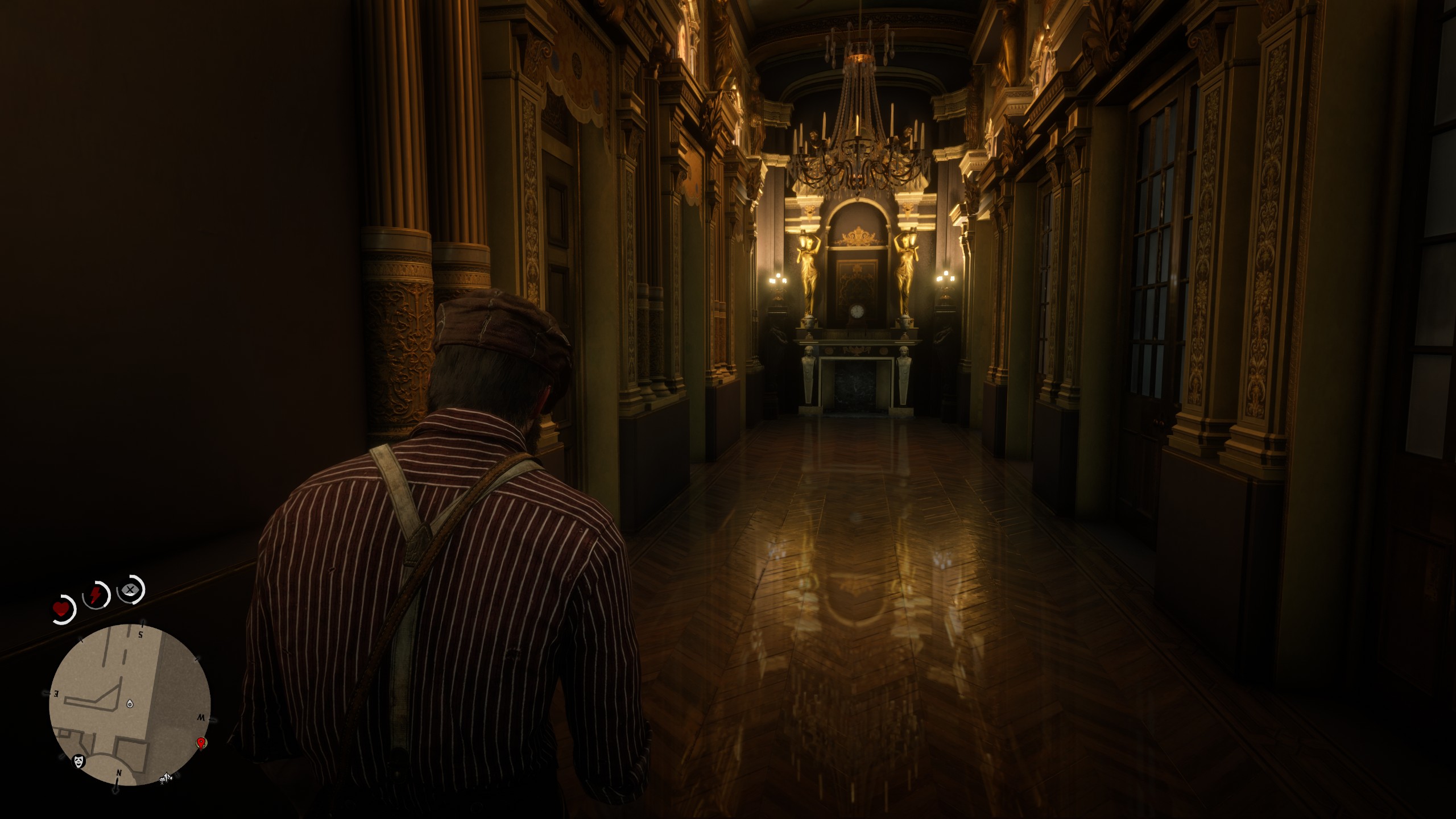
The repository also includes screenshots of a parquet hall reflecting a chandelier, statues and candles, plus street puddles and wet alley flagstones. The developer notes that the game has no ray tracing of its own, which is the point of the exercise.
VideoCardz reported that other DirectX 12 games require individual configuration profiles, and that the developer plans to automate that process. The README itself says users starting with another game should begin from the Red Dead Redemption 2 settings. There is no broad compatibility list in the primary source.
The project is explicit that it is not affiliated with Rockstar Games, NVIDIA or ReShade. That matters because the name Universal Ray Tracing Injector could easily be mistaken for an official or endorsed tool.
Limits, warnings and licensing
The most important warning is also the shortest: single player only, and never use it online. URTI injects itself into the game's rendering pipeline, so the developer's guidance is to keep it out of multiplayer and competitive environments.
Hardware support is bounded by DirectX Raytracing 1.1, which the project translates to NVIDIA RTX 20 series or newer and AMD RX 6000 or newer. ReShade 6.8 with add-on support is required, so older ReShade installs will not work.
The add-on is experimental. Ambient occlusion exists in the code but is disabled, glossy floors are optional rather than default, and the time budget means reflections may be simplified when the scene is expensive. The README says nothing about a performance target on specific hardware, so any frame rate claim would need independent testing.
Building from source requires Windows 10 or 11, Visual Studio 2022 with C++, CMake 3.20 or newer, and Microsoft's DirectX Shader Compiler. The code is MIT licensed, while third party components keep their own licenses and NVIDIA's NRD is optionally compiled but not included in the repository.
FAQ
Does URTI modify game files?
No. The repository says it adds reflections without modifying game files or shaders, by watching rendering and rebuilding the scene separately.
Which games are supported?
Red Dead Redemption 2 is the only game in the tested games table. Other DirectX 12 titles need their own profiles.
Which graphics cards work?
The README lists NVIDIA RTX 20 series or newer and AMD RX 6000 or newer, because the add-on needs DirectX Raytracing 1.1.
Can it be used online?
No. The developer states single player only and says never to use it online.
Does it add frame generation?
No. It is designed to draw reflections on presented frames including frame generated ones, but it is not a frame generation tool.
Is it official or affiliated with ReShade?
No. The README states the project is not affiliated with Rockstar Games, NVIDIA or ReShade, and its code is MIT licensed.
Bottom Line
Universal Ray Tracing Injector is an ambitious open source ReShade add-on that reconstructs DirectX 12 scene geometry and casts real ray traced reflections without touching game files. Its README documents a clear technical approach, a one game test list, a conservative default configuration, and a strict single player only rule. It is a research quality tool for RTX 20 and RX 6000 class hardware or newer, not a turnkey universal ray tracing upgrade.
Sources: Skynizz/URTI README and repository, fetched November 26, 2026, VideoCardz report, November 25, 2026 (secondary lead).
Related: RenoDX: 1,108 HDR Mods Built on ReShade, DLSS 5 on Second GPU: This ReShade Bridge Offloads Neural Rendering to a Spare Card