
DLSS 5 Pushes the RTX 5090 Connector to 91.7C and 646W on the 16-Pin Input
Saturday, September 26, 2026By Indie Kings | September 25, 2026
Updated September 25, 2026: A controlled thermal and power test from Korean outlet QuasarZone found that enabling DLSS 5 pushed the RTX 5090 Founders Edition 12V-2x6 connector to 91.7C in Cyberpunk 2077, up from 80.9C, while total card power rose from an average of 509.2W to 575.1W and the 16-pin input peaked at 646.7W.
Source note: All figures come from QuasarZone measurements, reported by VideoCardz. This is instrumented testing, not user reports. The same outlet had already documented melted RTX 5090 connectors from users who said they were running DLSS 5.
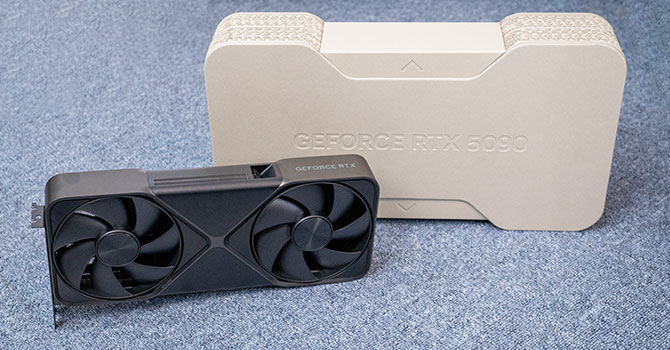
Image: GeForce RTX 5090 Founders Edition. Credit: TechPowerUp.
The test conditions
QuasarZone deliberately ignored image quality and measured the physical limits instead: power consumption, GPU temperature, and connector temperature with DLSS 5 switched on and off. That framing matters, because the interesting result is not that the card got hot, but how much of the connector's thermal headroom a single software toggle consumed.
| Setting | Value |
|---|---|
| Game | Cyberpunk 2077 |
| Resolution | 4K |
| DLSS mode | Quality |
| Graphics preset | Ultra |
| Duration | 20 minutes |
| Room temperature | 27.5C plus or minus 0.5C |
| Cards tested | RTX 5090 Founders Edition, RTX 5080 Founders Edition, and an ASUS ROG Astral RTX 5090 for per-pin current |
The RTX 5080 Founders Edition was included as a control, and it is the comparison that makes the 5090 result legible. The two cards run the same software in the same scene on the same day, so the difference in connector temperature is attributable to power, not to ambient conditions.
Connector temperatures
The 5090 connector was measured with a thermal camera from both sides, which is the detail that makes the numbers trustworthy. A single reading from one face can miss the hot spot, and on this connector the two faces behave differently.
| Card and measurement point | Without DLSS 5 | With DLSS 5 | Change |
|---|---|---|---|
| RTX 5090, side facing the four sense pins | 80.9C | 91.7C | +10.8C |
| RTX 5090, latch side | 77.1C | 83.4C | +6.3C |
| RTX 5080, sense pin side | Not stated | 48.6C | Stayed far cooler |
| RTX 5080, latch side | Not stated | 52.2C | Stayed far cooler |
The sense pin side running roughly 8C hotter than the latch side at identical power is worth noting on its own, because that is the face where current enters the connector. The 91.7C figure is the highest number in the entire test.
QuasarZone also noted that GPU core temperatures rose much less than connector temperatures across the same runs. So the core was not the limiting element, which is exactly the pattern you would expect when the bottleneck is current delivery rather than silicon.
Power draw, and why two tools disagree
Two independent measurement methods produced different absolute numbers, and the difference is explained rather than contradictory. HWiNFO reported sustained averages from software telemetry. An external PCIe power analyser test, PCAT, also captured short transients that software sampling misses.
| Measurement | Without DLSS 5 | With DLSS 5 |
|---|---|---|
| HWiNFO, RTX 5090 average | 509.2W | 575.1W |
| HWiNFO, RTX 5080 average | 298.2W | 350.3W |
| PCAT, RTX 5090 total average | 527.3W | 593.9W |
| PCAT, RTX 5090 total peak | 582.5W | 658.0W |
| PCAT, 16-pin input average | 516.5W | 582.7W |
| PCAT, 16-pin input peak | 571.7W | 646.7W |
Both cards were operating close to their power limits with DLSS 5 enabled, at 575W for the 5090 and 360W for the 5080. The 658.0W total peak exceeds the 5090's rated limit, and the 646.7W peak measured specifically at the 16-pin connector is the number that connects directly to connector failure.
The per-pin current that actually matters
This is the most useful part of the test, and it is the part that is easy to skip past. Connector failure is not caused by total watts alone. It is caused by current concentrating in individual pins when a connection degrades.
An ASUS ROG Astral RTX 5090, power-limited to the same 575W as the Founders Edition, was instrumented per pin. The six pins sit comfortably under the 9.2A specification in a healthy state, with or without DLSS 5.
| Condition | Current per pin | Against the 9.2A spec |
|---|---|---|
| Without DLSS 5, healthy connector | 6.94A to 7.47A | Comfortable |
| With DLSS 5, healthy connector | 7.83A to 8.51A | Still under, but closer |
| Without DLSS 5, one pin failed open | Highest pin about 8.9A | Approaching the limit |
| With DLSS 5, one pin failed open | Highest pin about 10.1A | Above the 9.2A specification |
There was also roughly a 0.7A gap between the highest and lowest pin under the DLSS 5 load, so current was already unevenly distributed in a brand new, healthy connector. The test then calculated the theoretical case of a single pin stopping to carry current because of wear or a poor connection, which is the normal way these connectors degrade.
With DLSS 5 disabled, the redistributed current still lands just under the limit. With DLSS 5 enabled, it does not. That is the mechanism: not a sudden overload, but the loss of the safety margin that a working connector depends on.
How this connects to the melt reports
We have previously reported melted RTX 5090 connectors and 12VHPWR failures, including the earlier RTX 5090 melt reports tied to unofficial DLSS 5 use. This test is different in kind, and it is more useful than another user report, because it establishes the power and current budget rather than just the outcome.
- DLSS 5 is not free at the connector. The same card in the same scene drew 66W more on average and peaked 76W higher at the 16-pin input, purely from a software toggle.
- Headroom, not wattage, is the failure variable. A healthy connector clears the spec. A connector with one degraded pin under the same software setting does not.
- Even current distribution was already degrading. A 0.7A spread across six pins in new hardware leaves less room for the uneven distribution that age and thermal cycling cause.
- Pre-existing weakness plus a heavier load equals a plausible chain. The 12V-2x6 design was introduced to improve on 12VHPWR, and this shows the specific margin it now depends on.
None of this is a prediction that a given card will fail. It is a measurement of how much less tolerance the connector has when DLSS 5 is running, which is the question the melt reports were implicitly asking.
FAQ
How hot did the RTX 5090 connector get with DLSS 5?
91.7C on the side facing the four sense pins in Cyberpunk 2077 at 4K with the Ultra preset, up from 80.9C without DLSS 5, per QuasarZone measurements reported by VideoCardz.
What was the peak power at the 16-pin connector?
646.7W peak and 582.7W average with DLSS 5 enabled, measured with an external PCIe power analyser, against 571.7W peak and 516.5W average without it.
Does DLSS 5 exceed the per-pin current specification?
Not in a healthy connector. Per-pin current reached 8.51A against the 9.2A specification. However, the test calculated that with one pin failed open, the highest pin would reach about 10.1A with DLSS 5 enabled, which is above the specification.
Did the RTX 5080 have the same problem?
No. The RTX 5080 Founders Edition reached 48.6C and 52.2C at the connector with DLSS 5 enabled, far below the 5090, while its average power rose from 298.2W to 350.3W.
What power limits were the cards running at?
Both cards were close to their limits with DLSS 5 enabled, at 575W for the RTX 5090 and 360W for the RTX 5080. The external measurement recorded a 658.0W peak on the 5090, above the rated limit.
Does this mean RTX 5090 cards will melt?
No such conclusion follows from the data. It measures the reduced safety margin under a heavier software load, not a failure rate.
Bottom Line
DLSS 5 costs more than frame rate. On an RTX 5090 Founders Edition it added 66W of average draw, pushed a 16-pin connector to 91.7C, and peaked at 646.7W on that connector, all measured in the same scene with the same settings as the baseline. The finding that matters is not the headline temperature but the per-pin current analysis: a healthy connector passes, and a connector with one degraded pin under the same load would exceed the 9.2A specification. The safety margin on this connector is real but finite, and DLSS 5 consumes a meaningful part of it. That does not make the technology unsafe, and it does not predict failures. It does mean that connector condition, not just card wattage, is now a variable worth taking seriously on a 575W part.
Sources: VideoCardz, RTX 5090 12V-2x6 connector reaches 91.7C with DLSS 5, 16-pin input peaks at 647W, by WhyCry, reporting QuasarZone testing | TechPowerUp, GeForce RTX 5090 Founders Edition review
Related: RTX 5090 melts after DLSS 5 | 12VHPWR melts again, RTX 5090 hits 175C | RTX 5090 at 575 watts, and the rest of the 50 series specs