
Bloodborne PC: One Port, Two Forks, Two Ideas of a PC Version
By Indie Kings | October 20, 2026
Updated October 20, 2026: Two public forks of Supermedo's native Windows Bloodborne port are now shipping builds with different priorities, per their repositories and release notes. Jgamrot's fork focuses on the launcher, setup and quality of life, with a 13 language interface, a full-screen map and frame generation from the parent port. TatsunaKyo's fork, branded The Crowned Workshop, focuses on rendering features, adding XeSS, HDR10, NVIDIA Reflex, AMD Anti-Lag 2 and multi frame generation on top of the same base.
The one-sentence version: Bloodborne's Windows port went from a single repository to a small fork ecosystem in under two weeks, and the two visible forks disagree about what a PC version should be.
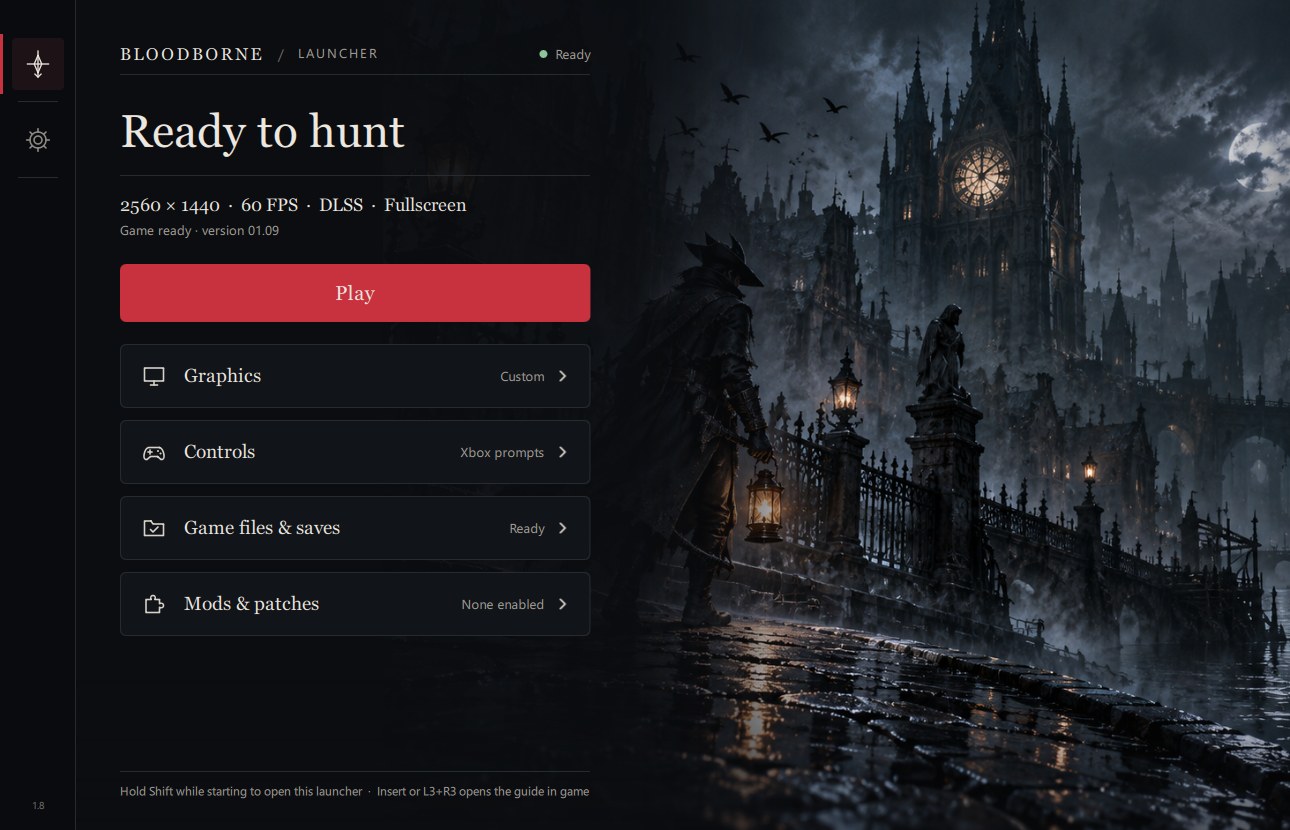
Image credit: Jgamrot fork of the Bloodborne Windows port, docs image.
The parent port: 12 days, 4,000 stars
The project that started this is Supermedo's Bloodborne port, credited in its README to Mohammed Albarghouthi. GitHub says the repository was created on October 6, 2026, and by October 20 it had 4,043 stars and 259 forks. Its latest release, windows-v1.9.2, was published on October 18. The license is GPL-2.0.
The lineage is stacked, and each layer is acknowledged. Supermedo's port builds on deadinside28's bbport, a native Linux port of the game, and on the shadPS4 renderer and shader recompiler. Online features borrow the network, NP and shadNet code from shadPS4 0.20, assembled for the port by Awaken, with a backend for The Hunter's Dream server. The in-engine PC menus, Rebirth, the mirror, two invaders and keyboard prompt text come from droogie's bbhost.
What the parent port does, in plain terms, is run the game's own PS4 code on a Windows PC and translate its graphics to Vulkan. It is not an emulator in the usual sense: there is no virtual console, just the executable and the renderer working together. That is why the requirements start with a decrypted copy of your own disc, and why no build contains game files.
Twelve days is a short time for a project to reach 4,000 stars, and the fork count explains what happened next. Once the hard part worked, the obvious next question was which PC conveniences matter most, and different people answered it differently.
Jgamrot's fork: the launcher and quality of life build
Jgamrot's fork has 403 stars, 15 forks and 69 open issues as of October 20. It was created on October 9, three days after the parent. Its description promises a launcher in 13 languages, DLSS, FSR 3.1 and 4, unlocked FPS, cheats, mods and one-click updates, and the README delivers a longer list than that.
The setup wizard is the first difference. On first start it installs the game from your own ZIP or PKG dump, checks the game files, saves and trophy key, and can be reopened later from a Game menu. The README specifies the target: CUSA03173, version 1.09, with about 70 GB free for a 30 GB archive. A second option points the launcher at an existing folder containing eboot.bin.
Graphics options are broad rather than exotic. DLSS on RTX 20 series and newer, FSR 3.1 and FSR 4, native-resolution TAA, output from 720p to 4K, fullscreen switching while playing, 30, 60 or 90 FPS caps or an unlocked frame rate with a cap. Individual effects can be turned off: chromatic aberration, depth of field, motion blur, SSAO, the game's own anti-aliasing, dynamic shadows, screen-space reflections and model detail.
The shader pre-build is the feature worth understanding. Shaders the game is known to use are compiled at startup, shown as "Preparing shaders" in the window title, so the first visit to an area or effect does not stutter. The README is honest that the included catalog covers the game up to the Blood-starved Beast so far, that it lists shaders rather than game code, and that each install builds them from its own files. Setting BB_SHADER_PREBUILD=0 disables it.
The current release, tagged qml-launcher-preview-21 and published on October 17, carries notes titled 1.9.7. Those notes add Hunter's Atlas, a full-screen map by MikeTat1988 under GPL-2.0, with position, floors, lamps, NPCs and gates across 16 main areas, optional fast travel to discovered lamps and pickup markers. The map needs a one-time "Prepare maps" step of 5 to 15 minutes, built from your own files, and a clean 1.09 install.
The same notes add FSR 3.1 frame generation on any GPU, with DLSS frame generation promised in a later build, plus ultrawide support with a centered HUD. They also fix a co-op problem: the seamless co-op mod hands out its bells only after a save backup, the backup always failed while the game was running, and new characters could not start co-op. The bells now appear when a co-op session starts from the launcher, with a Hunt Bell for the host and a Kin Bell for the guest.
In-game, the fork puts its settings into the game's own System menu and adds an Insert or L3 plus R3 guide covering FPS, achievements, settings, mods and cheats. Achievements use trophy names, descriptions and Gamerscore from a trophy key taken from your own PS4, and the README says plainly that nothing syncs to PlayStation Network. Keyboard and mouse work alongside a controller, with a 1:1 mouse camera and movement smoothing.
TatsunaKyo's fork: the rendering build
TatsunaKyo's fork calls itself Bloodborne: The Crowned Workshop and has a much smaller audience: 4 stars, 3 forks and 2 open issues on October 20. It was created on October 9 as well. Its pitch is not a better first run but a deeper graphics stack, and the README lists additions that the parent does not have.
Upscaling is the first pillar. The parent already shipped DLSS, FSR and TAA; this fork adds Intel XeSS Super Resolution and separate DLSS model presets, including a transformer preset. The README warns that XeSS uses different upscaling ratios than DLSS and FSR, and documents the differences rather than letting users discover them by eye.
Frame generation is the second pillar and the most complicated. The fork supports FSR frame generation at 2x, and NVIDIA DLSS frame generation and multi frame generation at 2x to 6x on supported GPUs. Frame generation can run with a different upscaler, works in both SDR and HDR10, and can be toggled live from the in-game menu. The normal FPS limit stays tied to real game frames, with an optional second limit for the generated output, which is a more honest control scheme than a single number that secretly means two different things.
The experimental edge is a DLSS frame generation mod for RTX 20 and 30 series cards through a project called RTX Encore. The author states that he does not own an RTX 20 or 30 series card to test it with, that it defaults off, that it requires Apply and a restart, and that the launcher verifies the selected GPU before downloading a pinned build. Only the ASI plugin and third-party notices are installed, and unchecking the option returns to the normal path. That is unusually careful for an experimental feature, and it is still an experimental feature.
Latency and display controls round it out. NVIDIA Reflex is a separate Off, On, On plus Boost choice, so it can be used without frame generation, and AMD Anti-Lag 2 is integrated through the Radeon Vulkan driver interface. HDR10 is supported on both frame generation paths. Borderless fullscreen, a redesigned launcher, an overlay and auto-updates are listed in the repository description.
The version story is messier than the feature list. The README badge points at revision 44 notes, the releases page on October 20 showed windows-v1.6-tatsunakyo.40-EXPERIMENTAL from October 15 and windows-v1.6-tatsunakyo.35-stable from October 14. A reader has to decide whether to trust a stable tag, an experimental tag or a revision number in the README, and the fork would be easier to recommend with one canonical version label.
How the two forks compare
Neither fork is a superset of the other, which is the useful conclusion. Jgamrot's build is easier to install and better documented for a first evening. TatsunaKyo's build goes further on image quality and latency, at the cost of experimental paths and a version scheme that needs decoding.
| Area | Jgamrot fork | TatsunaKyo fork |
|---|---|---|
| Primary focus | Launcher, setup wizard, quality of life | Rendering, upscaling, frame generation |
| Upscaling | DLSS, FSR 3.1, FSR 4, TAA | DLSS with model presets, FSR, XeSS Super Resolution, TAA |
| Frame generation | FSR 3.1 on any GPU, DLSS FG promised later | FSR FG 2x, DLSS FG and MFG 2x to 6x, live toggle |
| Latency tools | Not a headline feature | NVIDIA Reflex, AMD Anti-Lag 2 |
| HDR | Not a headline feature | HDR10 on both FG paths |
| Map and navigation | Hunter's Atlas full-screen map, 16 areas | Overlay and in-game menu, no map mod listed |
| Shader pre-build | Catalog up to Blood-starved Beast | Not a headline feature |
| Co-op fixes | Hunt Bell and Kin Bell delivered at session start | Online play listed, no equivalent fix in notes |
| Latest public build | qml-launcher-preview-21, October 17 | Revision 40 experimental, October 15; revision 35 stable, October 14 |
| GitHub traction | 403 stars, 15 forks, 69 open issues | 4 stars, 3 forks, 2 open issues |
Sources: the two fork READMEs and their release notes, plus GitHub repository metadata, checked October 20, 2026. Feature presence is per the projects' own documentation, not measured by us.
What both forks need from you
Both forks repeat the same warning in bold: no game files are included, and you need your own decrypted Bloodborne dump for CUSA03173, version 1.09, including eboot.bin and its original data. The Jgamrot README adds the disk figures, about 70 GB free for a 30 GB archive, and notes that most patches and cheats depend on 1.09 specifically.
That requirement is the line between a port and a distribution. The game's code runs from your dump, the renderer translates it, and the repositories ship the port only. The same pattern appears in the trophy system: names and Gamerscore need a trophy key from your own PS4, and without it achievements show numbers and icons rather than text.
Both forks are GPL-2.0, which follows from the shadPS4 lineage and the parent port. Neither repository is affiliated with Sony Interactive Entertainment or FromSoftware, and both say so. The Old Hunters expansion is supported from a base-game dump through a DLC folder setting in the Jgamrot fork, which is a useful detail for anyone whose dump is the base release rather than a complete edition.
Online play is beta and third party
Online exists, and it is the most fragile part of the stack. The Jgamrot README describes online play as beta: messages, bloodstains and ghosts through The Hunter's Dream, and co-op through a shadNet server. The TatsunaKyo README credits the same lineage, with the network and PSN code of shadp2p by Wozzardman, the shadNet server from the shadPS4 team, and The Hunter's Dream by droogie and its team.
This is not PlayStation Network, and nothing syncs achievements or saves to Sony. It is a community relay that speaks enough of the game's network protocol for messages and co-op to work. The practical consequence is version discipline: Jgamrot's release notes state that everyone in a co-op session needs the same build, 1.9.7 in that case. Mixing a parent build and a fork build in one session is not a supported configuration.
Third-party servers also mean third-party uptime and third-party moderation. A port that depends on someone else's relay for its messages and summons inherits that dependency, and the projects are honest that this is a beta arrangement rather than a service with a status page.
Experimental features and open issues
The issue counts tell different stories. Jgamrot's fork has 69 open issues against 403 stars, which is a busy project with a lot of reports arriving. TatsunaKyo's fork has 2 open issues against 4 stars, which is a small project that few people are testing. Neither number is a verdict. One means the fork is load bearing for many users, the other means its experimental paths have thin coverage.
The frame generation mod is the clearest example of thin coverage. The author says he could not test DLSS frame generation on RTX 20 or 30 series hardware because he does not own such a card, and the release notes carry that warning in capitals. The design limits the blast radius by defaulting the option off, verifying the GPU before download and refusing to replace original NVIDIA files, but a feature nobody could test on its target hardware is still a feature someone will file bugs against.
Divergence from the parent is the structural risk. Supermedo's port released 1.9.2 on October 18, and both forks have their own release trains and their own changelogs. A fix that lands upstream does not automatically appear in a fork, and a fork fix does not automatically go back. Users end up choosing a maintainer as much as a feature list, and the forks should be judged on how quickly they absorb parent fixes.
FAQ
Is this an official Bloodborne PC port?
No. It is a community project that runs the game's own code natively on Windows through a Vulkan renderer built on shadPS4. Both forks state they are not affiliated with Sony Interactive Entertainment or FromSoftware.
What files do I need to run it?
Your own decrypted Bloodborne dump for CUSA03173, version 1.09, including eboot.bin and its data. The Jgamrot README suggests about 70 GB free for a 30 GB archive. No build includes game files, and achievement text needs a trophy key from your own PS4.
Which fork should I use?
Jgamrot's fork if you want a guided setup, a full-screen map and co-op bells that work. TatsunaKyo's fork if you want XeSS, HDR10, Reflex, Anti-Lag 2 and multi frame generation, and you accept experimental paths and a less clear version scheme.
Can I play co-op?
Yes, as a beta through community servers. Messages, bloodstains and ghosts run through The Hunter's Dream, and co-op runs through a shadNet server. Everyone in a session needs the same build, and nothing connects to PlayStation Network.
Does the Old Hunters expansion work?
Jgamrot's README documents Old Hunters support from base-game dumps through a DLC folder setting, with the DLC files placed in one folder and selected in the launcher. Whether it works for you depends on the dump you own.
Is it legal?
The port code is GPL-2.0 and the projects distribute no game assets, but running the game still requires a copy you own. That is the projects' position, not a legal ruling, and anyone outside the usual preservation and modding scene should treat the ownership requirement as real rather than decorative.
Our take
The fork war is the healthiest thing about this project. A single maintainer carrying a 4,000 star port has to choose between onboarding and rendering, and now two people are choosing differently in public. Jgamrot is building the version a normal person can install on a Saturday. TatsunaKyo is building the version a person with an HDR monitor and a Reflex capable GPU will argue about on a forum. Both are useful, and neither is finished.
The detail I keep coming back to is the shader catalog that stops at Blood-starved Beast. That is an honest progress marker, and it tells you more about the state of the port than any feature list. A pre-built shader cache that covers the first third of the game is a real improvement and an incomplete one, and saying so is better than claiming stutter is solved.
What I would watch next is not frame generation. It is merge discipline. If the forks keep pulling parent fixes promptly, the ecosystem gets stronger than any single repository. If they drift, users will end up maintaining two installs and comparing changelogs, which is how promising fork ecosystems turn into support burdens. The next two weeks of commit history will answer that better than any roadmap.
I would also like to see TatsunaKyo settle on one version label. Revision 44 in the README, revision 40 experimental on the releases page and a stable 35 behind it is three answers to one question, and the answer determines whether a cautious user can install the build at all.
Bottom Line
Supermedo's native Windows Bloodborne port reached 4,043 stars and 259 forks in two weeks, and two forks are now shipping different builds. Jgamrot's fork, at 403 stars and 69 open issues, adds a 13 language launcher, a setup wizard, a shader pre-build catalog up to Blood-starved Beast, a full-screen map, FSR 3.1 frame generation, ultrawide support and a fix for missing co-op bells. TatsunaKyo's Crowned Workshop fork, at 4 stars and 2 open issues, adds XeSS, DLSS model presets, FSR and DLSS frame generation up to 6x, HDR10, Reflex, Anti-Lag 2 and an experimental RTX 20 and 30 DLSS frame generation mod its author could not test. Both are GPL-2.0, both require your own decrypted CUSA03173 version 1.09 dump, both treat online as a beta through community servers, and neither is affiliated with Sony or FromSoftware.
Sources: Supermedo/bloodborne_pc, Jgamrot/bloodborne_pc and TatsunaKyo/bloodborne_pc, including their READMEs, release notes and GitHub release metadata, fetched October 20, 2026.
Related: Bloodborne Seamless Co-Op Mod Allows 5 Players | ShadPS4 - The Future of PS4 Emulation