
Intel GPU D-Series: 480 GB of LPDDR5X for AI Inference
By Indie Kings | October 20, 2026
Updated October 20, 2026: Intel's GPU D-Series, the accelerator formerly code-named Crescent Island, pairs up to 480 GB of LPDDR5X memory with 1.3 petaflops of FP8 compute in a 350 W air-cooled PCIe card, per Intel's announcement as reported by TechPowerUp and TechRadar. The card has no display outputs, uses laptop memory instead of GDDR7 or HBM, and is aimed squarely at AI inference. Customer sampling is underway, with no pricing, general availability date or independent benchmark published.
The one-sentence version: Intel is betting that AI inference needs capacity more than bandwidth, so it built a 480 GB card out of laptop memory and kept the power low enough to air cool.
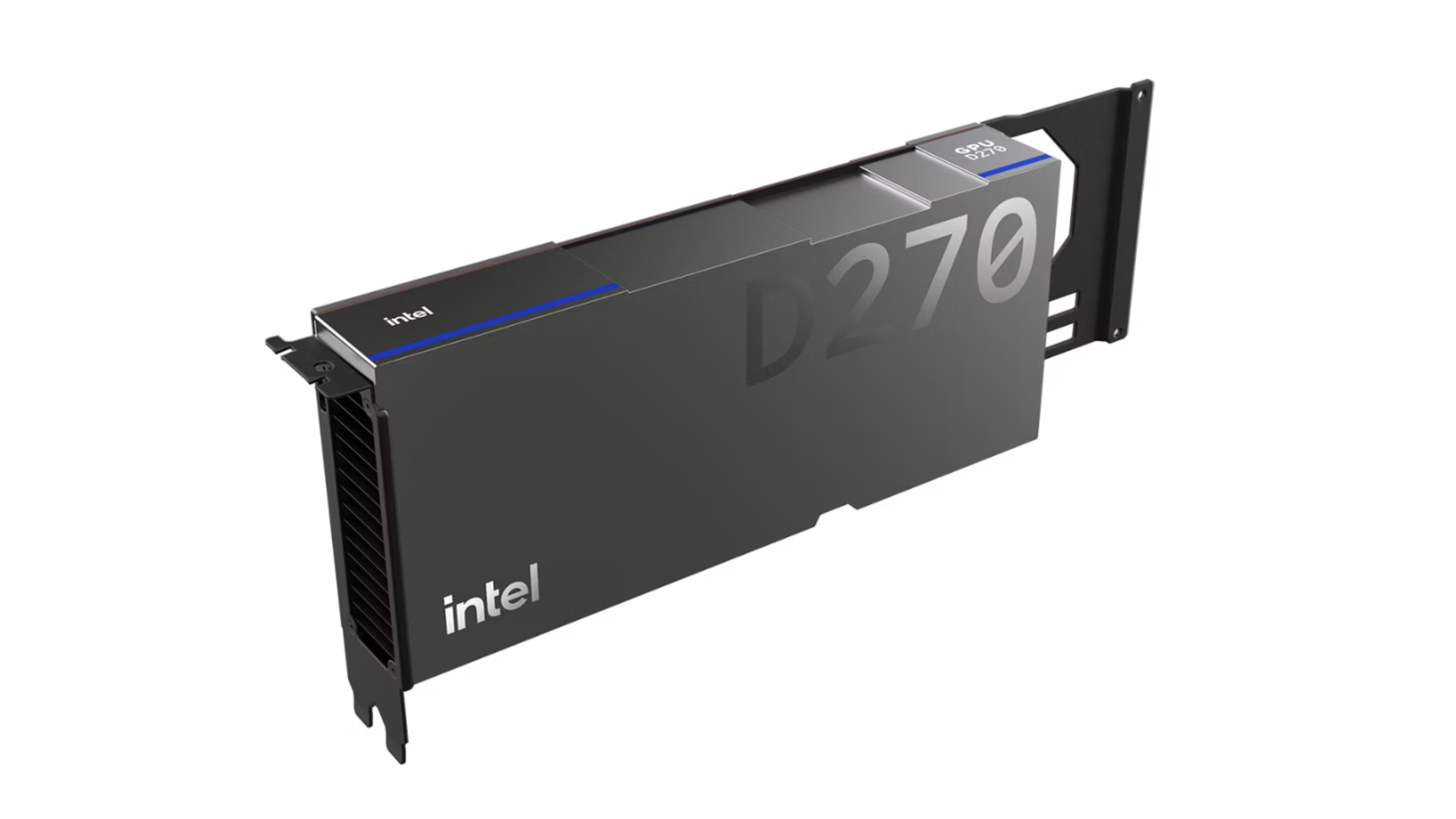
Image credit: Intel, via TechRadar.
What Intel announced
The D-Series is a server accelerator, not a graphics card in the usual sense. TechPowerUp reports 32 Xe3P cores, 256 vector engines and 256 XMX engines, with the matrix engines redesigned from a four-deep systolic pipeline on regular Xe3 to a 16-deep pipeline on Xe3P. Each core gets 1 MB of register file and 512 KB of L1 cache, and the chip carries 32 MB of unified L2.
Memory is the headline. Intel-branded cards ship with 160 GB out of the box, and the company allows its ODM partners to configure the same card with up to 480 GB of LPDDR5X. The maximum memory bandwidth is 1.5 TB/s. Compute is rated at up to 1.3 petaflops in FP8, with support for formats from FP4 to FP64.
The rest of the spec sheet is built for inference in existing servers. The card is PCIe 5.0 x16, draws 350 W, and is air cooled, so it drops into a standard chassis without a liquid loop. A media engine with four encoders and four decoders handles video workloads. There are no graphics processing elements, because the silicon does not output an image.
Intel's positioning is explicit. TechPowerUp quotes the company describing the card as designed to improve the economics of sustained, memory-intensive inference. The claimed model fit is up to 300 billion parameters on one card, and a cluster of eight cards handling trillion-parameter models. Those are capacity claims, not performance claims, and Intel has published no tokens per second figures.
Why LPDDR5X instead of HBM or GDDR7
The memory choice is the most interesting decision in the product. HBM is the standard for AI accelerators because it offers enormous bandwidth in a package designed to sit next to the compute die. GDDR7 is the standard for graphics because it balances bandwidth and cost. LPDDR5X is the standard for phones and thin laptops because it offers a lot of capacity per dollar and per watt, and it is designed to be power efficient rather than blisteringly fast.
Intel is using the phone memory for its capacity and efficiency, and accepting the bandwidth that comes with it. The trade is legible in the numbers: 480 GB at 1.5 TB/s, versus HBM-based accelerators that offer a fraction of that capacity at several times the bandwidth. Whether that is a good trade depends entirely on the workload, and inference is the one workload where capacity often wins.
There is also a supply argument. LPDDR5X is made in enormous volumes for mobile devices, and it does not compete directly with the HBM stacks that AI accelerators are fighting over. A vendor that can build a credible inference card from mobile memory has a supply chain that looks different from everyone else's, which matters when HBM allocation is the constraint on how many accelerators you can ship.
The capacity argument, in models
Model weights are the simplest way to understand why 480 GB matters. A dense model in FP8 needs roughly one byte per parameter, so a 300 billion parameter model needs about 300 GB before you add the KV cache, activations and framework overhead. That fits on a single 480 GB card with room for context, which is Intel's pitch. A 160 GB card would need several devices or a smaller model.
The KV cache is where long context and agentic workloads change the arithmetic. Every concurrent request holds state that grows with context length, and serving many users at once multiplies it. A card with a lot of memory can hold more concurrent sessions and longer prompts, which is exactly the shape of the workloads Intel is targeting. Capacity becomes a throughput feature when the alternative is evicting sessions.
That is why the 8-GPU trillion-parameter claim is plausible as a capacity statement. Trillion-parameter models in FP8 need about a terabyte of weights, so eight 480 GB cards have enough room for weights plus cache. Whether the interconnect and software can keep those eight cards fed is a separate question, and Intel did not publish an interconnect specification in the material TechPowerUp summarized.
The bandwidth tradeoff
Token generation is memory bound. Every generated token requires reading the model's weights, or at least the active parameters, and the rate is limited by how fast memory can deliver them. A card with 480 GB at 1.5 TB/s has a huge amount of storage for weights and a comparatively narrow pipe to read them through. For large models, that pipe is the ceiling.
Batching helps, because the same weight read can serve several sequences at once. That is why high capacity and high concurrency can compensate for lower bandwidth in serving workloads: the card holds more sessions, and the weights are read once per batch rather than once per user. It is a different optimization than the one training accelerators pursue, and it is the right one to evaluate the D-Series against.
The honest conclusion is that the bandwidth number alone does not settle performance. A 480 GB card that serves long-context requests for many users at once can beat a faster card that runs out of memory and spills sessions to the host. A 480 GB card running a single short request can lose badly to HBM hardware. Intel has not published the benchmark that would tell us which case dominates in practice.
| Specification | Intel GPU D-Series |
|---|---|
| Architecture | Xe3P, 32 cores, 256 vector engines, 256 XMX engines |
| Memory | 160 GB on Intel-branded cards, up to 480 GB LPDDR5X from ODMs |
| Memory bandwidth | Up to 1.5 TB/s |
| Compute | Up to 1.3 petaflops FP8, formats from FP4 to FP64 |
| Cache | 32 MB unified L2, 1 MB register file and 512 KB L1 per core |
| Form factor | PCIe 5.0 x16, 350 W, air cooled, no display outputs |
| Media | Four encoders and four decoders |
| Model fit claim | Up to 300 billion parameters on one card, trillion-parameter models on eight |
Source: Intel announcement as reported by TechPowerUp, October 12, 2026, and TechRadar, October 18, 2026.
350 W and air cooling
The power envelope is the second strategic decision. At 350 W and air cooled, the D-Series is designed for servers that already exist, not for new racks built around liquid cooling. That lowers the barrier for the kind of customer Intel is courting: an organization that wants to run inference on standard hardware, not a hyperscaler designing a custom facility.
It also changes the economics of density. A rack of 350 W cards draws less power and needs less cooling than a rack of 700 W or 1,000 W accelerators, which matters when power availability is the constraint on deployments. The trade is fewer flops per rack, and Intel is arguing that for inference, memory capacity and power efficiency matter more than peak compute density.
TechRadar frames the card as having more memory than the average laptop SSD. The precise version is that 480 GB exceeds a 256 GB entry-level laptop drive and roughly matches a 512 GB one, while the 160 GB base configuration is smaller than either. The comparison is a good headline and a reminder of how unusual the capacity is for a single PCIe card, even if the average laptop SSD is now larger than the phrase implies.
What is still unknown
There is no price. That is the biggest gap, because the entire value proposition is cost per generated token, and Intel has not published the number that would let anyone calculate it. A 480 GB card built from cheap memory could undercut HBM accelerators on capacity per dollar, or the low volume and custom design could erase that advantage.
There is no general availability date. Customer sampling is underway, which means select partners have hardware. Sampling is not shipping, and the history of Intel's accelerator programs includes projects that sampled and then slipped. The D-Series name and the Crescent Island code name are real, and the schedule is not.
There are no independent benchmarks. Intel's 1.3 petaflops and 1.5 TB/s are paper numbers until someone runs a model on the card and measures tokens per second, time to first token and performance under concurrency. The software stack matters just as much: whether PyTorch, vLLM and the common inference frameworks support the card on day one determines whether the capacity is usable.
Intel does have a software story to tell, with its oneAPI foundation and support for established AI frameworks, and the company has been shipping Arc Pro software for local AI workloads. Whether that stack extends cleanly to a 32 core Xe3P server part is unproven in public.
| Question | Status on October 20, 2026 |
|---|---|
| Price | Not announced |
| General availability | Not announced, customer sampling underway |
| Independent performance | None published |
| Tokens per second | No figures from Intel or third parties |
| Interconnect for 8-GPU clusters | Not detailed in the published summary |
| Framework support at launch | Intel cites oneAPI and established frameworks, without a version list |
Sources: TechPowerUp and TechRadar reports, October 12 and October 18, 2026. Absence of a public figure is stated as of October 20, 2026.
FAQ
Is the Intel GPU D-Series a graphics card?
No. It has no display outputs and no graphics processing elements. It is a PCIe inference accelerator with a media engine, designed to run AI models in servers rather than render images.
How much memory does it have?
Intel-branded cards ship with 160 GB of LPDDR5X. Intel allows ODM partners to configure the same card with up to 480 GB, at up to 1.5 TB/s of bandwidth.
Why LPDDR5X instead of HBM?
Capacity and cost. LPDDR5X is mobile memory made in huge volumes, so it offers more gigabytes per dollar and per watt than HBM. The trade is lower bandwidth, which matters most for single-request token generation and less for batched serving.
How much compute does it offer?
Up to 1.3 petaflops in FP8, with support from FP4 to FP64, across 32 Xe3P cores and 256 XMX engines. The matrix engines use a 16-deep pipeline instead of the four-deep design on regular Xe3.
Can it run a 300 billion parameter model?
Intel claims a single card can handle models up to 300 billion parameters, and that eight cards can run trillion-parameter models. Those are capacity claims; no tokens per second figures have been published.
When can I buy one?
No date or price has been announced. Intel says customer sampling is underway, and general availability, pricing and independent performance results are still undisclosed.
Our take
This is the most interesting Intel hardware decision in years, and the interesting part is not the 480 GB. It is the willingness to build a server product around mobile memory instead of chasing HBM. Everyone else is fighting for the same scarce stacks. Intel is proposing a different supply chain and a different optimization target, and that is a real strategy rather than a spec sheet stunt.
The risk is that the strategy is right and the execution is late. Intel has announced accelerators before, and the software stack has been the recurring problem. A card that needs a bespoke framework port is a card that customers evaluate for a year and then decline. The company's local AI work on Arc Pro is encouraging, but a 32 core Xe3P part with 480 GB is a different scale of validation.
The bandwidth tradeoff is the part I would want benchmarked first. Token generation is where the 1.5 TB/s pipe will show up, and it is where a capacity-first design can look slow. If Intel can show strong batched throughput on long-context requests, the capacity argument holds. If the first independent numbers are single-stream tokens per second against an H200, the conversation will be short.
I also want a price. Everything about this card is an economics argument, and the only number that matters is cost per million tokens. Intel has told us how much memory it holds and how many flops it computes. It has not told us what it costs, which is the one figure that decides whether the D-Series is a competitor or a demo.
Bottom Line
Intel's GPU D-Series, formerly Crescent Island, is an AI inference accelerator with up to 480 GB of LPDDR5X memory, 1.5 TB/s of bandwidth, 1.3 petaflops of FP8 compute and a 350 W air-cooled PCIe 5.0 x16 design with no display outputs. Intel-branded cards start at 160 GB, and ODM partners can configure up to 480 GB. Intel claims one card handles models up to 300 billion parameters and eight cards handle trillion-parameter models. The choice of LPDDR5X instead of HBM or GDDR7 favors capacity, cost and power over bandwidth, which is a defensible bet for batched inference and long-context serving. Customer sampling is underway, but pricing, general availability date, interconnect details and independent performance are all missing. The numbers that will decide the product are cost per token and measured throughput, and Intel has published neither.
Sources: TechRadar, "Behold, Intel plans a 480GB GPU," by Efosa Udinmwen, October 18, 2026. TechPowerUp, "Intel Crescent Island GPU Gets D-Series Name, Supports Up to 480 GB of LPDDR5X," October 12, 2026, reporting Intel's announcement and specifications. Intel newsroom, "Intel Accelerates Open Infrastructure for the Agentic AI Era," referenced by both reports and not directly accessible at the time of writing.
Related: LLM Scaler: Intel's Arc Pro Docker Line Has Missed Exactly One Month in Fifteen | AMD Halo Station Packs 96 Cores, 576GB HBM3E: 100000 Plus [2026]