
Open Vanilla: Vanilla WoW in a Browser Tab, Server and Bot Included
By Indie Kings | October 20, 2026
Updated October 20, 2026: Open Vanilla is a community project that runs a Vanilla-era World of Warcraft realm in a browser tab, ships a desktop launcher with a 19 addon suite, and publishes the server software so anyone can host their own realm, per its website and repositories. The site labels the build alpha v0.1.8, the latest GitHub release is v1.30.8 from October 19, and the realm list showed one online realm with zero players when we checked on October 20.
The one-sentence version: Open Vanilla is three products wearing one name, a browser client, a self-hosted server package and an AI companion called Herald that plays the game, and the AI is the part nobody else ships.
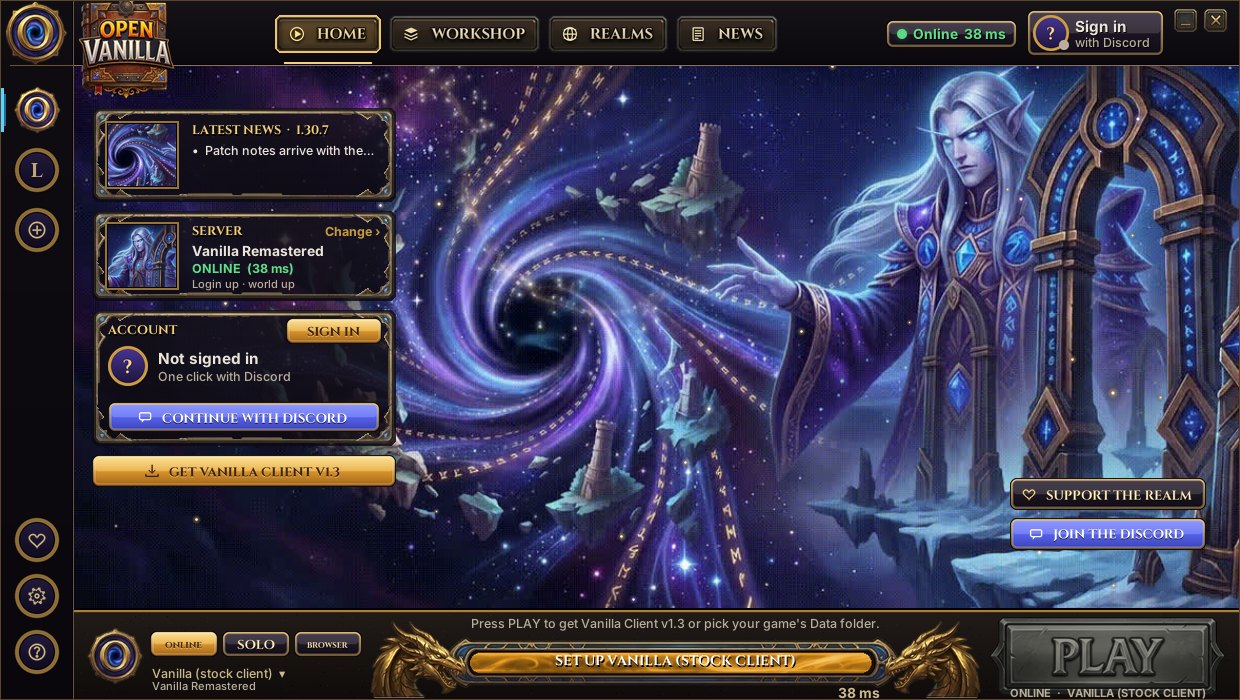
Image credit: Open Vanilla project, launcher repository media.
What Open Vanilla actually is
Three things ship under one name, and they are easy to confuse because the website presents them as one button. The first is a browser realm at play.openvanilla.app, where the site says you can play free as a guest or sign in with Discord. The second is a Windows launcher called OpenVanilla.exe that runs a native engine against your own game data, or your own offline world with bots, or the browser client. The third is Open Vanilla Server, a separate download that turns a PC into a realm with a database, login server, world server, website and admin console.
The project describes itself as a free, open-source, community-built MMO project on the site, and its GitHub account belongs to a developer named Orion. The site footer says the work is licensed under open-source MIT and Apache-2.0, and most of the individual repositories do carry MIT licenses. The main OpenVanilla repository does not list a license, which is a discrepancy worth keeping in view.
The scope is narrower than "World of Warcraft in a browser" implies. The realm is called Vanilla Remastered, described as classic Vanilla remastered, and the site lists three more realms as coming: Warfront for PvP, Moonguard for roleplay and Ascension Resurrected. Only Vanilla Remastered showed as ONLINE, and it showed zero players at the time of our check. The site separately claims 36 adventurers and 48 people today, numbers that describe accounts rather than a live population.
What exists is real and public. The GitHub account has 11 public repositories, the latest release was published on October 19, and the code covers the launcher, the server, the Discord bot, the creator app, the AI agent experiment and the art tools. Star counts are small, between zero and five per repository, which is what a project this young looks like rather than a red flag by itself.
The browser realm, checked
The play page is the claim that matters most, because "free Vanilla in your browser, nothing to install" is a sentence that either works or does not. We loaded play.openvanilla.app in a real browser on October 20. It served a sign-in page with two doors: Sign in with Discord, or Play free as a guest with no sign-up and heroes stored on the device.
The guest door was open but not unlimited. Clicking Play free as a guest returned a message: "No more guest accounts today. Sign in with Discord to play now." That is a daily cap on guest accounts, not a missing feature, and it is the kind of limit a small realm uses to keep anonymous traffic from overwhelming a server. The Discord path points at a standard OAuth authorization for the project's application, so the account system is Discord-based as advertised.
The page identifies the realm as Vanilla Remastered and describes the flow as three steps: Discord or guest, make your hero, play in your browser. The underlying engine is listed as benilla v0.2.0-wasm, compiled to wasm32-unknown-unknown, with WebGPU and WGSL pipelines. That means browser play depends on a modern browser with WebGPU support, and it means the client is a real renderer rather than a video stream.
Direct requests to the play host return HTTP 401, so the page is gated at the edge and only renders through the app. That is not a defect, but it does mean the "just send a link" story depends on the service being up and the guest quota not being exhausted, which is exactly what happened during our test.
The launcher and the 19 addons
The desktop launcher is the most conventional piece. The repository describes OpenVanilla.exe as the one program players run: pick a realm and a client, sign in with Discord, play online, solo or in the browser, and manage addons from the Workshop, with signed updates that download in the background. The launcher is Python, frozen to an executable, and the README calls the native path an Open Vanilla engine built on the open-source benilla client, run against your own Vanilla game data.
That phrase, your own game data, is doing legal as well as technical work. The launcher does not ship the game; it runs a client on files you supply. The site's terms describe Open Vanilla as a non-commercial educational and preservation project that does not distribute copyrighted game assets. Anyone who has set up a private server will recognize the arrangement, and anyone who has not should understand that the desktop path starts with game files you already have.
The addon suite is the part with immediate appeal. Every client ships with 19 built-in addons, per the site, including replacements for addons Vanilla players know: Bags for Bagnon, Meters for Details and Recount, Quests for Questie, Threat for KTM, Casting for ClassicCastbars, Plates for Plater, Prices for Auctioneer, Vendor for SellJunk. The list also includes Open Vanilla originals: guild recruitment, raid tools and Persona, a roleplay profile system in the spirit of MyRolePlay, invoked with /rp.
Nineteen addons preinstalled removes a real barrier. Vanilla addon setup is a folder-copy ritual with version mismatches, and a client that arrives with a coherent suite is a better first evening. The tradeoff is that a built-in suite is also a default interface, and defaults are hard to unseat once players build habits around them.
The Workshop and its 108 addons
The Workshop page listed 108 addons when we loaded it, sorted into categories such as interface, combat, quests, bags, maps, chat, auction and professions. Each entry is labeled Works, Partly or Needs fixes, and the page says every addon is loaded in the project's own client simulator so you know what works before you install it.
Installation is not uniform, and the page is honest about why. Addons whose license lets the project share them install in one click from the launcher. Every other addon links to its author instead. That is the correct way to handle other people's work, and it also means the advertised one-click convenience applies to a subset of the catalogue rather than all 108 entries.
One line on that page is worth quoting because it dates the snapshot: the ratings are described as a snapshot, with the realm unreachable and the page read-only. The public realm list said ONLINE at the same time. A read-only workshop with stale ratings is a small thing, but it suggests the site's data services are not always in sync with the realm itself.
| Piece | What it does | Where it runs | Status on October 20 |
|---|---|---|---|
| Browser realm | Vanilla Remastered in a tab, Discord or guest sign-in | play.openvanilla.app | Live, zero players shown, guest quota exhausted when tested |
| Desktop launcher | Online, solo with playerbots, or browser, plus addon management | Windows executable | Release v1.30.8, October 19 |
| Open Vanilla Server | SPP Classics realm, website, Server Studio, GM console | Your PC, Windows or Linux Docker path | 46 MB download in the same release |
| Workshop | 108 addons, simulator labels, one-click where licensing allows | Site and launcher | Read-only snapshot, realm reported unreachable by the page |
| Herald | Discord bot, chat bridge, nightly checks, autopilot | Realm side and desktop app | Live on the project's realm |
| Vanilla Forge | Zones, models, creatures, quests, items, signed packs | Desktop creator app | Coming soon |
| Vanilla Agents | Claude Code sessions as inn heroes, tests gate each quest | Desktop | Live, demo included |
Sources: openvanilla.app pages for the realm list, launcher, Workshop, Herald, Forge and Agents, plus the GitHub API for release and repository data, all checked October 20, 2026.
Self-hosting: SPP Classics in one window
Open Vanilla Server is the piece that makes this more than a private server with good branding. The repository says it runs an SPP Classics realm, which is a CMaNGOS world server with playerbots, wrapped in one window that starts and stops MySQL, realmd, mangosd and the web backend together. The same window shows service ports, CPU and memory, per-service logs and a command line.
The hosting features go further than a launcher usually does. A Caddy reverse proxy puts the realm on HTTPS with automatic certificates, a button copies a public invite link, a firewall helper opens the web ports, and a GM console manages accounts and levels. XP and drop rates and bot settings are editable without hand-editing configuration files, and world database backups are bundled. Before a realm goes live, the server checks roughly 79,000 extracted game files.
That asset check is the quiet admission in the design. The server needs a real Vanilla game installation's data, and it validates the extraction before letting players in. The project does not distribute those files, and the server README points at SPP Classics as the base. The 46 MB server zip is the tooling, not the game.
The documentation is unusually complete for a project at this stage: a setup guide, a host guidebook and a manual with chapters, including one on running a public realm on a rented server. The main repository also documents a Linux path using a wenilla-realm Docker stack, so Windows is the friendly path rather than the only one.
Herald, the bot that plays your character
Herald is a Hunter in a green hood who, according to the site, plays the game every night, learns what works, finds what is broken, and keeps the Discord running. That sentence covers four separate functions, and the repositories show how they fit together.
The first is a Discord bot that runs the gate question and roles, posts arrivals and live server status. The second is a chat bridge that connects Discord's #world channel to the in-game World channel in both directions, so a message typed in either place appears in both. The third is a nightly test pass: Herald signs in like a player, enters the world and checks that logins, the UI and the addons work, then reports what he found.
The fourth is autopilot, and it is the one that will start arguments. The site says you can hand Herald your character and watch him play, any race and any class, on any realm whose owner allows it. Goals are level up, quest, gather or explore, and rules are written in plain sentences such as "Rest when health is below 35%". A desktop app adds the rule editor, a Vanilla damage simulator for comparing gear, and session numbers.
The guardrails are stated rather than hidden. Herald's own characters are always marked as bots in game, never count in PvP rankings, the auction house economy or achievements, and a realm can switch him off. The repository says the design is honest on purpose: Herald plays on his own bot account, only where the realm allows it, and there are no anti-ban features or fake human delays. Learning from player data is opt-in and sends anonymous numbers, not chat, names or account details.
Bot play is a legitimate feature for a private realm and a hostile one for a live service. Open Vanilla is the former, so the ethics are its own to set, and the published rules are stricter than most. The interesting question is not whether Herald can level a character. It is whether a realm whose nightly regression test is also a player creates a two-tier game, and the project's answer is that Herald stays out of rankings and the economy.
Vanilla Forge and Vanilla Agents
Vanilla Forge is the creator app, written in Rust and labeled coming soon. It promises terrain editing with the game's own textures, .glb models from Blender turned into creatures, mounts or props, short forms for creatures, quests and items that write the server's tables, and a test button that builds into a copy of your game rather than your real folders. Publishing produces a signed .ovpack that a realm can verify and install, and the site says nothing from Blizzard is ever inside it.
The claim worth noting is the test loop: one button builds your pack, starts a test realm and puts you where you were looking, and changes can be applied while you play without restarting. If that works as described, it is the difference between modding as a database chore and modding as a level editor. The app is not released, so the claim is a design statement, not a review result.
Vanilla Agents is stranger and is already live. It turns Claude Code sessions into helpers in a vanilla inn: every session walks in, sits at a table and opens a laptop that fills with what it is doing, while you roam the inn as your own character. Work appears as quests in a quest log, nothing proceeds without your approval unless it is a small low-risk job, and a checker you cannot edit runs your project's real tests before anything counts as done.
The premise is a joke that turns out to be a workflow. Instead of watching a terminal, you walk to a table and read a laptop. The useful part is the gate: the quest is only complete when your tests pass, and a failed quest shows the evidence. The project lists 24 inns across 17 zones, pulled from your own game files, and a party mode where friends' helpers walk into your inn and split a plan. A demo fills the inn with six pretend helpers before you connect anything.
There is also a devkit and an agent kit. The devkit is for testing changes quickly on your own PC. The agent kit lets an AI coding agent you already run modify your own copy of the game, with the launcher's settings pointing it at the right places. Both are MIT licensed and both assume the same thing: you own the files you are modding.
Licensing, scanning and the alpha question
The project's open-source claim mostly holds, with one hole. The launcher, server, Herald, Forge, Agents, devkit and agent kit repositories carry MIT licenses, and the server's README explains that its CMaNGOS patches inherit GPL-2.0 because CMaNGOS is GPL-2.0, while patches to wenilla and wenilla-realm stay MIT. The site footer says MIT and Apache-2.0.
The main OpenVanilla repository, the one the download button points at, shows no license in GitHub's API. It credits benilla as MIT and Apache-2.0, CMaNGOS and playerbots as the realm base, SPP Classics as the packaging, and Cinzel as the font, but it does not state a license for its own contents. That may be an oversight rather than an intent, and it is the kind of oversight that matters when the pitch is open source.
The security claim is thinner than the phrase suggests. The site says every Workshop package is scanned and checked, which is the sentence people will read as antivirus scanning. The security page is a vulnerability disclosure policy: report privately through GitHub or a moderator, scope covers the launcher, the website, the web backend and the server package, and the team replies within a week and credits reporters. It does not describe a scanning pipeline, a signature scheme or a false-positive process for the addon catalogue.
Signed releases do exist. The release assets include version.json, version.json.sig and a SHA256SUMS file, and the launcher advertises signed updates. That is a meaningful integrity control for the client and its update channel. It is a different control from scanning community addon packages, and the project does not publish how the latter works.
Then there is the alpha question. The website presents open registration and a Play Now button. The main repository's README says Open Vanilla is in a private alpha with testers from its Discord, and asks people to report breakage in Issues. Both can be true if the private alpha refers to the native client while the browser realm is open, but the project does not say that, and a reader cannot tell which door the alpha label applies to.
What we could and could not verify
Several claims are checkable in a way that hardware stories rarely are, because the product is a website and public repositories. Others need an account, a Discord login or more time than a first look allows.
| Claim | What we saw on October 20 | Verdict |
|---|---|---|
| Free browser play, no account needed | Play page offers guest entry, but the button returned a daily quota message | Offered, exhausted at test time |
| Discord sign-in | Standard Discord OAuth flow for the project's app | Confirmed |
| One online realm | Vanilla Remastered listed ONLINE with 0 players; four more listed soon | Confirmed as displayed |
| 19 built-in addons | Stated on the site and repeated in the main README | Documented, not installed by us |
| Workshop packages scanned and checked | No scanning method published; security page covers vulnerability reports | Unverified |
| Open source | Most repositories MIT; main repository lists no license | Mostly confirmed |
| Private alpha | README says private alpha; site sells open signup | Conflicting wording |
Sources: direct checks of openvanilla.app, play.openvanilla.app, the GitHub API and project READMEs, October 20, 2026. We did not create an account or install the launcher.
FAQ
Is Open Vanilla free?
Yes. The site describes it as free, open source and built by volunteers, and tips through Ko-fi are optional and explicitly do not buy power, items or game time. The browser realm, the launcher and the server package are all free downloads.
Do I need to own World of Warcraft to play?
For the desktop client, the README says it runs the native engine against your own Vanilla game data, so you need a 1.12 installation to point it at. The browser realm is served by the project instead. The site says it does not distribute copyrighted game assets.
Can I play in a browser without an account?
The play page offers guest play with no sign-up, but when we clicked it on October 20 it returned "No more guest accounts today. Sign in with Discord to play now." Discord sign-in creates a free account, and guest progress stays on the device until you link it.
Can I host my own realm?
Yes, that is the point of Open Vanilla Server. It packages an SPP Classics realm with MySQL, realmd and mangosd into one window, adds a website with browser play, a Caddy HTTPS proxy, invite links, backups and a GM console, and checks roughly 79,000 extracted game files before going live.
Does Herald really play the game for me?
Herald Autopilot can, on realms whose owners allow it, with goals such as level up, quest, gather or explore and rules written in plain sentences. Herald's characters are marked as bots and excluded from PvP rankings, the economy and achievements, and the project says there are no anti-ban features or fake human delays.
Is it really open source?
Most components are MIT licensed, including the launcher, server, Herald, Forge, Agents, devkit and agent kit. The CMaNGOS patches are GPL-2.0 because CMaNGOS is. The main OpenVanilla repository, however, lists no license file, which is a gap the project should close if it wants the label to apply to everything.
Our take
The browser client is the demo and the server package is the product. Anyone can put a realm in a tab for a weekend. Publishing the whole stack, with a setup guide, a host guidebook, a Caddy proxy and a 79,000 file asset check, is the part that turns a project into infrastructure, and it is why this deserves more attention than a novelty link.
Herald is the honest differentiator. A Discord bot that runs the gate and bridges chat is ordinary. A bot that signs in every night, tests logins and addons, reports broken quests and can level a character with rules in plain English is a different category, and the published guardrails, bot tags, no PvP, no economy, no achievements, realm opt-in, no anti-ban tricks, are stricter than the feature requires. That restraint is the strongest signal in the whole project.
The weak points are the ones a small team always has. The open-source label has a hole in the main repository, the "scanned and checked" line has no published mechanism behind it, the alpha label does not match the open signup, and the guest quota ran out on our first try. None of those sink the project. All of them are the kind of thing that gets quoted back at a team when a bad addon package or a broken update lands, and fixing the paperwork now is cheaper than explaining it later.
Bottom Line
Open Vanilla is a free, community-built Vanilla-era World of Warcraft project with three real pieces: a WebGPU browser realm that loads in a tab, a Windows launcher with 19 built-in addons and a 108 addon Workshop, and a server package that runs an SPP Classics realm with playerbots, HTTPS, backups and a GM console from one window. Its AI companion Herald runs the Discord, bridges world chat, tests every release and can play a character under plain-language rules while staying out of rankings and the economy. The site says alpha v0.1.8 while the latest GitHub release is v1.30.8, most components are MIT licensed but the main repository lists none, the "packages are scanned" claim has no published method, and guest play returned a daily quota message on our first attempt. The realm showed zero players when checked, which is the number to watch before treating this as a populated server rather than a promising stack.
Sources: Open Vanilla project pages at openvanilla.app, including the Workshop, host guide and security policy, and play.openvanilla.app, all checked October 20, 2026. GitHub repositories and release metadata for OpenVanilla, openvanilla-launcher, openvanilla-server, herald, vanilla-forge, vanilla-agents and openvanilla-devkit, fetched October 20, 2026.
Related: MaNGOS Zero Runs Vanilla Server Auth Plus World | Private Server Successors After Turtle WoW Are Being Built to Survive a Court Order | Swing, Draw, Heal: Vanilla WoW Gets A Full Body VR Client