
Co-op Anything: An AI Agent Turns Single-Player Games Into Co-op
By Indie Kings | October 31, 2026
Updated October 31, 2026: Co-op Anything is a repository that tells a coding agent to add multiplayer to a single-player game, test it with bots and ship it to friends. It was created on October 16, 2026, has 1,711 stars and 233 forks, and had no tagged release when checked on October 31.
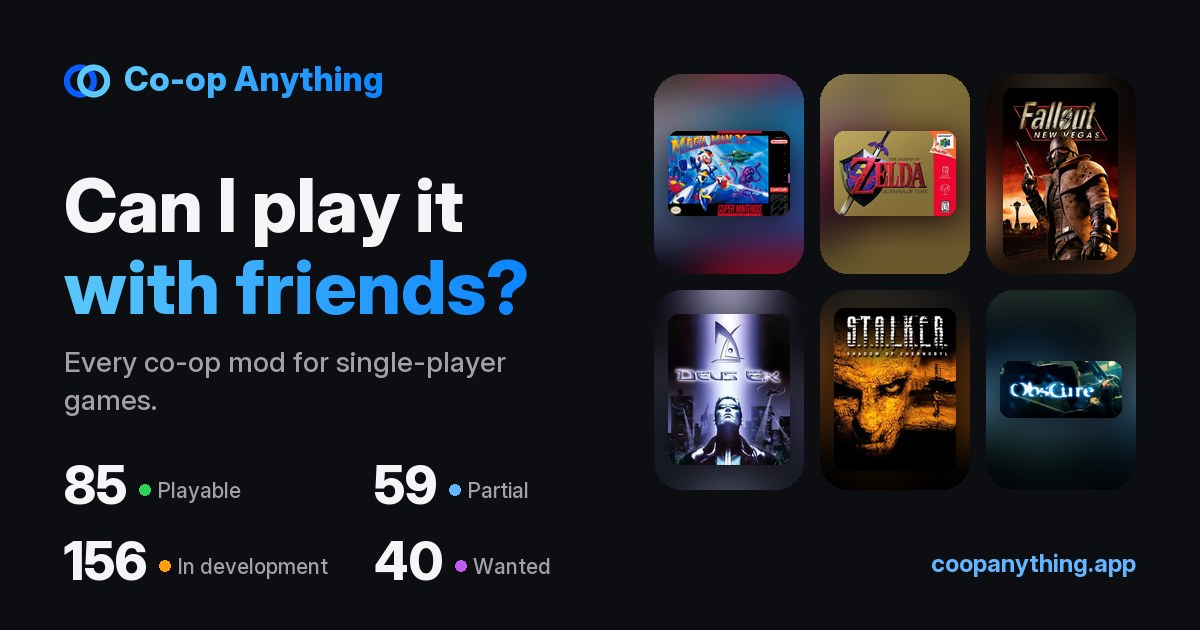
Image: CoOp Anything share card from the project site, showing its co-op mod directory.
Two paths, one finish line
The pitch is direct: point your AI coding agent at the repository, name a single-player game, and let the agent do the research, reverse engineering, coding and testing. The repository supplies an MCP server, playbooks and skills. The agent supplies the hours. The output is supposed to be a co-op mod that friends install in one click and join over Steam without port forwarding.
The playbook splits the work into two paths. Path 1 is for games that already have a co-op mod, even a buggy, stalled or abandoned one. The agent finds the last build, mines bug reports from issues, forums and Discord, audits the code, fixes it as a separate package, tests it and ships it. The skills for that path are coop-research, coop-revive, coop-qa and couchlink. The guide is called Reviving abandoned mods.
Path 2 is for games with nothing usable. The agent reverse engineers the game and its engine, hooks in, shows the second player, syncs enemies, world and story, handles level changes and saves, tests and ships. The skills are coop-reverse-engineer, coop-build-from-zero, coop-networking, coop-sync-testing, coop-qa and couchlink. The guide is called How co-op mods work.
Both paths end the same way: automated tests with real game clients, an easy install, Steam relay networking, and a pull request back to the repository. That last step is the community design. One person's agent gets a game halfway, sends what it learned back, and the next person's agent starts from there instead of from zero.
The MCP server is the interface for agents that support it. It lets an agent search the co-op directory, detect a game's engine from its install folder, read the playbook and skills, and validate contributions. Claude Code picks it up from the repository's .mcp.json. Other agents add it with a command. For the binary work, the README recommends pairing it with a reverse-engineering MCP such as REA, which looks inside the game while Co-op Anything decides what to do.
The supported agent list is broad: Claude Code, Codex, Gemini CLI, Cursor and OpenCode are named in the quick start. The repository also carries skill folders for Claude Code and a generic .agents directory. The point is not to lock the workflow to one vendor. The point is to give any agent that can read files and run commands the same playbook.
There is also a one-PC route. Couchlink runs a copy of the game for each player, each with its own part of the screen, its own controller or keyboard and mouse, and its own Steam account if desired. It works with co-op mods and with games that only play online. Mods made through Co-op Anything can plug into it through the couchlink skill.
The test harness is the product
The most useful part of the repository is not the prompt. It is the tooling for proving that a co-op mod actually works. Co-op bugs are timing and state bugs: an enemy dies twice, a door opens on one machine and stays shut on another, a player teleports when the host changes levels. Friends are a slow and unreliable test rig for that kind of problem. Bots and recorders are better.
The chaos tool is a UDP relay that adds lag, loss, reordering, duplicates and one-way cuts between real clients, with live controls. The flight tool is a flight recorder for the mod plus an analyzer. It lines up two to four machines, finds the first desync, shrinks it to a reproducible case and writes a regression test. The fuzz tool is a seeded N-player co-op fuzzer with invariant oracles: clients converge, effects are not applied twice, each actor has one owner, nothing is duplicated and nothing stays stale.
The ownership tool is a small C++ library for one owner per NPC, with epochs, handoff and stale echo rejection. The fakeworld tool is an in-memory game world for testing sync without launching the game. The gameslot and gamepool tools lock and warm a pool of game copies so several can run on one PC safely. The scenarios and bots tools provide JSON start states and multi-bot playbooks with a state diff after each step.
The animcheck tool compares animation and pose across machines and flags sliding, T-poses, floating and rubber-banding. The bridge and inspect tools provide an RPC server inside the game, with console commands, state dumps, saves, loads and screenshots, plus a live side-by-side view of every copy. The hotreload tool splits a mod into a loader and a core so the core can be swapped inside running games instead of restarting them. The mutants and buildlock tools provide runtime mutation twins for every fix and a shared build lock with a cache.
That list is the difference between a prompt collection and an engineering workflow. A prompt can tell an agent to add co-op. A test harness can tell the agent whether co-op survived a level transition, a host migration or a packet loss spike. The repository says each tool has tests, mutation twins and one command that prints ALL OK. It also says the tools came from the Fallout: New Vegas co-op project, which is a useful provenance note: these are not abstract utilities written for a demo.
The QA levels are equally practical. Every entry in the directory says how it was proven: untested, player reports, automated tests with bots driving real game clients, or a verified playthrough. That scale is more honest than a binary works or does not work label. It lets a reader choose a mod with automated coverage or one that only has a few player reports.
The limits are visible too. The repository had 143 open issues and no tagged release at the time of writing. That is a lot of open work for a project created on October 16. The directory has more than 230 co-op mods and gaps, and each entry varies in age, quality and QA level. The harness is real, but the catalog is not uniformly verified.
What has shipped, and what is still a promise
Five first-party projects are listed as games being made co-op right now. Deus Ex has a released co-op project. Dungeon Keeper has shared-keeper co-op on KeeperFX with Steam relay networking. S.T.A.L.K.E.R. Shadow of Chernobyl has a fix patch for Shadow of COOP that unlocks the true ending. Fallout: New Vegas has story co-op with shared quests, dialogue results, karma and reputation. Zelda: Ocarina of Time has fixes for a fully synced Ship of Harkinian co-op fork.
The community list is longer. Mega Man X and Mega Man X4 have native PC recompilations with co-op netplay. Pilotwings 64 has split-screen. Crab Champions, Stacklands, Half Sword, Enter the Gungeon, Clive Barker's Jericho, Poppy Playtime, Divinity II, Command and Conquer 3, Far Cry 2, Gothic 3, Fear and Hunger and Modern Warfare 2 all appear with links to their own projects. The directory behind those links is the part that could outlast any single mod.
The README's answer to will it work for my game is yes, with a caveat. If a co-op mod already exists, the project says most path 1 work takes days at most. If nothing exists, it depends on the engine. The engine table gives a feel for the route: Unreal, Source and id Tech games can reuse existing netcode; Bethesda games need a script extender and host-authority sync; Unity needs Harmony patches and a networking library; Unreal Engine 4 and 5 need UE4SS or Dumper-7; proprietary engines need DLL hooks; decompiled or open-source games can take networking directly in code; console games need a decomp, a recompiled PC port or emulator netplay.
The legal rules are narrow and explicit. The repository does not host game files or assets. Building on decompiled code is fine as long as the game's code lives in its own repository. The project does not touch anti-cheat or online services, and it is co-op only. It is not a tool for cheating in other people's multiplayer games. Those rules do not settle every legal question around modding, but they define what the project will and will not ship.
The networking shortcut is worth understanding. The Steam relay uses Valve's free Spacewar test app, so friends do not need to buy anything extra beyond the game itself. The relay avoids port forwarding and gives the session a Steam identity. That is a clever use of an existing test app, but it also means the experience depends on Valve's service and on each player's Steam account. The README presents it as the default path, not as a guarantee that every network will cooperate.
The project is also honest about effort. An agent can spend many hours on a path 2 game, and the result depends on the engine, the game's state layout and how much of the code is accessible. The README's yes is a statement of possibility, not a promise of a weekend project. That distinction matters for anyone who reads the pitch and expects a one-click co-op button for every game in their library.
Games so far
| Game | What the project did | Release |
|---|---|---|
| Deus Ex (2000) | Revived the HX co-op mod with a fix package, Steam relay and automated test suite | deus-ex-coop |
| Dungeon Keeper (1997) | Shared-keeper co-op on KeeperFX with Steam relay networking | dungeon-keeper-coop |
| S.T.A.L.K.E.R. Shadow of Chernobyl | Fix patch for Shadow of COOP with the true ending unlocked | stalker-soc-coop-fixes |
| Fallout: New Vegas | Story co-op with shared quests, dialogue results, karma and reputation | fnv-coop |
| Zelda: Ocarina of Time | Fixes for a fully synced Ship of Harkinian co-op fork | ocarina-coop |
FAQ
What is Co-op Anything?
An MCP server, playbook and skill set that lets a coding agent research, build, fix and test co-op for a single-player PC game. It also runs a directory of more than 230 existing co-op mods and gaps.
Do I need to know how to code?
The README says no. You need the game, a coding agent and patience. The agent follows the playbook, but it can spend many hours on a game with no existing co-op mod.
Does my friend need to buy anything?
Everyone needs the game installed. The Steam relay uses Valve's free Spacewar test app, so nobody needs to buy a separate networking tool or forward ports.
Which games work?
The directory covers more than 230 games, and five first-party projects are listed: Deus Ex, Dungeon Keeper, S.T.A.L.K.E.R. Shadow of Chernobyl, Fallout: New Vegas and Zelda: Ocarina of Time. A game with an existing mod is usually faster than one built from zero.
Is it legal?
The repository does not host game files or assets and says it does not touch anti-cheat or online services. It is co-op only. Whether a specific mod is legal depends on the game, its license and the jurisdiction, so the project's rules are not legal advice.
Is it finished?
No tagged release existed on October 31, 2026, and the repository had 143 open issues. The tools and playbooks are usable, but the directory's QA levels range from untested to verified playthroughs.
Bottom Line
Co-op Anything turns a vague request into a workflow: point an agent at a single-player game, choose the revive path or the build-from-zero path, and use the repository's bots, recorders and fuzzers to prove the result before friends join. It has five first-party projects, a directory of more than 230 mods and gaps, an MCP server for agent integration, a Steam relay that avoids port forwarding and a split-screen route through Couchlink. It also has no tagged release, 143 open issues and a catalog with uneven QA.
Our take: the test harness is the part worth stealing. The pitch will attract people who want co-op for every game in their library, but the bots, desync recorder and ownership library are what make the promise more than a prompt. Start with a game that already has a mod, read its QA level, and expect the agent to spend real time before anyone gets a second player.
Sources
- GitHub cranebeaker/coop-anything README, paths, skills, MCP server, sync tools, games, directory and rules, accessed October 31, 2026
- GitHub cranebeaker/coop-anything playbook and tools documentation, including automated QA, networking, console emulators and split-screen guides
- GitHub API metadata for cranebeaker/coop-anything, stars, forks, issues, creation date and license, accessed October 31, 2026
- CoOp:Anything directory at coopanything.app, linked from the repository README
Related: Universal Modder Gives AI Agents A Safe Modding Playbook | REA Tools: A Website for Agent-Driven Reverse Engineering | Bloodborne Seamless Co-Op Mod Allows 5 Players