
Kelvaroq: Shared Memory Work Targets Xbox Series Playback
By Indie Kings | November 26, 2026
Updated November 26, 2026: Kelvaroq is an experimental Xbox Series compatibility runtime that the README says is written in Rust and built on VIctory and victory-fork. Its public build reports about 10 rendered frames per second in the prologue at 3840 by 2160 on an RTX 5080. The more important claim is an in testing memory layer that the project says lets the GPU read the game's own memory directly, instead of copying console memory between RAM and VRAM every frame. All figures here are project reported and are presented with their source and conditions.
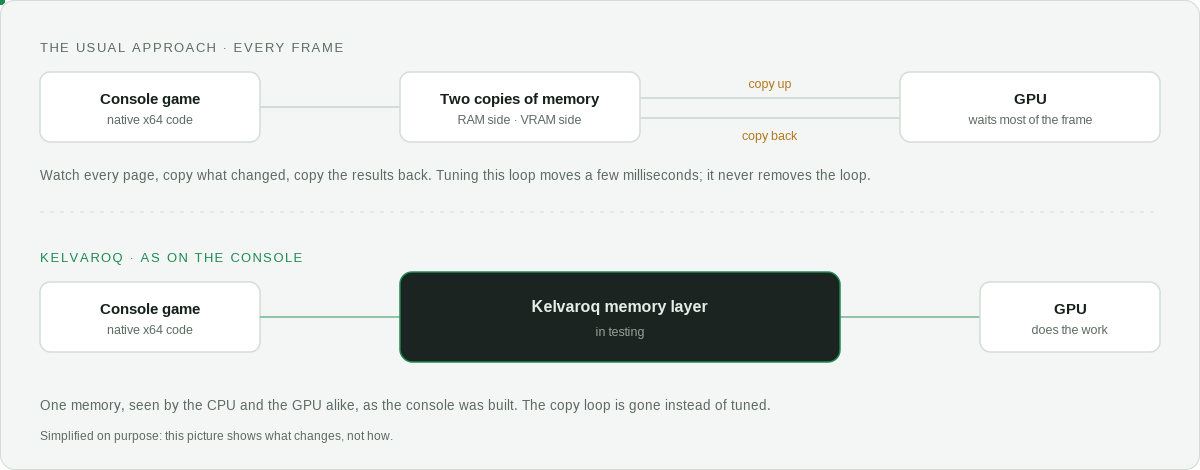
Image: Memory architecture diagram published in the Kelvaroq repository. Credit: Stellarr Studio SAS and Kelvaroq contributors.
The Kelvaroq repository describes an experimental Windows x64 runtime for Xbox Series X and Series S software. The README says the native engine is built on VIctory and victory-fork, with a Rust crate for texture preparation and frame pacing, and an Unicorn based reference engine retained for research. The stated goal is a playable scene at 3840 by 2160 and 30 rendered fps with correct textures and steady frame pacing on NVIDIA and AMD hardware.
The project is developed by Stellarr Studio SAS, a French company, and the README says its code, research, reverse engineering notes, measurements and documentation were produced with Moon AI. The repository is free software under GPL 3.0 or later, while the research directory is under GPL 2.0 or later because of its Unicorn dependency.
Overview
Kelvaroq is narrow in scope. The README does not present it as a general Xbox Series emulator with a broad compatibility list. It describes work on one console title, its prologue and its first mission, and defines a heavy frame as a present with at least 3,000 draws. The project's own boundary is explicit: it contains no game files, game code, assets, keys or download links, and it says it does not decrypt, download or unlock games or bypass copy protection.
The central technical argument is about memory. The README says the console title is native x64 code that already runs on a PC processor. It says the expensive part is keeping two memory spaces in step: the CPU side and the GPU side. In its account, about two thirds of the extra cost of a heavy frame goes to watching pages, copying changed data to the card and copying results back. It also reports that, with nothing drawn, the title's own code held a locked 30 fps in the heaviest prologue scene on its test PC across 5,331 heavy frames, with a 99th percentile of 33.9 ms; drawing the same scene through a compatibility layer took about 130 ms per frame.
The proposed fix is not another tuning pass. Kelvaroq says its new memory layer gives the GPU the game's own memory as the console does, removing the copy loop instead of making it faster. The README dates the fully functional status of that layer to November 26, 2026 and says it remains in testing. The public build still uses the current engine until the new layer is stable and clean.
Key Details
| Item | Reported detail | Source |
|---|---|---|
| Project type | Experimental Xbox Series X and Series S compatibility runtime for Windows x64 | Repository description and README |
| Main implementation | Windows runtime described as written in Rust, built on VIctory and victory-fork | README |
| Developer | Stellarr Studio SAS, a French company; README says the work was produced with Moon AI | README |
| Target | A playable scene at 3840 by 2160 and 30 rendered fps on NVIDIA and AMD GPUs | README |
| Public build status | About 10 rendered fps in typical prologue views and 7 to 8 fps in the heaviest scenes, reported at 3840 by 2160 on an RTX 5080 | README Status section |
| New memory layer | Described as fully functional on November 26, 2026 and in testing, not yet in the public build | README update and release policy |
| License | GPL 3.0 or later for the repository; GPL 2.0 or later for the research directory | README |
| Repository snapshot | 289 stars, 83 forks and 22 open issues, as returned by the GitHub API when fetched; repository created November 24, 2026 | GitHub API |
| Content boundary | No game files, game code, assets, keys or download links; no decrypting, downloading or unlocking | README and disclaimer |
| Measurement source | Maintainer reported logs and README tables, not independent tests by this site | README and documentation.md |
The repository snapshot is deliberately date stamped because those counts move quickly. GitHub's API also showed the repository was pushed on November 26, 2026. This article does not treat repository popularity as evidence that the technical claims are correct.
How It Works
At a high level, Kelvaroq runs console executable code on the PC and supplies the services the title expects. The README says the CPU side does not need instruction translation for the target code because it is x64. The native engine uses VIctory's loader, audio, input and Direct3D 12 renderer; Kelvaroq adds the rendering crate, patches and measurement tools. A separate Unicorn based reference engine is kept for startup research and memory effect checks.
The harder problem is graphics memory. The README says the public engine tracks changed pages, sends copies to the GPU and copies GPU writes back. Kelvaroq's testing layer instead aims to give the GPU direct access to the game's memory, reducing the work spent on synchronization and transfers. The published diagram explicitly says it is simplified and shows the change in approach rather than the implementation.
The project reports several results for the in testing layer. It says 100 percent of the game's graphics memory is shared with the GPU from allocation, that 97.4 percent of GPU memory views fit directly in that shared memory, and that one live session served about 64 million of 115 million GPU lookups from the game's own memory with no copy. It also says 121 million descriptor rows were checked against recorded gameplay with zero errors, that per frame memory bookkeeping on a heavy frame fell from about 18 seconds to about 60 ms on an RTX 5080, and that no memory was left behind after the game closed, down from about 19 GB per session.
Those numbers are attributed to the project's README and are not independently reproduced here. They also describe a build under test, not the public build. The README says the next priorities are removing the remaining legacy components, then performance work aimed at mid range and older PCs. It says minimum requirements will be published only after they are measured.
Evidence and Verification
This article was built from primary material published by the project. The GitHub repository page and API were checked for the project description, license, creation date and current repository counts. The README was checked for the architecture description, scope, status figures, update note, release policy, legal boundary and credits. The French documentation file was checked for the pinned victory-fork revision, heavy frame protocol, earlier patch measurements and the distinction between controlled tests and in game runs.
The image is the memory architecture SVG stored in the repository. It was checked with an Indie Kings referrer and returned HTTP 200 with an SVG content type. Its own text labels the Kelvaroq side as in testing and says the picture is simplified on purpose, so the caption here presents it as a diagram, not as a gameplay capture.
The performance figures come from maintainer reported logs and README tables. The before and after runs described there used the same save and warm pipeline cache for 300 seconds each, at 3840 by 2160 on an RTX 5080, and the README says both runs were checked for rendering errors. That is useful context, but it is still a project controlled comparison rather than an independent benchmark.
One README claim was left out rather than repeated: a self reported position on an external tracker. The tracker figure is not needed to understand the technical work, and this article does not promote it as a verified ranking.
Performance and Limits
The README's Status section gives a clear trail for the public engine. A heavy frame is a present with at least 3,000 draws. The table below reproduces the reported medians, 95th percentiles and mean frame rates. The 30 fps target corresponds to 33.3 ms per frame, so the public build remains well above the target.
| Stage | Median | 95th percentile | Mean fps | Heavy frames | GPU busy |
|---|---|---|---|---|---|
| Experimental branch before the port | 254.9 ms | Not listed | Not listed | Not listed | Not listed |
| Port to victory-fork, patches 0001 to 0037 | About 235 ms | Not listed | Not listed | Not listed | Not listed |
| Memory and submission, patches 0038 to 0040 | 198.3 ms | 312.4 ms | 4.5 | 959 | About 78 percent |
| Mesh launch and wide hash, patches 0041 to 0042 | 119.8 ms | 207.8 ms | 7.3 | 1,564 | About 35 percent |
| Copies, changed pages and async present, patches 0044 to 0048 | 108.5 ms | 261.5 ms | 7.6 | 1,648 | About 30 percent |
| 30 fps target | 33.3 ms | Not listed | Not listed | Not listed | Not listed |
The README also reports an external playtest of a build from the public repository. A tester used a Ryzen 9 7950X, RTX 4090 and 32 GB of DDR5 at 2560 by 1440 and monitored a 36 minute 46 second session without a crash. The README reports a mean of 10 fps and a median of 11 fps, with about 10.9 fps mean after ten minutes. It also reports that RAM use peaked at 15.5 GB early and later settled near 10.5 GB and then about 7 GB. The project notes that one session cannot rule out a leak, that the monitor was restarted once, and that the first monitoring pass targeted the launcher process.
The remaining limits are visible in the README. The public build still drops about 7 percent of draws, mostly because ray tracing structures are not built there, although native DirectX 12 ray tracing is reported as working in the build under test. Textures wait when video memory is full. The submission thread that prepares GPU work is described as the current critical path. The project also lists 64 lane compute shaders on 32 lane GPUs, clamped indirect calls, VRAM budgeting, missing host pipelines, DLSS and frame generation as unfinished work.
The cleanest way to read the project is as two tracks. The public build is slow but documented with reproducible timing conditions. The shared memory layer is more ambitious and more consequential, but its headline numbers come from an in testing build and have not been published as a general release.
FAQ
What is Kelvaroq?
It is an experimental Xbox Series compatibility runtime for Windows x64. The README says it is written in Rust and built on VIctory and victory-fork, with an Unicorn based reference engine for research.
Is Kelvaroq a finished Xbox Series emulator?
No. The README calls it experimental and lists unfinished rendering, memory, shader and performance work. The public build is being used to measure and narrow those problems.
What does the new memory layer try to fix?
It aims to remove the per frame copy loop between system RAM and video memory. The project says the GPU should read the game's memory directly, as it would on the console, rather than relying on repeated copies and synchronization.
How fast is the public build?
The README reports about 10 rendered fps in typical prologue views and 7 to 8 fps in the heaviest scenes at 3840 by 2160 on an RTX 5080. A separate tester reported a 10 fps mean over a 36 minute 46 second session at 2560 by 1440 on an RTX 4090.
Does Kelvaroq include game files or keys?
No. The repository says it contains no game files, game code, assets, keys or download links, and that it does not decrypt, download or unlock games. This article adds no acquisition, dumping or setup guidance.
When will the shared memory layer be public?
The README says it will go public when the build is stable and clean and the test suites pass. As of the November 26, 2026 update, it remained in testing and the public build stayed on the current engine.
Bottom Line
Kelvaroq is worth watching because it attacks a specific cost rather than chasing a few milliseconds in a copy loop. Its README reports that the public engine has reached a playable prologue at roughly 10 fps on a high end PC, and that an in testing memory layer has already changed the scale of the memory work from seconds to tens of milliseconds in measured heavy frames.
That claim is still self reported, tied to one title and not yet shipped in a public build. The meaningful test will be a stable release with the legacy copy path removed, consistent frame pacing and measurements on lower end hardware. Until then, treat Kelvaroq as a serious engineering prototype with a clearly documented boundary around game files and a very specific performance problem to solve.
Related: Xbox Series PC Compatibility Guide: VIctory and XCL Repos, Leonida Recompiles Xbox GTA 6 Code for Native PC Play, XenonRecomp: Pioneering Static Recompilation for Xbox 360 Game Preservation.