
Intel XeSS: XMX Path Heads to Proton, One DLL at a Time
By Indie Kings | October 20, 2026
Updated October 20, 2026: An Intel engineer opened pull requests on October 19 to add XeSS support to Valve's Proton, with matching changes to VKD3D-Proton and DXVK, per Phoronix and PC Gamer. The proposal adds a built-in libxess.dll that forwards XeSS Direct3D 12 calls to the Linux XeSS library, so Intel GPUs can use the XMX accelerated path under Proton instead of the slower fallback. None of the requests are merged yet.
The one-sentence version: Intel is trying to make its best upscaler work on Linux by shipping one DLL inside Proton, and if Valve takes it, Intel handhelds get a better reason to run SteamOS.
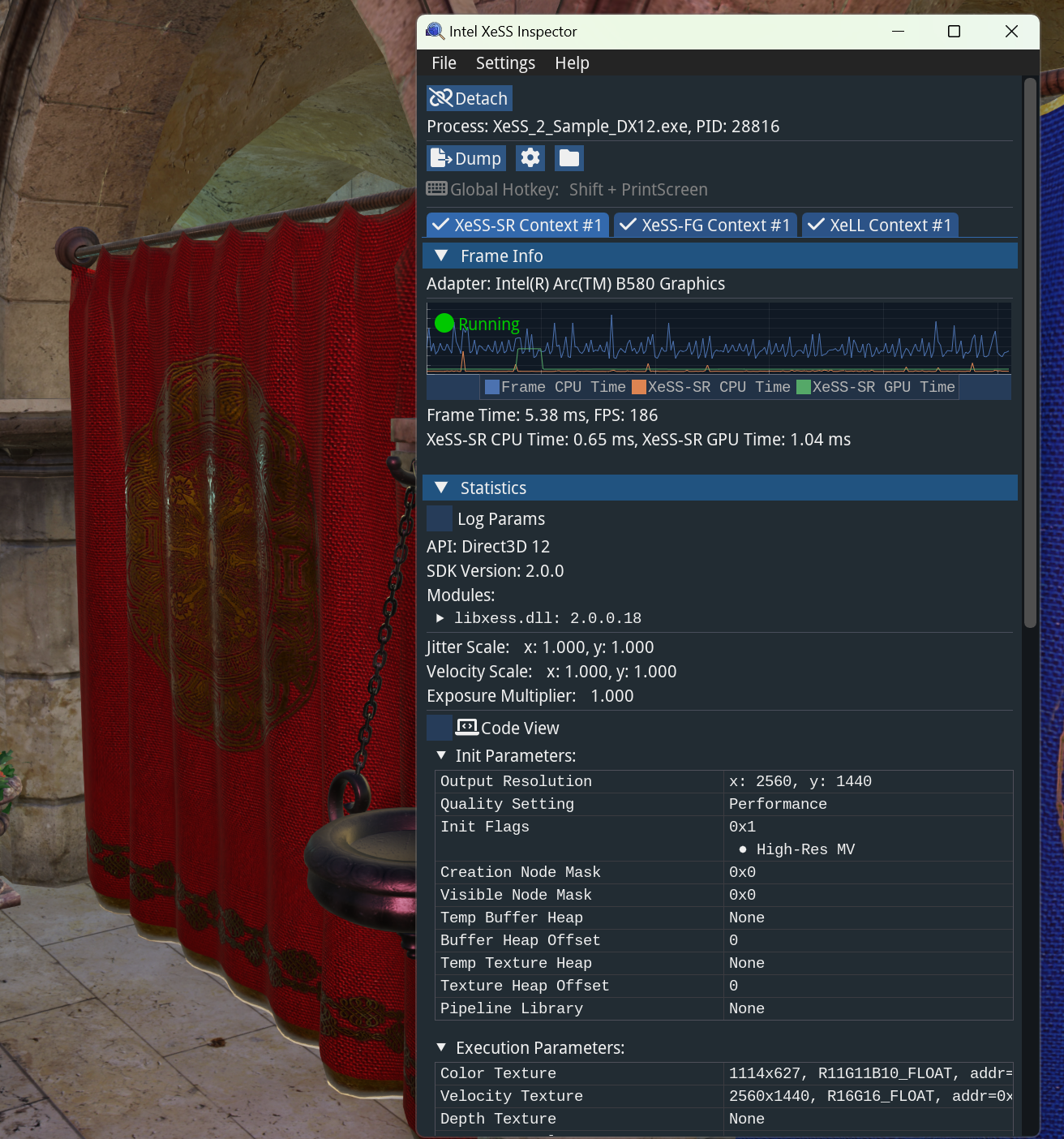
Image credit: Intel, XeSS Inspector repository.
What Intel actually proposed
Phoronix reported on October 19 that an Intel engineer opened the pull requests for XeSS support in Proton, plus associated changes to VKD3D-Proton and DXVK. PC Gamer identified the engineer as Damian Tomczak and quoted the request directly: "Adds a builtin libxess.dll which forwards the XeSS D3D12 calls to the Linux XeSS library (libxess.so), so XeSS can use XMX (the fast upscaler) under Proton instead of the slower fallback path. D3D12 objects are converted to Vulkan through vkd3d-proton's interop interface."
Three repositories change together, and each does a different job. Proton carries the built-in library and the forwarding layer. VKD3D-Proton enables the Vulkan extensions and features XeSS needs and handles the object conversion between Direct3D 12 and Vulkan. DXVK stops hiding Intel GPU brand advertising when XeSS is provided by Proton, which sounds cosmetic until you remember that some games select features based on the reported vendor.
The design is deliberately narrow. Intel is not asking Valve to port a game or patch titles one by one. It is asking for a shim that lets a game's existing XeSS integration reach the native Linux library, so the same code path that runs on Windows can run under Proton. That is the same shape as the work already done for AMD's FidelityFX Super Resolution and NVIDIA's DLSS, and Phoronix notes that similar upscaler work has been merged before.
Status matters more than the technical detail right now. The requests were open on October 19, a Wine and Proton ticket tracks the work, and nothing had landed. A merged PR would be a commitment from Valve to carry and support the shim. An open PR is an offer, and Valve has its own review process, test matrix and release cadence to get through first.
Why XMX is the whole point
XeSS has two paths. The DP4a path runs on a wide range of GPUs, including hardware from other vendors, using dot product instructions that most modern shader cores support. The XMX path uses Intel's dedicated matrix engines on Arc GPUs, and it is the version Intel built the technology around. The DP4a version is the compatibility story. The XMX version is the performance story.
Under Proton today, a game calling XeSS lands on the slower path, because the Windows library and the Linux library are different and Proton has no built-in bridge for the Direct3D 12 calls. Intel's shim changes that by forwarding to libxess.so, which can use XMX on Intel hardware. In plain terms, the patch is not adding a feature. It is removing a penalty that Intel GPUs pay on Linux.
That penalty matters most on handhelds, where every frame of headroom counts. PC Gamer frames the story around future Intel-powered handheld gaming PCs, and names the MSI Claw 8 EX AI+ with an Intel Arc G3 Extreme as an example of the hardware class. A handheld running Windows can already use the XMX path. A handheld running SteamOS cannot, and the gap is one of the reasons Intel machines have stayed on Windows.
The XeSS 3 stack behind the patch
The Intel XeSS SDK repository is at version 3.0.2, released on July 24, 2026, with about 1,000 stars. Its README describes three technologies rather than one. XeSS Super Resolution boosts frame rates on all GPUs with Shader Model 6.4 and DP4a support. XeSS Frame Generation is available on discrete and integrated Intel Arc GPUs and on non-Intel GPUs with Shader Model 6.4 support. Xe Low Latency reduces input lag, on Arc hardware and on non-Intel GPUs when combined with frame generation.
The dependency structure is spelled out: frame generation requires Xe Low Latency integration, while super resolution and low latency can be enabled independently. The SDK also ships Unreal Engine and Unity plugins, which is how most games will meet the technology. None of that changes with the Proton patch, but it explains why a single shim can matter across a large library: the integrations already exist in the games.
There is a licensing wrinkle worth noting for anyone who wants to fork or redistribute the SDK. GitHub reports the XeSS repository license as NOASSERTION rather than a standard SPDX identifier, because Intel uses its own license text rather than MIT or Apache-2.0. That is normal for vendor SDKs, and it means the terms live in the repository rather than in a one word summary.
The inspector tool developers use
Intel's second repository in this batch is the debugging tool that goes with the SDK. XeSS Inspector is at version 2.5.1, released on August 20, 2026, and its job is to verify, debug and tune an XeSS integration rather than to run the upscaler itself.
The feature list is aimed at developers. It shows context views for super resolution, frame generation and low latency, each on its own tab. It monitors initialization and execution parameters, CPU and GPU times, and the sleep and low latency marker state. It can dump input and output frames for offline inspection, draw input buffers over the target application as a HUD, and override state for quick experiments without code changes or API integration.
One prerequisite is a useful reality check: the target application must have XeSS integrated and must not be protected by anti-cheat or anti-debugging measures. That tells you who the tool is for. It is for the person integrating XeSS in a build, not for a player trying to inspect a shipped competitive game.
The repository has 37 stars, five forks and no open issues, and GitHub lists no license for it. That is a small audience by design. Most players will never run it, and the people who need it will run it constantly while tuning a game's upscaler settings.
Why SteamOS and handhelds care
SteamOS has historically been an AMD story. Valve's own hardware used AMD APUs, and the compatibility work around Proton was tuned around Radeon graphics. PC Gamer notes that Valve has improved compatibility with both AMD and Intel's recent platforms in SteamOS releases this year, and that broader SteamOS support now reaches beyond handhelds into home-built Steam Machines.
That shift is what makes Intel's timing logical. If SteamOS is going to run on more hardware, the upscalers have to work equally well on that hardware. A game that ships XeSS and runs under Proton on an Intel handheld currently gets the fallback path, while the same game on Windows gets XMX. Closing that gap removes a concrete reason to stay on Windows, and it costs Valve relatively little because the shim is maintained by Intel.
The benefit is not automatic for every game. It applies to titles that ship XeSS through Direct3D 12 and run under Proton, which is a large but not universal set. Games with no XeSS integration see nothing. Games that use anti-cheat may not run under Proton at all, regardless of upscaler support. And the patch does nothing for Intel's own driver stack on Linux outside Proton, which is a separate path with its own state.
| Component | Change in the proposal | Status on October 20 |
|---|---|---|
| Proton | Built-in libxess.dll forwards Direct3D 12 XeSS calls to libxess.so so XMX can be used | Pull request open, not merged |
| VKD3D-Proton | Enables the Vulkan extensions and features XeSS needs, converts Direct3D 12 objects through its interop interface | Pull request open, not merged |
| DXVK | Stops hiding Intel GPU brand advertising when Proton provides XeSS | Pull request open, not merged |
| XeSS 3 SDK | Super resolution, frame generation and Xe Low Latency, version 3.0.2 | Released July 24, 2026 |
| XeSS Inspector | Debugging and validation for the three XeSS technologies, version 2.5.1 | Released August 20, 2026 |
Sources: Phoronix, October 19, 2026; PC Gamer, October 19, 2026; Intel XeSS and XeSS Inspector repositories and releases, checked October 20, 2026.
What is still missing
There are no performance numbers. Neither Intel's request nor the press coverage claims a percentage improvement, a frame rate gain or a specific game result. The only claim is architectural: XMX is faster than the fallback path, so removing the fallback should help. That is plausible and unmeasured in public, and anyone quoting a number right now is inventing it.
There is also no merge commitment. Valve reviews Proton changes against a large game library, and a graphics library shim touches the most sensitive part of the stack. The request could land quickly, could land with changes, or could sit while Valve tests. Until a Proton release ships it, the practical benefit is zero for players.
Finally, there is no SteamOS version requirement in the proposal. Even after a Proton merge, the fix reaches users through Proton updates rather than through the operating system, so the timing depends on Valve's Proton release channel and on how quickly distributions pick it up. That is usually weeks rather than days, and it is the difference between a headline and a change you can measure on your own handheld.
FAQ
What did Intel propose?
Pull requests that add a built-in libxess.dll to Proton, forwarding Direct3D 12 XeSS calls to the Linux libxess.so so Intel GPUs can use the XMX accelerated path instead of the slower fallback. VKD3D-Proton and DXVK changes support it.
Is it merged?
No. The requests were open on October 19, 2026, and Phoronix reported that they were not merged. A Wine and Proton ticket tracks the work, and Valve has not announced a timeline.
Does this make XeSS work on Steam Deck?
Not directly. Steam Deck uses AMD hardware, where XeSS runs through the DP4a path rather than XMX. The proposal is aimed at Intel GPUs, so the benefit lands on Intel handhelds and Intel discrete GPUs running Proton.
Will every game get faster?
Only games that already ship XeSS through Direct3D 12 and run under Proton. No performance figures have been published, so any expected gain is architectural rather than measured.
What is XeSS Inspector?
Intel's debugging and validation tool for XeSS integrations, at version 2.5.1. It shows context state, CPU and GPU times, frame dumps, a HUD overlay and state overrides, and it requires the target app to have XeSS and no anti-cheat or anti-debug protection.
Does Intel's XeSS SDK cover frame generation?
Yes. XeSS 3 includes super resolution, frame generation and Xe Low Latency, with frame generation requiring low latency integration. Super resolution works on all GPUs with Shader Model 6.4 and DP4a support, while frame generation covers Arc and non-Intel GPUs with Shader Model 6.4.
Our take
This is the least glamorous way to ship a feature and probably the most effective. Intel is not asking developers to rewrite anything or asking Valve to bless an Intel-only path. It is asking for a bridge at the point where the calls already happen, maintained upstream, with the vendor paying the maintenance cost. That is how upscalers become default rather than optional.
The handheld framing is correct but incomplete. The bigger prize is credibility on Linux. Intel has spent years telling people that Arc is a serious GPU, and a SteamOS user who cannot use the fast path has a concrete counterargument. A merged shim does not win that argument alone, but it removes one of the few remaining technical reasons to dismiss Intel hardware on Linux.
What I want to see next is not a benchmark from Intel. It is a merged PR and a Proton release note, followed by someone independent running the same game on the same handheld with and without the shim. Until that exists, the honest description is a good proposal with a clean design and no measured result.
Bottom Line
Intel opened pull requests on October 19, 2026, to add XeSS support to Proton, with matching VKD3D-Proton and DXVK changes. The patch adds a built-in libxess.dll that forwards Direct3D 12 XeSS calls to the Linux library so Intel GPUs can use the XMX accelerated path instead of the slower fallback, and it stops DXVK from hiding Intel's GPU brand when Proton provides XeSS. The requests are not merged, no performance numbers have been published, and the benefit applies only to games that ship XeSS through Direct3D 12 and run under Proton. The XeSS 3 SDK behind it is at version 3.0.2 with super resolution, frame generation and Xe Low Latency, and the XeSS Inspector debugging tool is at version 2.5.1. If Valve takes the work, Intel handhelds get a stronger case for SteamOS. Until then, it is a well-shaped proposal and nothing a player can install.
Sources: Phoronix, "Intel Working To Add XMX-Accelerated XeSS To Valve's Steam Play (Proton)," October 19, 2026. PC Gamer, "Intel bringing faster upscaler to Valve's Proton," by Jacob Ridley, October 19, 2026. intel/xess SDK repository and v3.0.2 release, and GameTechDev/XeSSInspector repository and v2.5.1 release, fetched October 20, 2026.
Related: XeSS 3 Lands in Unreal With Super Resolution Frame Gen and Low Latency [2026] | Why MSI Claw Beats Steam Deck This Prime Day